
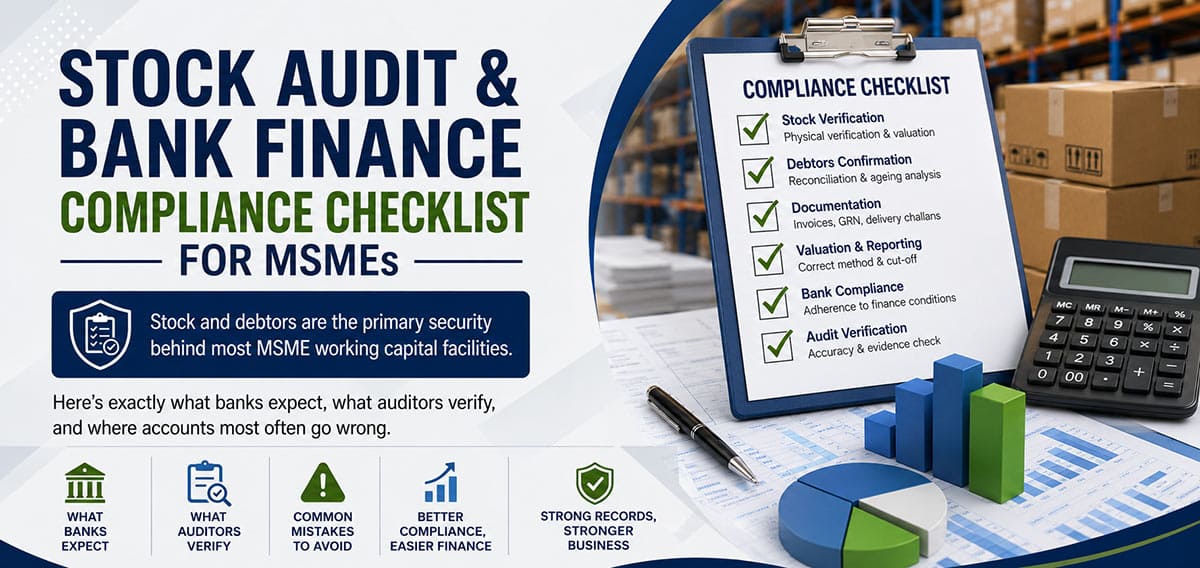
Stock and debtors are the primary security behind most MSME working capital facilities. Here’s exactly what banks expect, what auditors verify, and where accounts most often go wrong.
Why Banks Require Stock Audits
Working capital finance in the form of cash credit or overdraft facilities is typically secured by hypothecation of stock and debtors — meaning the bank’s security is the borrower’s inventory and receivables, not a fixed physical asset. Since this security fluctuates monthly, banks rely on the borrower’s self-reported stock statement to compute lending eligibility, and periodically engage an independent chartered accountant to verify that what’s being reported actually exists and is correctly valued.
Understanding Drawing Power
Drawing Power (DP) is the maximum amount a borrower can actually draw against their sanctioned cash credit limit, computed from the value of eligible stock and debtors after deducting the margin prescribed in the sanction letter — and it is frequently lower than the sanctioned limit itself.
Eligible stock
Only stock genuinely owned by the borrower, held at approved locations, and not obsolete or non-moving typically counts. Stock held on job-work for others, or received on consignment, is usually excluded.
Eligible debtors
Receivables beyond the age limit specified in the sanction terms (commonly 90 days) are usually excluded from DP computation — including these anyway is one of the most frequent stock-audit findings.
Creditors for purchases
Trade creditors for goods purchased must be deducted from the gross stock value to arrive at the paid-for stock actually eligible as security — omitting this deduction inflates DP artificially.
An inaccurate stock statement cuts both ways
Overstating eligible stock creates a hidden excess drawing that the bank will eventually flag and may treat as irregular. Understating it unnecessarily restricts the business’s own access to sanctioned credit. Neither is a minor administrative slip — both distort the bank’s actual risk exposure.
Monthly Stock Statement — Getting It Right
Use the bank’s prescribed format
Where the bank has provided a specific format, use it exactly and confirm with the relationship manager before your first submission. Where no format is prescribed, the ICAI Technical Guide format is the standard fallback — but switching formats mid-year creates reconciliation problems, so pick one and stay consistent.
Prepare from actual stock records, not estimates
The statement should reflect actual physical/book stock records for the period, not a rough approximation — this becomes especially important because it also feeds into the year-end closing stock figure used in the statutory audit.
Reconcile monthly, not just at year-end
If monthly/quarterly stock statements are prepared accurately and consistently throughout the year, the year-end closing stock figure is effectively pre-verified, which materially reduces both statutory audit time and stock audit findings.
Submit to every lender in a consortium/multiple banking arrangement
In a consortium, the statement typically goes to the lead bank and is shared with members. Under a multiple banking arrangement (no formal consortium agreement), submit separately to each bank in their own prescribed format.
Documents the Auditor Will Ask For
| Category | Documents |
|---|---|
| Sanction & documentation | Latest sanction letter and renewal, hypothecation deed, demand promissory note, guarantee bond |
| Stock records | Last 6 months’ stock statements, stock register, purchase and sales invoices for the audit period |
| Financials | Audited financial statements, previous stock audit report, comparative purchase/sales figures for the last 6 months plus current month to date |
| Insurance | Insurance policy with bank hypothecation clause noted, confirmation of current validity and adequate coverage for both primary and collateral security |
| Compliance | Latest GST returns filed, ABC analysis of stock by value where available, details of non-moving/obsolete stock held beyond 6 months |
| Debtors/creditors | Month-wise ageing of debtors and creditors, with major parties verified on a sample basis |
The Stock Audit Checklist
Ownership & existence
Confirm the stock physically exists at the stated location, is owned by the borrower (not held on consignment or job-work), and matches the description and quantity in the stock statement submitted.
Hypothecation signage
Check whether the required bank name-plate indicating hypothecation is displayed at the premises entrance — a small but commonly missed sanction-term compliance item.
Valuation basis
Verify the inventory valuation method used is consistent with what’s disclosed and with the audited financials, and that the DP margin has been applied exactly as prescribed in the sanction letter.
Insurance adequacy
Confirm the policy is current (not expired), names the bank’s hypothecation clause correctly, and covers the full value of stock — not just the sanctioned limit.
Ageing & obsolescence
Identify non-moving, slow-moving, or obsolete stock included at full value in the statement — this should be written down or excluded, not carried at cost indefinitely.
DP register cross-check
Reconcile the bank’s DP register against the account’s actual operations and the terms of sanction — the auditor’s review of both the correspondence file and DP register together gives the fullest picture of how the account has actually been conducted.
Common Issues That Trigger Irregular Classification
Findings that recur across stock audit reports
- Stock statements or QIS/CMA data not submitted on time, not in the prescribed format, or with inadequate item-level detail.
- Debtors beyond the sanction-term age limit (commonly 90 days) still included in DP computation.
- Insurance policy without the bank’s hypothecation clause noted, expired and unrenewed, or covering less than the actual stock value.
- Job-work stock or obsolete/non-moving inventory included at full value in the submitted stock figures.
- Stock/book-debt statements required to be CA-certified under the sanction terms but submitted without that certification.
Common Questions
How often is a stock audit typically required?
Frequency depends on the sanction terms and exposure level, but a common pattern for meaningful working capital exposure is twice yearly — one visit before September, another before March — with the exact requirement always specified in the sanction letter.
Who bears the cost of a stock audit?
The borrower typically bears the fee, even though the bank appoints and empanels the auditor, since the audit is a condition of the sanctioned facility.
What happens if the stock audit finds a significant discrepancy?
Depending on severity, the bank may reduce the drawing power immediately, require the account to be regularised, or in serious cases treat the account as irregular — with knock-on consequences for renewal and, in persistent cases, asset classification.
Does an accurate monthly stock statement actually reduce statutory audit work?
Yes — where stock statements have been prepared carefully and consistently through the year, the year-end closing stock figure is effectively already verified, which can meaningfully reduce the time needed for the statutory audit’s inventory verification procedures.