
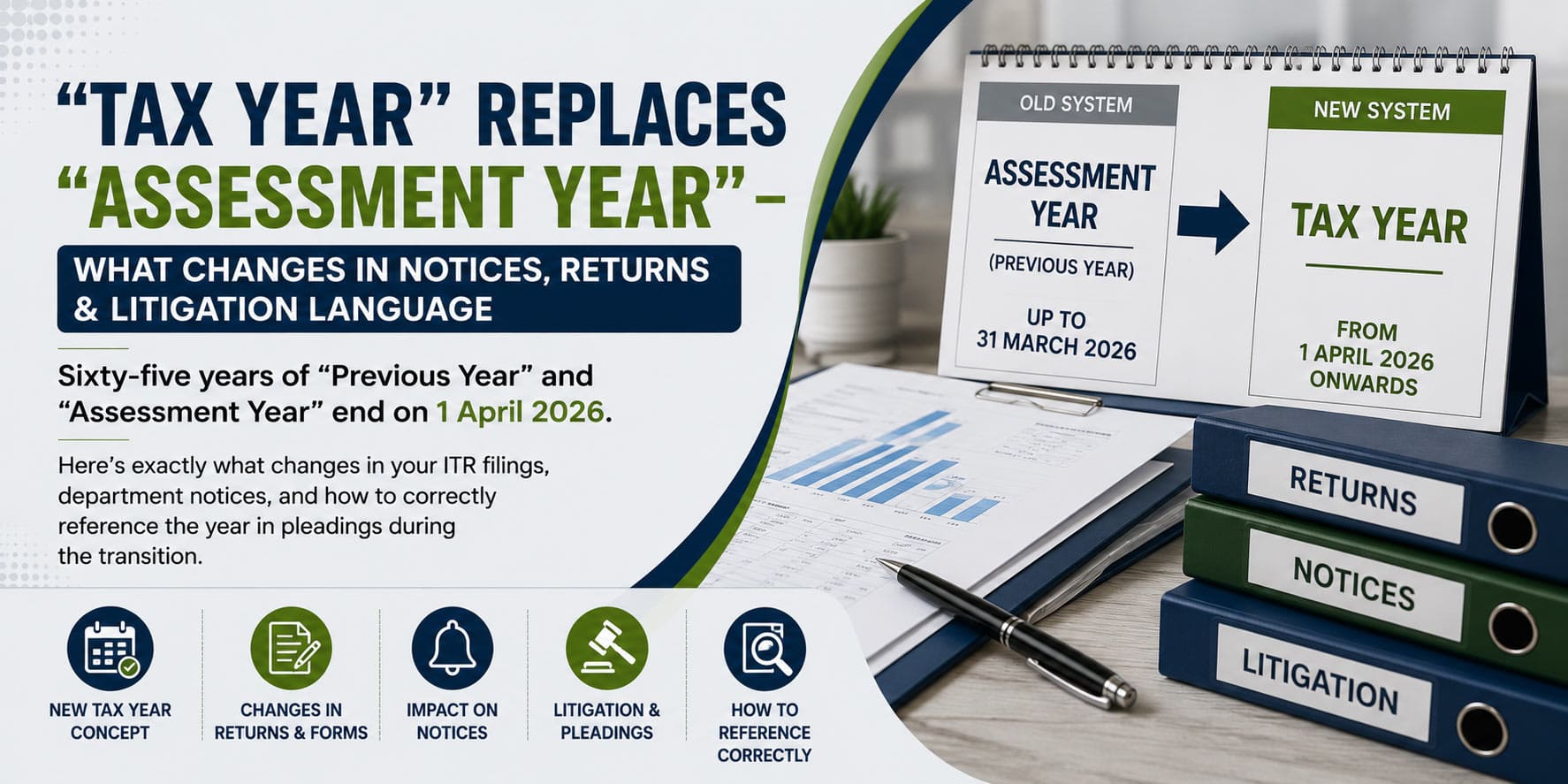
Sixty-five years of “Previous Year” and “Assessment Year” end on 1 April 2026. Here’s exactly what changes in your ITR filings, department notices, and how to correctly reference the year in pleadings during the transition.
The Old System — Two Years for One Income
Under the Income Tax Act, 1961, every rupee of income lived in two calendars at once. The Previous Year was the 12-month period (1 April to 31 March) in which the income was actually earned. The Assessment Year — defined under the old Section 2(9) — was the following 12-month period, during which that income was assessed and the return filed. Income earned in FY 2024-25 (the Previous Year) was reported and taxed in AY 2025-26 (the Assessment Year).
This one-year lag was a genuine, decades-long source of confusion — not just for salaried individuals filing their first return, but for practitioners drafting notices, orders, and pleadings, where a single wrong year reference could derail an otherwise sound submission.
The New System — One “Tax Year” NEW
The Income Tax Act, 2025 abolishes the Previous Year / Assessment Year distinction entirely. Under Section 3 of the new Act, “Tax Year” means the twelve-month period commencing 1 April and ending 31 March — the single reference point for the year income is earned, assessed, and reported. For a business newly set up, or a new source of income coming into existence during the year, the Tax Year runs from that date to the following 31 March.
The first Tax Year under the new Act is 1 April 2026 to 31 March 2027 — “Tax Year 2026-27.” Income earned during this period is reported “for Tax Year 2026-27,” not “for AY 2027-28.” There is no separate assessment year to track.
Old Terminology (IT Act 1961)
- Income earned: Previous Year
- Return filed for: Assessment Year (PY + 1)
- Notice references: Assessment Year
- TDS return period: Assessment Year
- Advance tax challan: Assessment Year
- Example: income in FY 2024-25 → filed for AY 2025-26
New Terminology (IT Act 2025)
- Income earned: Tax Year
- Return filed for: Same Tax Year
- Notice references: Tax Year
- TDS return period: Tax Year
- Advance tax challan: Tax Year
- Example: income in Tax Year 2026-27 → filed for Tax Year 2026-27
This is a vocabulary reform, not a tax reform
Tax rates, exemptions, deductions, and due dates are unaffected. The 1 April–31 March period itself doesn’t change, and return filing due dates (31 July for non-audit cases, 31 October for audit cases, 30 November for transfer pricing cases) remain aligned with the existing structure. Only the year label — and the fact that you no longer add one year to find the filing year — has changed.
What Changes in Return Filing
The ITR forms applicable from Tax Year 2026-27 onward drop “Assessment Year” fields entirely and ask only for the Tax Year. Practically:
No more AY selection error
Selecting the wrong Assessment Year while filing was among the most common causes of defective-return notices. With a single Tax Year reference, this specific error class disappears going forward.
Challans & TDS returns
Advance tax challans and TDS returns (Forms 24Q, 26Q, 27Q, 27EQ) for periods from April 2026 onward reference the Tax Year. Using an old AY-style reference after the transition risks a payment or credit mismatch at CPC.
Form renumbering
New forms accompany the Tax Year terminology — including replacements for Form 16, Form 26AS, and Form 15G/15H under the Income-tax Rules, 2026. Confirm current form numbers before using them in client communication, as several sources report different numbering and this should be checked against the notified Rules.
What Changes in Notices & Orders
This is where the transition needs the most care in practice, because two parallel systems will run side by side for at least two to three assessment cycles.
New notices reference Tax Year
Every notice, intimation, or order issued under the new Act for Tax Year 2026-27 onward — processing intimations, scrutiny notices, demand notices — will use “Tax Year,” not “Assessment Year.”
Old notices remain valid, in old language
A reassessment or scrutiny notice issued under the 1961 Act before 1 April 2026 remains valid and continues to be processed under that Act — with its original AY reference — even if the proceedings run well beyond April 2026.
Belated and revised returns for pre-transition income
A return filed after 1 April 2026 but relating to income earned before that date (for example, a belated return for FY 2024-25 / AY 2025-26) continues to be governed by the old Act and its AY terminology, regardless of when it is actually filed.
Section numbers change alongside the year label
Notices under the new Act don’t just relabel the year — the underlying section also changes. A processing intimation that was Section 143(1) becomes a differently-numbered provision under the 2025 Act; a scrutiny notice that was Section 143(2) likewise moves. Always confirm the section quoted on a new-Act notice against the current mapping before responding — this is the single most common drafting error during the transition.
Section mapping for commonly encountered notices
The table below reflects the mapping most consistently reported by tax publications tracking the transition. Given how much hinges on citing the correct section in a notice response or pleading, verify each reference against the First Schedule of the Income-tax Act, 2025 and the CBDT’s official mapping circular before relying on it in a filing.
| Subject Matter | Old Section (IT Act 1961) | New Section (IT Act 2025)* |
|---|---|---|
| Return of income | 139 | 263(1) |
| Intimation after processing | 143(1) | 263(6) |
| Scrutiny notice | 143(2) | 263(9) |
| Reassessment notice | 148 | 267 |
| Rectification of mistake | 154 | 295 |
| Notice of demand | 156 | 292 |
| Revision by Commissioner | 263 | 279 |
| Penalty for under-reporting | 270A | 303 |
*Mapping as commonly reported by tax practitioner publications tracking the transition — cross-check against the First Schedule before citing in any filing or pleading.
What Changes in Litigation Language
For a litigation practice, this transition isn’t just a filing convenience — it changes how appeal memos, writ petitions, and submissions before the ITAT and High Courts should be drafted, and creates a real risk of internally inconsistent pleadings if the wrong terminology is used for the wrong period.
Match terminology to the governing Act
A pleading concerning a proceeding that originated under the 1961 Act — even one still running in 2027 or 2028 — should continue to use “Assessment Year” and the old section numbers throughout. A pleading concerning a Tax Year 2026-27 (or later) matter should use “Tax Year” and the new section numbers. Mixing the two within a single pleading reads as careless drafting to a bench, even where it doesn’t go to jurisdiction.
Pending proceedings are unaffected
Any assessment, appeal, revision, or rectification pending as of 31 March 2026 continues under the 1961 Act in its entirety — old terminology, old section numbers, old limitation periods. The Tax Year concept has no bearing on how these matters are argued or decided.
Check the notice date, not the filing date
The applicable Act is generally determined by when the notice or proceeding originated, not by when a response or appeal happens to be filed. A rectification application filed in 2027 against an old-Act order still argues in AY terms — the date of your submission doesn’t convert it to a Tax Year matter.
Cause titles and prayer clauses
Update templates for appeal memos, grounds of appeal, and writ petitions so the cause title and prayer clause reference the correct year label and section automatically based on which Act governs — rather than relying on manual correction, which is where transition-period errors tend to creep in.
Practical rule of thumb: ask “which Act does this proceeding belong to?” before asking “which year is this?” Once you’ve fixed the governing Act, the correct year label and section numbers follow automatically — reversing that order is where most terminology errors happen during a transition period like this one.
The Transition Timeline
| Period | What Applies |
|---|---|
| Before 31 March 2026 | All filings, notices, and proceedings use Previous Year / Assessment Year terminology under the IT Act, 1961 |
| 1 April 2026 | IT Act, 2025 comes into force; Tax Year 2026-27 begins |
| 2026–2028 | Dual-system period — old-Act matters (pre-April 2026 notices/proceedings) continue in AY language; new-Act matters use Tax Year language, side by side |
| 31 July 2027 | Filing due date for Tax Year 2026-27 returns (non-audit cases) |
| FY 2026-27 onward | All new notices, orders, and CBDT communications use Tax Year exclusively |
The dual-system period is where errors happen
- Old demand notices, CPC intimations, and Form 26AS-equivalent records for pre-transition years retain AY references indefinitely — they don’t get relabelled.
- The e-filing portal is expected to support both systems concurrently during the transition; don’t assume a single unified year field.
- Rectification applications take the terminology of the return/order they relate to — not the terminology in fashion on the date you happen to file the application.
Practitioner’s Checklist
Update templates
Engagement letters, tax computation sheets, notice-response drafts, appeal memos, and audit reports all need a Tax Year variant alongside the existing Assessment Year version, for as long as both systems run concurrently.
Brief your team
Junior staff and article assistants should be trained specifically on when to use “Assessment Year” (pending old-Act matters) versus “Tax Year” (new-Act matters) — and on the section mapping between the two Acts.
Verify software readiness
Confirm your return-filing software, notice-tracking system, and practice management tools correctly handle both AY (legacy) and Tax Year (current) references without conflating the two.
Reset client expectations
Most clients never fully understood the FY/AY distinction — use this transition as an opportunity to simplify: “income earned in 2026-27 is now reported for Tax Year 2026-27, with nothing to add or subtract.”
Common Questions
Does the Tax Year change affect tax liability, rates, or exemptions?
No. This is a terminology change only. Income, deductions, exemptions, and applicable tax rates are unaffected by the shift from Assessment Year to Tax Year.
Will old notices and orders be reissued using the new terminology?
No. Notices and orders issued under the 1961 Act retain their original Assessment Year references and continue to be processed under that Act, even where the proceedings extend well beyond April 2026.
What terminology should a rectification application filed in 2027 use, for an order passed in 2024?
Assessment Year terminology, since the application concerns a proceeding governed by the 1961 Act. The date the rectification application itself is filed doesn’t change which Act — or which year-language — governs the underlying matter.
Is “Tax Year” the same period as “Financial Year”?
Yes, in terms of the period covered (1 April to 31 March) — but the Income Tax Act, 2025 does not use “Financial Year” as a defined term for tax purposes. It uses “Tax Year” exclusively going forward for income tax filings, notices, and proceedings.
How long will the dual-terminology period last?
As long as proceedings, appeals, or rectifications relating to pre-April 2026 income remain pending or arise — which, given typical assessment and appellate timelines, practitioners should expect to extend well into 2028 and beyond for some matters.