
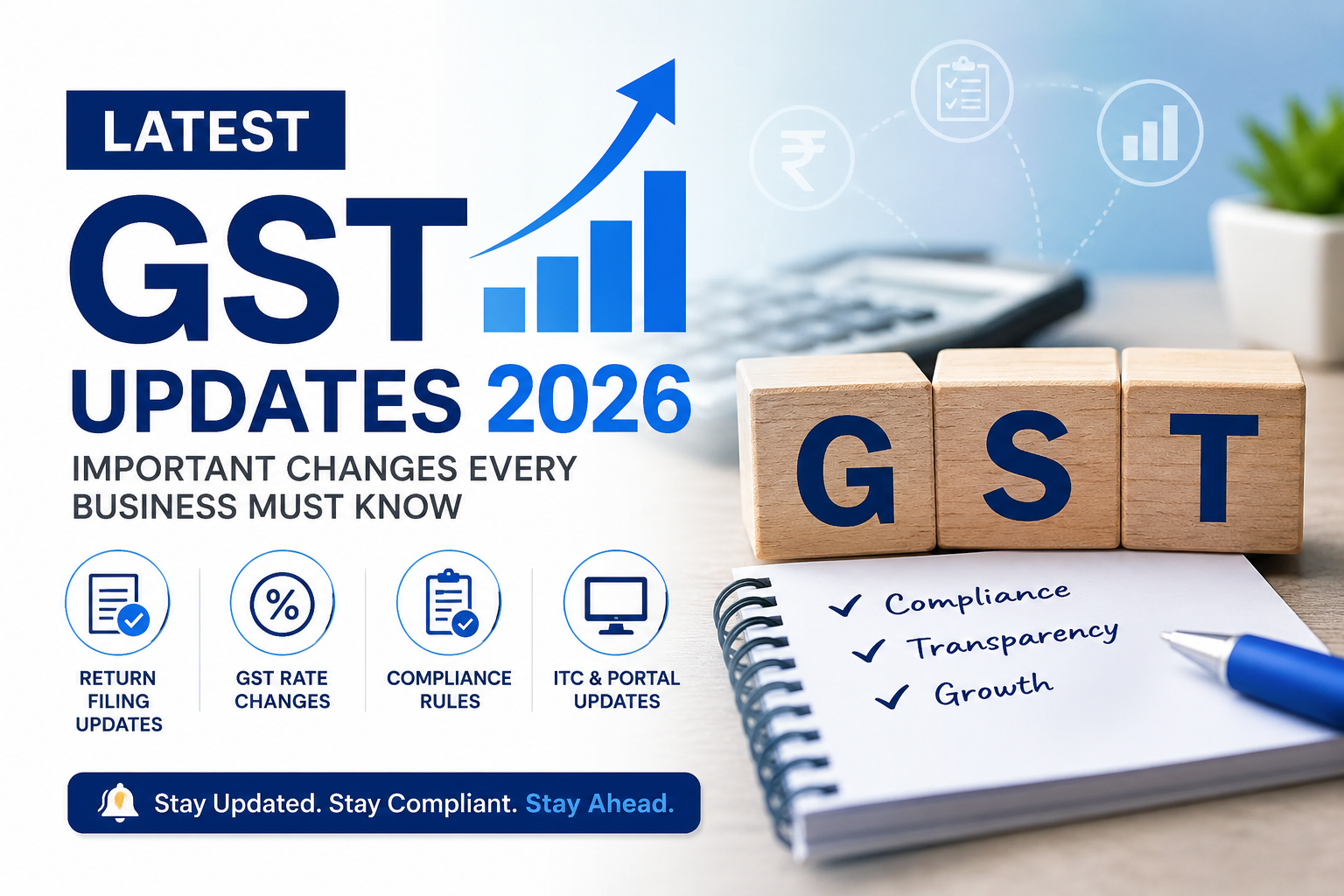
The Goods and Services Tax (GST) system in India continues to evolve with regular amendments, compliance updates, and digital reforms introduced by the government and GST Council. Businesses, startups, freelancers, manufacturers, and service providers must stay informed about the Latest GST Updates 2026 to avoid penalties, maintain compliance, and manage taxation efficiently.
In 2026, several important changes have been introduced related to GST return filing, Input Tax Credit (ITC), invoice matching, GST registration, compliance monitoring, and dispute resolution. These updates aim to strengthen transparency, improve tax collection, and simplify GST administration for businesses across India.
Understanding these latest GST changes is essential for every taxpayer operating under the GST framework.
1. Stricter GST Return Filing Rules
One of the biggest GST updates in 2026 is the implementation of stricter return filing systems. Tax authorities are now closely monitoring delayed filings and non-compliance activities. Businesses that fail to file GST returns on time may face automatic restrictions and penalties.
The GST portal has introduced stronger validation systems to ensure accurate reporting of invoices, tax liabilities, and Input Tax Credit claims. Authorities are also increasing scrutiny of businesses that frequently delay GST filings or show mismatched records.
Businesses should now focus on:
- Timely GST return filing
- Proper invoice reconciliation
- Accurate bookkeeping
- Regular compliance monitoring
- Monthly tax verification
Late filing of GST returns may result in:
- Late fees and interest charges
- Suspension of GST registration
- ITC claim restrictions
- Compliance notices
- Legal scrutiny
Maintaining updated accounting records and working with professional GST consultants can help businesses avoid these issues.
2. GST 2.0 Reforms and Tax Structure Simplification
The government and GST Council continue to work on GST 2.0 reforms to make the taxation system simpler and more business-friendly. One of the key discussions involves rationalization of GST tax slabs to reduce confusion and improve compliance.
Currently, businesses often face challenges in product classification and tax rate determination. The proposed GST reforms aim to simplify this structure and create a more transparent taxation framework.
Expected benefits of GST 2.0 include:
- Simplified GST rate structure
- Reduced compliance complexity
- Better ease of doing business
- Improved tax administration
- Faster dispute resolution
- Reduced classification disputes
Small businesses and startups are expected to benefit significantly from these changes as simplified compliance procedures can reduce operational burdens and tax-related confusion.
3. Input Tax Credit (ITC) Compliance Becomes More Important
Input Tax Credit remains one of the most critical areas under GST compliance. In 2026, authorities have strengthened monitoring systems related to ITC claims to reduce fake invoicing and tax fraud.
Businesses must ensure that:
- Supplier invoices are accurate
- Vendors file GST returns properly
- Purchase invoices match GSTR-2B data
- Tax invoices comply with GST regulations
Incorrect ITC claims may lead to:
- ITC reversal
- Penalties
- GST notices
- Financial losses
- Legal action
Businesses should regularly reconcile purchase records with GST portal data to ensure accurate ITC claims. Companies dealing with multiple vendors should create a systematic process for invoice verification and supplier compliance monitoring.
Experts also recommend maintaining proper documentation and backup records to handle future GST audits or verification requests efficiently.
4. Enhanced Monitoring Through AI and Data Analytics
The government is increasingly using artificial intelligence (AI), automation, and data analytics to monitor GST compliance. Advanced systems are now being used to identify suspicious transactions, fake invoices, tax evasion activities, and irregular filing patterns.
Authorities can now detect:
- Mismatched invoices
- Fake Input Tax Credit claims
- Unusual tax filing behavior
- Non-compliant suppliers
- Fraudulent transactions
This technology-driven approach means businesses must become more disciplined with:
- GST filings
- Invoice generation
- Vendor management
- Accounting transparency
- Documentation practices
Businesses relying on manual accounting systems may face higher compliance risks. Digital accounting software and professional GST support are becoming increasingly important for maintaining compliance in 2026.
5. E-Invoicing and Digital Compliance Expansion
The government continues expanding the scope of e-invoicing under GST. More businesses are now required to generate electronic invoices for transactions to improve transparency and automate tax reporting.
E-invoicing helps:
- Reduce invoice manipulation
- Improve tax reporting accuracy
- Simplify return filing
- Enable real-time invoice tracking
- Reduce tax fraud
Businesses covered under e-invoicing requirements must ensure that:
- Invoice formats are GST compliant
- IRN generation is completed correctly
- Digital records are maintained properly
- Accounting systems are updated
Failure to comply with e-invoicing rules may result in penalties and invalid tax invoices.
6. GST Registration and Amendment Process Updates
The GST registration process has also seen important updates in 2026. Authorities have simplified certain procedures while tightening verification standards to reduce fraudulent registrations.
Businesses applying for GST registration may now experience:
- Faster digital verification
- Improved application tracking
- Enhanced document scrutiny
- Simplified amendment requests
Taxpayers can also update registration details more efficiently through online systems. This is especially useful for businesses changing addresses, adding business activities, or modifying ownership details.
However, authorities are conducting stricter verification to prevent misuse of GST registrations and fake entities.
7. GST Notices and Compliance Verification
GST notices have become more common due to automated compliance monitoring systems. Businesses may receive notices for:
- Mismatched invoices
- Incorrect ITC claims
- Delayed return filing
- Tax payment discrepancies
- Non-compliance issues
Receiving a GST notice does not always mean serious legal trouble, but businesses should respond carefully and within deadlines. Professional consultation is highly recommended to handle notices properly and avoid escalation.
Maintaining accurate records and performing regular GST audits internally can significantly reduce the chances of compliance notices.
8. Improvements in GST Appeal and Dispute Resolution
The GST Appellate Tribunal system is also undergoing improvements to handle disputes more efficiently. Authorities are working on reducing delays in appeal processing and improving transparency in tax litigation.
The updated system aims to:
- Speed up dispute resolution
- Improve consistency in decisions
- Reduce legal delays
- Simplify appeal procedures
Businesses involved in GST disputes may benefit from faster resolution mechanisms and more organized appeal structures.
9. Importance of Professional GST Consultancy
With increasing compliance complexity, businesses are now relying more on professional GST consultants for:
- GST return filing
- ITC reconciliation
- Notice handling
- Compliance management
- Tax planning
- GST audits
- Business advisory
Professional guidance helps businesses reduce risks, improve financial management, and stay compliant with evolving GST regulations.
Final Thoughts
GST compliance in India is becoming more advanced, technology-driven, and strictly monitored. Businesses that maintain proper accounting systems, accurate filings, invoice reconciliation, and compliance practices will face fewer legal and financial challenges.
The latest GST updates in 2026 clearly indicate that authorities are focusing on transparency, automation, and stricter compliance enforcement. Businesses should proactively adapt to these changes by improving financial processes and seeking professional support when required.
Staying updated with GST developments is no longer optional. It is essential for maintaining smooth business operations, avoiding penalties, and ensuring long-term financial stability.
Visit: Taxtip