
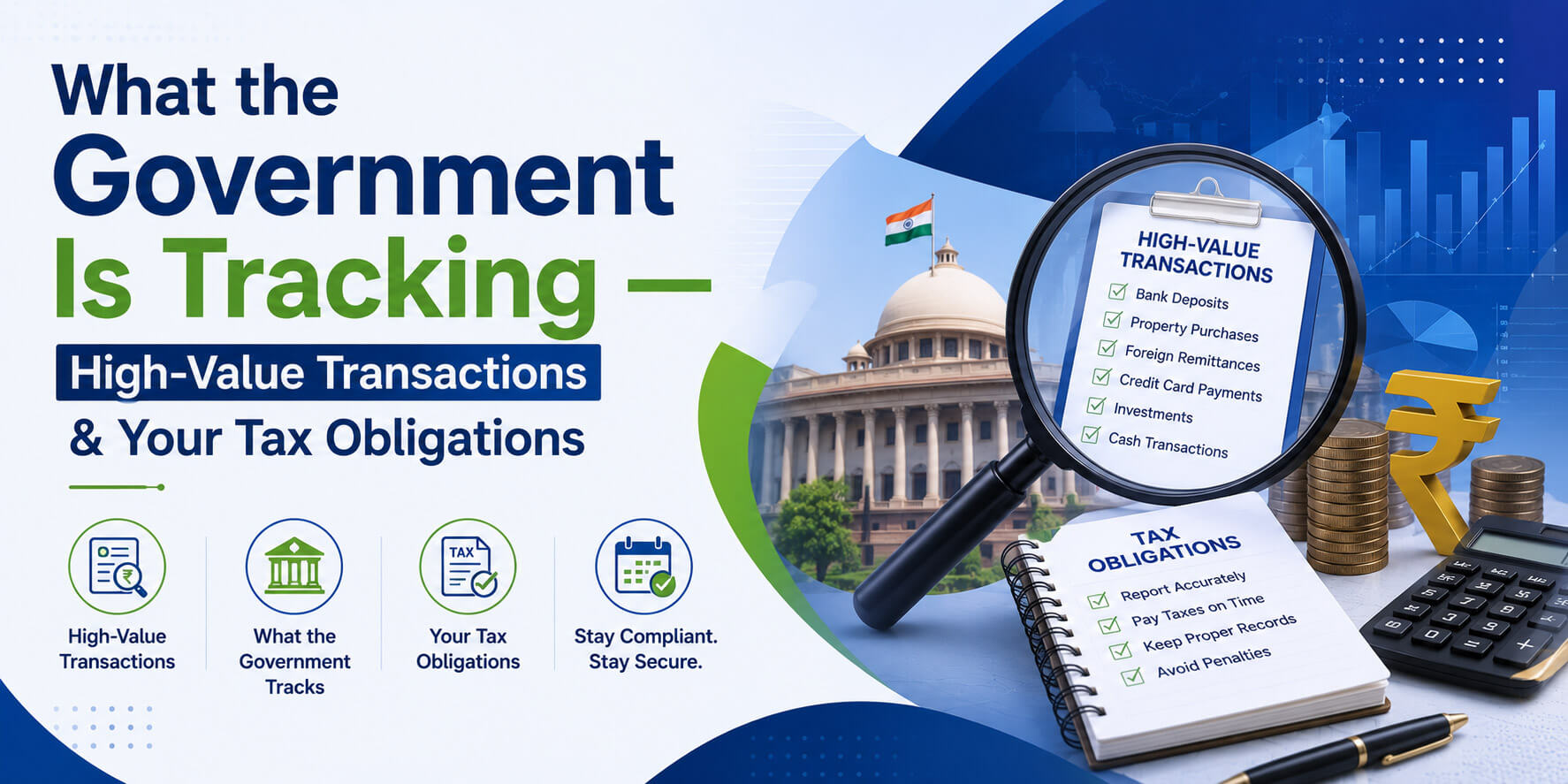
How the Government Knows About Your Finances
There is a widespread misconception that the Income Tax Department only knows what you tell it through your Income Tax Return. The reality is starkly different. The Department operates a sophisticated, multi-source data intelligence network that aggregates financial data from banks, mutual funds, registrars, stockbrokers, companies, GST authorities, foreign exchange dealers, credit card companies, and even post offices — and cross-references all of it against your PAN, year after year.
This network is anchored by the Statement of Financial Transactions (SFT) mechanism under Section 285BA of the Income Tax Act, 1961 (now Section 268 of the Income Tax Act, 2025), mandating specified reporting entities to file annual returns of high-value transactions. The data flows into your Annual Information Statement (AIS) and Form 26AS, which the Department uses to generate non-filer notices, scrutiny triggers, and mismatch alerts.
In addition to SFT, the Department receives data from TDS returns (26Q, 24Q, 27Q), TCS returns (27EQ), GST GSTIN data shared by the GST Council, FEMA transaction reports from the Reserve Bank of India, and import-export records from the Directorate General of Foreign Trade. Put simply: the government sees your financial life almost in its entirety.
Banks & Financial Institutions
Report cash deposits, savings account credits, fixed deposits, credit card spends, and cash purchase of instruments. Every scheduled commercial bank, co-operative bank, and post office is a mandatory reporter.
Stock Exchanges & Depositories
Report purchases and sales of listed securities, derivatives transactions, and dividend receipts. SEBI-registered brokers, mutual fund registrars (CAMS, KFintech), and depositories (NSDL, CDSL) all file SFT.
Registrars & Sub-Registrars
Report every immovable property transaction above ₹30 lakh at the time of registration. The stamp duty registration data feeds directly into AIS, often within days of a property transaction.
Credit Card Companies
Report aggregate credit card spends above ₹1 lakh (cash) and ₹10 lakh (non-cash) per year per card. High credit card spend with low declared income is one of the most common scrutiny triggers.
Foreign Exchange Dealers & Banks
Report all outward remittances under the Liberalised Remittance Scheme (LRS) above ₹7 lakh. Also report foreign currency sales above ₹10 lakh in a year. TCS on LRS transactions is now tracked in real-time.
GST Network (GSTN)
Business turnover declared in GSTR-1 and GSTR-3B is shared with the Income Tax Department. A mismatch between GST turnover and ITR income is one of the most common triggers for tax notices today.
The core principle: PAN is the thread that ties it all together
Every SFT, TDS return, TCS return, and third-party data source links transactions to your PAN. This is why quoting PAN (or Aadhaar, in some cases) is mandatory for all high-value financial transactions. Even if you split a transaction across family members, the IT Department’s data analytics systems are designed to detect patterns of structured splitting — known as “smurfing” — and flag them for inquiry.
The SFT Framework — Who Reports and When
The Statement of Financial Transactions (SFT) is the backbone of the government’s high-value transaction intelligence. Governed by Section 268 of the Income Tax Act, 2025 (old: Section 285BA) read with Rule 114E of the Income Tax Rules, it mandates a specified list of entities to report certain transactions to the Income Tax Department by 31 May of the following financial year.
Who Must File SFT (Reporting Entities)
- Scheduled commercial banks & co-operative banks
- Post offices & post office savings banks
- Non-banking financial companies (NBFCs)
- Nidhi companies
- Companies issuing bonds or debentures
- Companies issuing shares (including buybacks)
- Trustees of Mutual Funds / AMCs
- Authorised dealers (foreign exchange)
- Registrars / Sub-Registrars (property)
- Stock exchanges / depositories / brokers
Filing Details
- Form: Form 61A (SFT — for entities other than sub-registrars)
- Form: Form 61B (CRS — common reporting standard for foreign accounts)
- Due date: 31 May following the financial year
- Penalty for non-filing: ₹500/day under Section 271FA
- Penalty for inaccurate SFT: ₹50,000 per inaccuracy
- Portal: income tax e-filing portal (Form 61A utility)
- Aggregation basis: PAN of the transacting person
- Old section: Sec. 285BA | New section: Sec. 268
🎓 Practitioner’s Note
For clients who receive a notice under Section 133(6) or an AIS mismatch email from the IT Department, the first step is always to pull the AIS and TIS for the relevant year and identify which SFT transaction has triggered the query. The AIS will show the exact reporting entity (e.g., “HDFC Bank — SFT-005”), the amount reported, and the category code. Match this against the client’s declared income and respond accordingly with documentary evidence.
Banking & Cash Transactions
Cash transactions remain one of the most intensively monitored categories. The government has progressively tightened reporting thresholds and introduced TDS on cash withdrawals precisely because cash is the medium most commonly used to conceal income. Every significant cash movement in a bank account is tracked, classified, and matched against declared income.
Cash Deposits in Savings Bank Accounts
SFT-001 · Reported by: Banks, Post Offices, Co-operative Banks
| Category | Threshold | Aggregation | Reported In | Key Risk |
|---|---|---|---|---|
| Cash deposits — savings bank account (single or multiple accounts, same bank) | ₹10 lakh or more | Aggregate across all savings accounts in one year per PAN | SFT-001 | Mismatch between cash deposits and declared income sources |
| Cash deposits — current account (business accounts) | ₹50 lakh or more | Aggregate across all current/cash credit accounts per PAN | SFT-002 | Turnover mismatch between bank statement and ITR / GST |
| Cash deposits — post office savings scheme (other than time deposits) | ₹10 lakh or more | Aggregate per PAN per year | SFT-001 | Often overlooked — post office deposits are fully tracked |
Fixed Deposits & Time Deposits
SFT-003 · Reported by: Banks, Post Offices, NBFCs, Nidhi Companies
| Category | Threshold | Aggregation | Reported In | Key Risk |
|---|---|---|---|---|
| Cash payment for purchase of bank FDs / time deposits (new or renewal) | ₹10 lakh or more | Aggregate per year per PAN (includes roll-overs paid in cash) | SFT-003 | Source of cash used to create FD must be explainable |
| Non-cash (cheque/NEFT) payment for FDs / time deposits | ₹10 lakh or more | Aggregate per year per PAN | SFT-003 | Interest income on FDs also reflected in AIS via TDS data (Form 26AS) |
Credit Card Transactions
SFT-004 · Reported by: Banks & NBFCs issuing credit cards
| Category | Threshold | Aggregation | Reported In | Key Risk |
|---|---|---|---|---|
| Payment of credit card bills in CASH | ₹1 lakh or more | Aggregate per year per card per PAN | SFT-004 | Cash payment of credit card bills is a classic unexplained cash indicator |
| Payment of credit card bills by any other mode (cheque/NEFT/bank transfer) | ₹10 lakh or more | Aggregate per year per card per PAN | SFT-004 | High card spend vs. low declared income is one of the top scrutiny triggers |
Cash Purchase of Bank Instruments
SFT-005 · Reported by: Banks, NBFCs
| Category | Threshold | Aggregation | Reported In | Key Risk |
|---|---|---|---|---|
| Cash purchase of demand drafts, pay orders, banker’s cheques, or pre-paid payment instruments | ₹10 lakh or more | Aggregate per year per PAN | SFT-005 | Layering of cash — instrument used to convert untaxed cash into negotiable instruments |
TDS on cash withdrawals — an additional layer of surveillance
- Cash withdrawals above ₹1 crore in a year attract TDS @ 2% for most persons (Section 393(3)[Sl.5] of IT Act 2025; old: Section 194N).
- For co-operative societies, the threshold is higher at ₹3 crore.
- Non-ITR filers face TDS @ 2% above ₹20 lakh and @ 5% above ₹1 crore — a built-in penalty for non-compliance.
- This TDS is visible in Form 26AS / AIS of the account holder — creating a two-sided data trail.
Investments & Securities Transactions
The capital markets are among the most thoroughly monitored sectors. Brokers, depositories, mutual fund registrars, and companies themselves are all required to file SFT data. Whether you buy shares, invest in mutual funds, receive dividends, or subscribe to a company’s shares — the transaction is reported to the IT Department and appears in your AIS.
Purchase / Sale of Shares and Securities
SFT-006 · Reported by: Listed companies, stock exchanges, SEBI-registered brokers, depositories (NSDL/CDSL)
| Category | Threshold | Aggregation | Reported In | Notes |
|---|---|---|---|---|
| Purchase of shares in a company (unlisted) — rights or public issue | ₹10 lakh or more | Per company per PAN per year | SFT-006 | Reported by the company itself at the time of allotment |
| Purchase or sale of shares, debentures, bonds, or other listed securities through a broker | ₹10 lakh or more | Aggregate buy-side or sell-side per PAN per year | SFT-006 | Broker files SFT; capital gains also tracked via LTCG/STCG reporting in ITR |
| Buy-back of shares by a company from its shareholders | ₹10 lakh or more | Per company per PAN | SFT-006 | Company reports; TDS also deducted under IT Act 2025 provisions |
Mutual Fund Investments
SFT-007 · Reported by: Trustees / AMCs of Mutual Funds, CAMS, KFintech (RTAs)
| Category | Threshold | Aggregation | Reported In | Notes |
|---|---|---|---|---|
| Purchase (subscription) of mutual fund units by a person | ₹10 lakh or more | Aggregate across all MF schemes per PAN per year | SFT-007 | SIP investments are aggregated — ₹85,000/month SIP across schemes triggers reporting |
| Redemption / sale of mutual fund units | ₹10 lakh or more | Aggregate per PAN per year | SFT-007 | Capital gains on redemption also reported; must be disclosed in ITR Schedule CG |
Bonds, Debentures & RBI Instruments
SFT-008 · Reported by: Companies issuing bonds/debentures, RBI (for RBI bonds)
| Category | Threshold | Aggregation | Reported In | Notes |
|---|---|---|---|---|
| Purchase of bonds or debentures (excluding shares) issued by a company | ₹10 lakh or more | Per company per PAN per year | SFT-008 | Includes RBI Floating Rate Savings Bonds (7.35%) and RBI sovereign gold bonds |
🎓 Practitioner’s Note — Capital Gains Compliance
- Since AY 2019-20, LTCG on equity shares and equity-oriented mutual funds (above ₹1 lakh) is taxable at 10% under Section 97(1)(a) of the IT Act 2025 (old: Section 112A). The AIS now pre-populates LTCG figures from SFT data. Verify the AIS figures against the broker contract notes — errors in AIS are common and must be corrected before filing.
- For clients with large share portfolios, maintain a transaction-wise capital gains statement from the broker (available from CAMS, KFintech, or Zerodha P&L report) and reconcile with AIS Schedule 112A data before ITR filing.
- Dividend income from shares and mutual funds is now fully taxable and appears in AIS under “Dividend” — cross-check against dividend warrants and Form 26AS TDS entries.
Immovable Property Transactions
Immovable property is historically the preferred vehicle for parking undisclosed income in India. The Department has consequently built the tightest surveillance around property transactions — with data coming simultaneously from the Sub-Registrar of Properties (SFT), from TDS on property purchases (Form 26QB), and from direct Section 142(1) / 148 notices where the stamp duty value far exceeds the declared consideration.
Purchase and Sale of Immovable Property
SFT-012 / SFT-013 · Reported by: Sub-Registrar / Inspector General of Registration
| Category | Threshold | Who Reports | SFT Code | Notes |
|---|---|---|---|---|
| Purchase of immovable property (land, building, flat) | ₹30 lakh or more | Sub-Registrar / IGR at time of registration | SFT-012 | Value = sale consideration or stamp duty value, whichever is higher. Registration date = date of reporting. |
| Sale of immovable property | ₹30 lakh or more | Sub-Registrar / IGR at time of registration | SFT-012 | Both buyer and seller PAN are captured. Capital gain in seller’s AIS; property purchase in buyer’s AIS. |
Triple-layer surveillance on property transactions
- SFT from Registrar: Transaction reported by Sub-Registrar based on registration value — immediately reflected in both buyer’s and seller’s AIS.
- TDS via Form 26QB: Buyer must deduct TDS @ 1% of consideration (above ₹50 lakh) under new Section 393(1)[Sl.3(iii)] (old: Section 194IA) and file Form 26QB within 30 days. Non-deduction = 1% interest per month + potential prosecution.
- Section 50C / 43CA (Deeming): If sale consideration is less than stamp duty value, the higher stamp duty value is deemed to be the sale price for capital gains computation — plugging the most common under-declaration route.
- Cash payment prohibition: Cash payment exceeding ₹20,000 in a single day for property transactions is prohibited under Section 269SS/269T — violation attracts a 100% penalty equal to the cash amount.
Under-construction property & advance payments
Payments made to builders and developers are tracked through both the builder’s GST filings (GST on under-construction flats) and the TDS obligation on the buyer. Advance paid to book a flat is a high-value transaction that appears in the buyer’s AIS once the flat is registered.
Agricultural land transactions
Sale of agricultural land is generally exempt from capital gains if it meets the distance criterion. However, the registration data is still captured by SFT. If the land is subsequently reclassified as non-agricultural or is within urban limits, the exemption does not apply — and the AIS data can be used to reopen the assessment.
Joint development agreements (JDA)
Foreign Remittances — Liberalised Remittance Scheme (LRS)
The Liberalised Remittance Scheme (LRS) permits resident individuals to remit up to USD 2,50,000 per financial year abroad for permissible current account and capital account transactions. Every rupee remitted under LRS is tracked — and since 1 October 2023, TCS has been levied on most LRS remittances, creating a transaction trail that is automatically linked to the remitter’s PAN.
| LRS Purpose | Reporting Threshold | TCS Rate (IT Act 2025) | Old TCS Rate | Reported Via |
|---|---|---|---|---|
| Education abroad (through educational loan) | Above ₹7 lakh remittance in a year | 0.5% | 0.5% | SFT by Authorised Dealer + Form 27EQ |
| Education abroad (own funds) or medical treatment abroad | Above ₹7 lakh | 2% (above ₹10L) | 5% (pre-Oct 2023) | SFT + Form 27EQ (TCS code 1086) |
| Overseas tour programme package (up to ₹10 lakh) | First rupee | 2% | 5% | Form 27EQ (TCS code 1088) |
| Overseas tour programme package (above ₹10 lakh) | Above ₹10 lakh | 2% | 5% | Form 27EQ (TCS code 1089) |
| Any other LRS purpose (investments, gifts, maintenance of relatives, etc.) | Above ₹7 lakh (aggregate) | 20% (above ₹10L) | 20% (post-Oct 2023) | SFT + Form 27EQ (TCS code 1087) |
| Foreign currency sale (cash) by traveller | ₹10 lakh or more per year | SFT report only (no TCS below LRS threshold) | — | SFT by Authorised Dealer |
LRS and overseas investments — a compliance blind spot
- Resident individuals who hold foreign bank accounts, overseas securities, or foreign immovable property must disclose them in Schedule FA of their ITR (compulsory in ITR-2 / ITR-3 / ITR-6) — regardless of whether income was earned.
- Non-disclosure of foreign assets attracts a flat penalty of ₹10 lakh per year under the Black Money (Undisclosed Foreign Income & Assets) and Imposition of Tax Act, 2015 — a separate law with even harsher consequences than the IT Act.
- India participates in the Common Reporting Standard (CRS) — foreign financial institutions in 100+ countries automatically report account details of Indian residents to India’s IT Department annually via Form 61B.
Business Turnover & GST Intelligence
For businesses — whether proprietorships, partnerships, or companies — the GST network has become the government’s most powerful income verification tool. The GST returns filed by every registered business contain granular, invoice-level turnover data that is automatically shared with the Income Tax Department. Any material divergence between GST turnover and ITR income triggers an automated mismatch flag.
What GST Data Reveals to IT Dept.
- Total taxable turnover from GSTR-1 (outward supplies)
- Total taxable turnover from GSTR-3B (monthly summary)
- B2B invoice-level data for purchases over ₹5 lakh
- Export turnover and zero-rated supply details
- Input tax credit claimed and reversed
- HSN/SAC code classification of goods and services
- Inter-state vs. intra-state supply classification
- E-way bill data for goods movement above ₹50,000
Common Mismatch Scenarios Flagged
- GST turnover ₹1.5 crore but ITR shows ₹80 lakh gross receipts
- Composition dealer turnover exceeds ₹1.5 crore limit
- Large ITC claimed but income declared under presumptive scheme
- Export refunds claimed but ITR shows domestic income only
- GST registration cancelled but turnover still being reported
- Professional filing ITR-4 (presumptive) with GST turnover above 44ADA limit
- Multi-GSTIN holder with different PANs — cross-entity transactions
High-Value Business Purchases — Section 194Q TDS
SFT / TDS · Applicable to buyers with turnover above ₹10 crore
| Transaction | Threshold | TDS / TCS Rate | Section (IT Act 2025) | Filed In |
|---|---|---|---|---|
| Purchase of any goods by a buyer whose turnover exceeds ₹10 crore | In excess of ₹50 lakh per seller per year | TDS @ 0.1% | Sec. 393(1)[Sl.8(ii)] | Form 26Q (Code 1031) |
| Sale of goods by a seller whose turnover exceeds ₹10 crore (TCS counterpart) | In excess of ₹50 lakh per buyer per year | TCS @ 0.1% | Sec. 394(1)[Sl.10] / old Sec. 206C(1H) | Form 27EQ |
| E-commerce operator — sales by Individual / HUF participants | ₹5 lakh per participant per year | TDS @ 0.1% | Sec. 393(1)[Sl.8(v)] | Form 26Q (Code 1035) |
AIS, TIS and Form 26AS — The Taxpayer’s Digital Mirror
All SFT data, TDS data, TCS data, GST data, and third-party information flowing into the IT Department is consolidated and presented to each taxpayer through three interconnected documents: Form 26AS, the Annual Information Statement (AIS), and the Taxpayer Information Summary (TIS). Together, they form a near-complete picture of your financial year — as seen by the government.
Form 26AS
The foundational tax credit statement. Shows TDS deducted by all deductors, TCS collected, advance tax and self-assessment tax paid, refunds issued, SFT transactions (high-value), and demand/proceedings status. Available on the IT portal under “View Form 26AS”. Section 395B of IT Act 2025 (old: 203AA).
Annual Information Statement (AIS)
A comprehensive version of Form 26AS, covering 46 information categories including interest income (bank/post office), dividend, securities transactions, mutual fund transactions, foreign remittances, GST turnover, rent received, purchase/sale of property, and more. Taxpayer can submit online feedback on each entry if it is incorrect or belongs to another person.
Taxpayer Information Summary (TIS)
A derived summary of the AIS — shows category-wise aggregated amounts as “reported value” and “processed value” (after taxpayer feedback). The TIS is the document that the IT Department’s systems directly compare against your filed ITR for mismatch detection. Download both AIS and TIS before filing any ITR.
Critical: From AY 2025-26 onwards, the ITR pre-filling facility on the IT portal auto-populates income figures directly from AIS/TIS data. If you do not verify and correct AIS errors before filing, the pre-filled ITR may contain incorrect figures — which, if filed without correction, become your declared income. Always download the AIS, verify every entry, submit feedback for any incorrect data, and only then proceed to file.
AIS Information Categories — What Is Tracked
| AIS Category | Source of Data | Common Issues |
|---|---|---|
| Salary income (incl. perquisites) | Form 24Q TDS return filed by employer | Multiple employers in same year may show combined figures; Form 12B non-submission can lead to TDS mismatch |
| Interest income — savings / FD / bonds | Form 26Q TDS by banks + SFT-003 for FDs | Banks sometimes report accrued interest even if not paid; verify against bank certificates and Form 15G/H submissions |
| Dividend income | Form 26Q TDS (Section 393[Sl.7]) + company SFT | Dividends from unlisted companies may not appear if TDS not deducted; also verify mutual fund dividends separately |
| Securities / equity transaction proceeds | SFT-006 from broker / exchange + LTCG TDS | Gross sales value shown (not net gain) — must compute actual capital gain separately and cross-check with broker P&L statement |
| Mutual fund transactions | SFT-007 from CAMS / KFintech | SIP purchases aggregated; redemption proceeds shown gross; compute FIFO/weighted average cost gain separately |
| Purchase / sale of immovable property | SFT-012 from Sub-Registrar + Form 26QB TDS | Stamp duty value used — may differ from actual agreement value; capital gain computation must use actual indexed cost |
| GST turnover | GSTN data feed | Mismatch with ITR gross receipts is the single largest compliance gap for business taxpayers |
| Rent received | Form 26Q TDS (Section 393[Sl.2]) + SFT for rent above ₹50,000/month | Rental income from multiple properties must be aggregated; municipal tax deduction and standard deduction (30%) to be claimed |
| Foreign remittances (LRS) | SFT by Authorised Dealers + Form 27EQ TCS | LRS remittance is not income — but the source of funds used must be from disclosed income; foreign assets bought via LRS must appear in Schedule FA of ITR |
| Cash deposits in savings / current accounts | SFT-001 / SFT-002 by banks | Cash deposits without corresponding income declaration is the primary trigger for cases under Section 68 (unexplained cash credit) |
| Credit card spend | SFT-004 by credit card issuer | Lifestyle spend exceeding declared income is a red flag; particularly watched in high-net-worth and professional segments |
| Virtual digital assets (crypto) | SFT by crypto exchanges + Form 26QE TDS | VDA gains taxable at flat 30% under Section 115 of IT Act 2025; loss set-off not permitted against other income; TDS @ 1% on transfer |
Consequences of Non-Disclosure
The consequences of failing to disclose income from high-value transactions — whether intentional or due to oversight — are severe and escalate rapidly once the Department initiates action. The IT Act 2025 retains, and in some cases strengthens, all the penalty and prosecution provisions of the 1961 Act.
Tax + Interest
Undisclosed income taxed at applicable rates (or at 60% if treated as unexplained investment / cash credit under Section 68/69). Interest @ 1% per month under Sections 234A (filing delay), 234B (advance tax shortfall), 234C (instalment deferment).
Penalty
Penalty for concealment of income: 50% to 200% of tax evaded under Section 270A of IT Act 2025. For misreporting, the rate is 200%. For unexplained cash credits under Section 68, a flat surcharge of 25% of tax is added under Section 115BBE.
Reopening of Assessments
Assessments can be reopened up to 3 years from end of relevant AY (general cases); up to 10 years if escaped income exceeds ₹50 lakh and the Department has evidence (Section 148 / new Section 276). AIS mismatch is now treated as sufficient “information” to issue a Section 148 notice.
Prosecution
Wilful failure to file returns: rigorous imprisonment up to 7 years + fine. Tax evasion: 3 months to 7 years + fine. Post-search (survey/raid) non-cooperation: separate prosecution. Prosecution can run concurrently with penalty proceedings.
Section 68 — Unexplained Cash Credits: The most potent provision
Under Section 68 of the IT Act 2025, if any sum is found credited in the books of a person and the person does not satisfactorily explain the nature and source of such credit, the entire amount is taxable as income of that year. For closely held companies and firms, even the source of funds for share capital and loans must be explained to the satisfaction of the Assessing Officer. This provision has been extensively used in post-demonetisation cases and continues to be a primary weapon in high-value cash deposit scrutiny.
Faceless Assessment — no human interface, but full data intelligence
Under the Faceless Assessment Scheme, your case can be selected by an algorithm, assigned to an AO in a different city, and an assessment order passed — all without any face-to-face interaction. The basis for selection is almost always an AIS / SFT mismatch. Respond to all e-notices under Section 142(1) or 148A promptly and within the given time. Delay in response is treated as non-cooperation and may lead to ex-parte assessment orders.
What You Should Do — A Taxpayer’s Action Plan
Understanding what the government tracks is only half the picture. The more important question is: what actions should a responsible taxpayer take to ensure full compliance and avoid the consequences of data mismatches? The following steps apply to individuals, HUFs, and businesses alike.
Download and review your AIS every year before filing your ITR
Log in to the IT e-filing portal → ‘Services’ → ‘Annual Information Statement (AIS)’. Download both the AIS (full detail) and TIS (summary). Go through every category systematically — interest, dividends, property, MF, shares, GST turnover, foreign remittances. Flag any entries that are incorrect, duplicated, or do not belong to you, and submit online feedback. The IT portal allows you to dispute AIS entries before they are used in assessment.
Reconcile AIS with Form 26AS and your own books / bank statements
Cross-check TDS credits in AIS against Form 26AS. Ensure that every TDS entry maps to an income that you are declaring in your ITR. Do not leave unexplained credits in your bank account — even if temporarily parked, they will appear in SFT cash deposit data and must be accounted for. Maintain a reconciliation note before filing.
Declare all income — including incomes that appear “small” or “exempt”
Even if a particular income is fully exempt (e.g., agricultural income, LTCG below ₹1.25 lakh), it must be disclosed in the appropriate schedule of your ITR. The IT Department does not automatically know which portion is exempt — it only sees the gross amount. If you declare an income as exempt without disclosing it, the AIS data will show a mismatch.
File Schedule FA and Schedule FSI in ITR if you hold any foreign assets
If you have made any LRS remittances for overseas investments, hold a foreign bank account, own foreign shares or property, or have signing authority on a foreign account — you must file ITR-2 or ITR-3 (not ITR-1 or ITR-4) and fill Schedule FA (Foreign Assets) and Schedule FSI (Foreign Source Income) every year, even if no income was earned from the foreign asset during the year. The Black Money Act penalty for non-disclosure is ₹10 lakh per year per asset.
Match GST turnover with ITR income before filing
If you are a GST-registered business or professional, print your GSTR-1 and GSTR-3B summary for the year before filing your ITR. The taxable turnover declared in GST and the gross receipts/turnover declared in your ITR must be reconcilable. Differences due to exempt supplies, composition levies, or timing differences must be documented and explainable. The IT Department’s systems perform this match automatically.
Respond promptly and accurately to all IT notices and e-mails
If you receive a non-filer notice, an AIS mismatch communication, or a Section 142(1) / 148A notice, do not ignore it. Every such notice has a statutory response deadline. Engage a qualified CA for representation. The Faceless Assessment system has strict timelines and ex-parte orders are passed against non-respondents. Prompt, document-backed responses resolve the vast majority of AIS mismatch cases without penalty.
The bottom line: Transparency is the only sustainable strategy
With the convergence of SFT data, GST data, TDS/TCS trails, CRS foreign account information, and increasingly sophisticated AI-based data analytics at the IT Department, the possibility of conducting significant financial transactions outside the tax net has been dramatically reduced. For every legitimate taxpayer, this data infrastructure is actually an asset — it ensures that the taxes paid by honest citizens are not undercut by those who evade. The best protection against a notice or penalty is a complete, accurate, and timely filed Income Tax Return.