
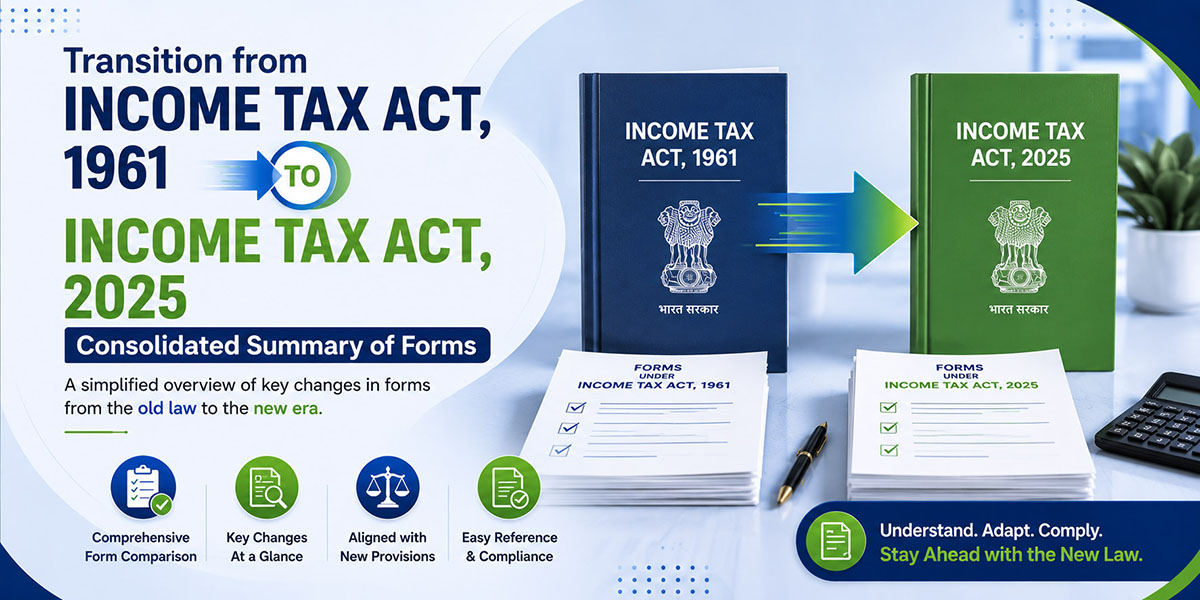
Why This Transition Matters
The Income Tax Act, 2025 is not merely a cosmetic redrafting of the Income Tax Act, 1961 — it is a comprehensive, structured recodification that reorganises nearly six decades of accumulated provisions, provisos, explanations, and amendments into a clean, readable statute. The Act received Presidential assent and is applicable with effect from 1 April 2026, i.e., Tax Year 2026-27 (Assessment Year 2027-28) onwards.
For practising chartered accountants, tax consultants, and finance professionals, the single most operationally disruptive aspect of this transition is the renumbering and redesignation of statutory forms. Every form — whether it is an ITR, a TDS certificate, an audit report, a declaration, or an application — bears reference to the section of the Act under which it is prescribed. With section numbers changed wholesale, forms are being revised and renotified accordingly.
Key clarification for practitioners
The substantive legal position — who must file, what is taxable, what deductions are available, what rates apply — remains largely unchanged. What has changed is the citation of sections, the layout of forms, and the cross-referencing within each form. The data fields and schedules within most forms remain the same or are expanded for greater clarity.
The Road to Recodification
Income Tax Act, 1961 enacted
Replaced the Income Tax Act, 1922. Introduced a modern framework with 298 sections, later expanding to over 500 sections with numerous sub-sections, provisos, and explanations added over decades.
Multiple simplification attempts
Several expert committees (including the Kelkar Committee and Akhilesh Ranjan Committee) recommended a new, simplified direct tax code. The Direct Taxes Code Bill, 2010 lapsed. The Task Force report of 2019 laid the foundation for what became the IT Act 2025.
Income Tax Act, 2025 receives Presidential assent
A structured recodification consolidating all provisions into a logical chapter-based architecture. Section numbers restructured; TDS provisions consolidated under Sections 392–397; ITR and TDS form notifications issued progressively.
Effective date: Tax Year 2026-27
IT Act 2025 applies for the first time from Tax Year 2026-27 (AY 2027-28). All returns, TDS statements, audit reports, and applications filed on or after this date must cite the new section numbers and use the revised form formats.
What Changed — and What Did Not
What Has Changed
- All section numbers across the Act renumbered and rearranged in a logical chapter-based structure
- TDS provisions (old: Sections 192–206CC) consolidated under new Sections 392–397
- All statutory forms revised to cite new section references and schedules
- Forms for audit reports and certifications updated to reflect new section-based cross-references
- ITR forms revised with cleaner schedule architecture aligned with new Act
- Challans and TDS return forms updated (Form 24Q, 26Q, 27Q, 27EQ revised)
- Some forms merged, renamed, or restructured for clarity
What Has NOT Changed
- Tax rates, slabs, and surcharge/cess structure (subject to annual Finance Act changes)
- TDS rates and threshold limits
- TCS rates and categories
- The underlying taxability of income heads and deductions
- Due dates for TDS deposits, return filing, and ITR filing
- The data points and schedules required in ITR forms
- Advance tax instalments and interest provisions (conceptually)
- Penalties and prosecution provisions (restructured but substantively same)
Section Renumbering Logic
The new Act follows a chapter-based block numbering. TDS is in Chapter XIX (Sections 392–397). Earlier, TDS sections were spread across Chapter XVII-B (Sections 192–206CC), making cross-referencing cumbersome.
Form Numbering Retained
Importantly, most form numbers (Form 16, Form 26AS, ITR-1, etc.) have been retained for continuity. What changes is the section reference printed within each form and the format of certain schedules.
Dual Reference Period
For TY 2026-27 (first year of IT Act 2025), practitioners need to be fluent in both the old and new section numbers — particularly for matters relating to pending assessments, appeals, and rectifications under the old Act.
ITR Forms — Returns of Income
ITR (Income Tax Return) forms are the primary vehicle through which taxpayers declare their total income and tax liability. The following table maps each ITR form to its applicability, the old and new section references for the filing obligation, and its status under the IT Act 2025.
| Form | Applicable To | Old Section (1961) | New Section (2025) | Status | Key Schedules / Notes |
|---|---|---|---|---|---|
| ITR-1 (Sahaj) |
Resident Individuals with income from salary/one house property/other sources up to ₹50 lakh. Not applicable to directors or those with foreign assets. | Sec. 139(1) | Sec. 263(1) | Revised | Salary schedule aligned with new Section 17 (old Section 17). AIS/TIS pre-fill expanded. Form continues with simplified layout. |
| ITR-2 | Individuals and HUFs with income from capital gains, foreign assets/income, more than one house property, or directorship. No business/professional income. | Sec. 139(1) | Sec. 263(1) | Revised | Schedule CG updated to reflect new capital gains sections. Schedule FA (foreign assets) expanded. Pass-through income schedules revised. |
| ITR-3 | Individuals and HUFs having income from business or profession (including partners of firms with active involvement). Most complex individual form. | Sec. 139(1) | Sec. 263(1) | Revised | Schedule BP (business profit) reformatted. Section 44AB audit reference updated to new section. IFOS and speculative income schedules restructured. |
| ITR-4 (Sugam) |
Individuals, HUFs, and firms (other than LLP) opting for presumptive taxation under Sections 44AD, 44ADA, or 44AE. Income limit ₹50 lakh (profession) / ₹3 crore (business). | Sec. 139(1) r/w Sec. 44AD / 44ADA / 44AE | Sec. 263(1) r/w Sec. 58 / 59 / 60 | Revised | Presumptive income schedule updated with new section citations. Now includes enhanced disclosure for turnover verified via GST portal. |
| ITR-5 | Persons other than individuals, HUFs, companies, and those filing ITR-7 — i.e., firms, LLPs, AOPs, BOIs, co-operative societies, local authorities. | Sec. 139(1) / 139(4C) | Sec. 263(1) / 263(4C) | Revised | Schedule PLI (partners’ liability and interest) updated. LLP schedules expanded. AMT computation schedule references revised. |
| ITR-6 | Companies (other than those claiming exemption under Section 11 / new Section 10 equivalent). Mandatory e-filing only. | Sec. 139(1) | Sec. 263(1) | Revised | MAT computation schedule updated with new Section references for book profit. CSR schedule revised. DTAA relief schedule (Schedule TR) updated with new treaty-override sections. |
| ITR-7 | Persons (including companies) required to furnish return under Sections 139(4A)–(4F): charitable/religious trusts, political parties, scientific research institutions, news agencies, educational institutions, etc. | Sec. 139(4A) to 139(4F) | Sec. 263(4A) to 263(4F) | Revised | Schedule ER (exemption regime) restructured — Section 11/12/13 references mapped to new equivalents. Compliance clauses for registration (Sec. 12A/12AB) updated. |
| ITR-U (Updated Return) |
Any person wishing to file an updated return within two years from the end of the relevant assessment year, subject to payment of additional tax. | Sec. 139(8A) | Sec. 263(8A) | Continued | Two-year window retained. Additional tax rates (25%/50% of aggregate tax + interest) unchanged. Form updated with new section citations. |
🎓 Practitioner’s Note — ITR Filing
- For AY 2027-28 (TY 2026-27), use only the revised ITR forms as notified under the IT Act 2025. Filing old-format forms citing 1961 sections will result in defective return notices.
- The due date for non-audit cases remains 31 July; for audit cases, 31 October; for transfer pricing cases, 30 November.
- The AIS and TIS pre-fill has been significantly expanded under the new portal — always reconcile before filing.
- For ITR-7 filers (trusts, etc.), verify that your registration under the new equivalent of Section 12A/12AB has been migrated/revalidated under the IT Act 2025 framework.
TDS & TCS Forms — Deduction, Collection & Certificates
TDS and TCS compliance involves a family of interrelated forms — from the quarterly statement of deduction to the certificate issued to the deductee. The new Act consolidates all TDS provisions under Chapter XIX (Sections 392–397). The TDS return forms and certificate forms have been revised to reflect the new section references.
| Form | Purpose | Old Section (1961) | New Section (2025) | Periodicity | Status |
|---|---|---|---|---|---|
| Form 24Q | Quarterly TDS statement — salary payments (TDS on salary by employers) | Sec. 192 / Rule 31A | Sec. 392(7) / Rule 31A | Quarterly (Q4 extended to 31 May) | Revised |
| Form 26Q | Quarterly TDS statement — domestic non-salary payments (interest, rent, commission, professional fees, contracts, etc.) | Sec. 193–194T / Rule 31A | Sec. 393(1) & (3) / Rule 31A | Quarterly | Revised |
| Form 27Q | Quarterly TDS statement — payments to non-residents (other than salary) | Sec. 195–196D / Rule 31A | Sec. 393(2) / Rule 31A | Quarterly | Revised |
| Form 27EQ | Quarterly TCS statement — all tax collected at source by sellers | Sec. 206C / Rule 31AA | Sec. 394(1) / Rule 31AA | Quarterly | Revised |
| Form 26QB | TDS on sale of immovable property by buyer — single transaction challan-cum-statement | Sec. 194IA | Sec. 393(1) [Sl. No. 3(iii)] | Per transaction (within 30 days) | Revised |
| Form 26QC | TDS on rent by individual/HUF (not liable for tax audit) — challan-cum-statement | Sec. 194IB | Sec. 393(1) [Sl. No. 2(ii)] | Per transaction / end of tenancy | Revised |
| Form 26QD | TDS on payment to contractor/professional by individual/HUF (not liable for tax audit) | Sec. 194M | Sec. 393(1) [Sl. No. 6(iv)] | Per transaction (within 30 days) | Revised |
| Form 26QE | TDS on transfer of virtual digital asset (VDA) by specified persons | Sec. 194S | Sec. 393(1) [Sl. No. 8(vi)] | Monthly (by 30th of following month) | Continued |
| Form | Certificate For | Old Section | New Section (2025) | Issued By | Due Date | Status |
|---|---|---|---|---|---|---|
| Form 16 Part A + Part B |
TDS certificate for salary — issued by employer to employee. Part A: tax deducted & deposited (from TRACES). Part B: computation of taxable salary and deductions. | Sec. 203 / Rule 31 | Sec. 395 / Rule 31 | Employer (Deductor) | 31 May (after end of FY) | Revised |
| Form 16A | TDS certificate for non-salary payments — issued for TDS on interest, rent, professional fees, commission, etc. | Sec. 203 / Rule 31 | Sec. 395 / Rule 31 | Deductor (Bank / Business) | 15 days from due date of quarterly return | Revised |
| Form 16B | TDS certificate for purchase of immovable property — issued by buyer to seller for TDS under Section 194IA / new Section 393(1)[Sl.3(iii)]. | Sec. 203 r/w Sec. 194IA | Sec. 395 r/w Sec. 393(1)[3(iii)] | Buyer of property | 15 days from Form 26QB filing | Revised |
| Form 16C | TDS certificate for rent paid by individual/HUF — where TDS deducted under the individual/HUF rent TDS provision. | Sec. 203 r/w Sec. 194IB | Sec. 395 r/w Sec. 393(1)[2(ii)] | Tenant (Individual/HUF) | 15 days from Form 26QC filing | Revised |
| Form 16D | TDS certificate for payment to contractor/professional by individual/HUF — for 26QD transactions. | Sec. 203 r/w Sec. 194M | Sec. 395 r/w Sec. 393(1)[6(iv)] | Individual/HUF payer | 15 days from Form 26QD filing | Revised |
| Form 27D | TCS certificate — issued by seller/collector to buyer/collected party for tax collected at source. | Sec. 206C(5) / Rule 37D | Sec. 394(5) / Rule 37D | Seller / Collector | 15 days from quarterly TCS return | Revised |
TRACES-generated certificates — important change
Form 16 (Part A) and Form 16A must be downloaded from TRACES (TDS Reconciliation Analysis and Correction Enabling System) only — they cannot be prepared manually. From AY 2027-28, TRACES will generate these in the revised format reflecting new section citations. Verify that your TAN is active and 24Q/26Q returns are filed correctly before downloading.
| Form | Purpose | Old Section | New Section (2025) | Filed By | Status |
|---|---|---|---|---|---|
| Form 27EQ | Quarterly statement of TCS — covers all collections under Section 206C (old) / Section 394(1) (new): liquor, scrap, forest produce, minerals, motor vehicles, LRS, overseas tour packages, luxury goods, etc. | Sec. 206C / Rule 31AA | Sec. 394(1) / Rule 31AA | Seller / Collector | Revised |
| Form 27D | TCS certificate issued to the buyer/collectee — counterpart of Form 16A for TCS. Downloaded from TRACES. | Sec. 206C(5) | Sec. 394(5) | Seller / Collector | Revised |
| Form 27C | Declaration by buyer to seller — for non-collection of TCS where goods are purchased for manufacturing, processing, or production (not for trading). | Sec. 206C(1A) / Rule 37C | Sec. 394(1A) / Rule 37C | Buyer (to seller) | Continued |
| Challan / Form | Purpose | Old Rule / Provision | New Provision (2025) | Deposit Deadline | Status |
|---|---|---|---|---|---|
| ITNS 281 (Challan 281) |
Deposit of TDS and TCS with the government. Used by all deductors and collectors through banks / IT portal. | Rule 30 / 37CA | Rule 30 / 37CA (revised) | 7th of following month (March: 30 April) | Minor revision |
| ITNS 280 (Challan 280) |
Deposit of advance tax, self-assessment tax, and regular assessment tax by taxpayers. | Sec. 140A / 208 / 210 | Sec. 271 / 209 / 210 | As per advance tax schedule / on filing ITR | Minor revision |
| ITNS 282 | Payment of securities transaction tax, wealth tax (discontinued), and other direct taxes (estate duty, etc.). | Respective Acts | Respective Acts | As applicable | Unchanged |
Audit & Report Forms
Tax audit reports and other certification forms are among the most section-reference-intensive documents in income tax practice. Every clause of a tax audit report cites specific sections of the Act. With the renumbering under the IT Act 2025, these forms have undergone significant reformatting in their internal clauses — while the data requirements remain largely the same.
| Form | Nature of Audit / Report | Old Section (1961) | New Section (2025) | Applicable To | Status |
|---|---|---|---|---|---|
| Form 3CA | Audit report under Section 44AB — for taxpayers whose accounts are required to be audited under any other law (e.g., Companies Act). Auditor’s report in prescribed form. | Sec. 44AB | Sec. 58(1) | Companies, co-operative societies audited under their respective statutes | Revised |
| Form 3CB | Audit report under Section 44AB — for taxpayers not otherwise required to get accounts audited. CA’s report on the financial statements. | Sec. 44AB | Sec. 58(1) | Business/professional entities with turnover above threshold, not separately audited | Revised |
| Form 3CD | Statement of particulars — the detailed clause-by-clause report accompanying Forms 3CA/3CB. Contains 44 clauses covering all aspects of income, deductions, disallowances, and compliance. | Rule 6G r/w Sec. 44AB | Rule 6G r/w Sec. 58(1) | All entities subject to tax audit | Significantly Revised |
| Form 3CEB | Report of accountant under transfer pricing provisions — for international and specified domestic transactions above the prescribed limit. | Sec. 92E | Sec. 157 | Entities with international / specified domestic transactions | Revised |
| Form 29B | Report on computation of book profits for MAT purposes (Minimum Alternate Tax) — certified by a CA. | Sec. 115JB | Sec. 113 | All companies subject to MAT | Revised |
| Form 29C | Report on computation of adjusted total income for AMT purposes — for non-corporate entities (AMT: Alternate Minimum Tax). | Sec. 115JC | Sec. 114 | Firms, LLPs, AOPs, BOIs subject to AMT | Revised |
| Form 10B | Audit report for charitable / religious trusts and institutions claiming exemption — prescribed audit by a CA to verify application of income, accumulation, etc. | Sec. 12A / 12AB | Sec. 332 / 333 | Trusts and institutions registered under Section 12A/12AB | Revised |
| Form 10BB | Audit report for educational institutions and hospitals — Clause (23C) exemption institutions must furnish this report if income exceeds prescribed limits. | Sec. 10(23C) | Sec. 11(23C) | Universities, educational institutions, hospitals, etc. | Revised |
| Form 56F | Report of CA — for deduction under Section 10AA (SEZ units). CA certifies the computation of deduction for export profits from Special Economic Zones. | Sec. 10AA | Sec. 11(12) | Undertakings in Special Economic Zones | Revised |
Critical: Form 3CD clause renumbering
Form 3CD is the most impacted audit form. Every clause within the form that references a specific section — e.g., “Amounts paid to persons specified in Section 40A(2)(b)” or “Amounts inadmissible under Section 43B” — has been revised to cite the equivalent new section numbers. The number of clauses and the data requirements are largely the same, but practitioners must not use the old-format Form 3CD for AY 2027-28 audits. Ensure your audit software/utility is updated to the revised Form 3CD format before uploading on the portal.
Declaration & Exemption Forms
These forms are used by deductees, taxpayers, or institutions to declare their status, claim exemptions, or submit information to reduce TDS or obtain certificates. They are section-specific and must now bear the new section references.
| Form | Purpose | Old Section (1961) | New Section (2025) | Who Submits | Status |
|---|---|---|---|---|---|
| Form 15G | Declaration by resident individual (below 60 years) and certain entities (trusts, co-operative societies) that estimated total income is below the taxable limit — for NIL TDS on interest, dividends, EPF withdrawals, etc. | Sec. 197A(1) & (1A) | Sec. 396(1) & (1A) | Resident individual / eligible entity → to deductor | Revised |
| Form 15H | Declaration by resident senior citizen (60 years and above) that estimated total income for the year is below the taxable limit — for NIL TDS on interest income. | Sec. 197A(1C) | Sec. 396(1C) | Senior citizen resident → to bank / deductor | Revised |
| Form 13 | Application for NIL or lower TDS / TCS certificate — deductee applies to Assessing Officer for a lower deduction certificate where the AO is satisfied that the total income justifies it. | Sec. 197 / 206C(9) | Sec. 396(1) / Rule 28 | Deductee → to jurisdictional AO / TRACES system | Revised |
| Form 15CA | Declaration by remitter — for all foreign remittances requiring RBI / bank compliance. Remitter declares the nature of payment, taxability, and DTAA position before remitting funds abroad. | Sec. 195 / Rule 37BB | Sec. 393(2) / Rule 37BB | Remitter (authorised dealer / taxpayer) | Revised |
| Form 15CB | CA Certificate for foreign remittances — CA certifies the nature of remittance, taxability under the Income Tax Act and DTAA, and TDS deducted. Required for payments above ₹5 lakh where 15CA is needed (specific cases). | Sec. 195 / Rule 37BB | Sec. 393(2) / Rule 37BB | Chartered Accountant → to remitter | Revised |
| Form 10F | Information to be furnished by non-resident — where DTAA benefit is claimed and the Tax Residency Certificate does not contain all required information. Submitted by NR to deductor. | Rule 21AB r/w Sec. 90/90A | Rule 21AB r/w Sec. 144/145 | Non-resident → to deductor | Revised |
| Form 12B | Particulars of income furnished by employee to new employer — where employee changes employer mid-year. Enables new employer to compute correct TDS for the full year. | Rule 26A r/w Sec. 192 | Rule 26A r/w Sec. 392(7) | Employee → to new employer | Continued |
| Form 12BA | Statement showing particulars of perquisites and profits in lieu of salary — issued by employer to employee alongside Form 16. | Rule 26A r/w Sec. 17 | Rule 26A r/w Sec. 17 | Employer → to employee | Continued |
Registration & Application Forms
These forms deal with the registration, recognition, or application processes for entities such as charitable trusts, political parties, research institutions, and others. The IT Act 2025 has renumbered the provisions governing exemptions and registrations, which directly impacts these forms.
| Form | Purpose | Old Section (1961) | New Section (2025) | Applicable To | Status |
|---|---|---|---|---|---|
| Form 10A | Application for registration / provisional registration of trust or institution — first-time registration or re-registration after approval lapses. | Sec. 12A / 12AB / 10(23C) | Sec. 332 / 333 / 11(23C) | Charitable / religious trusts and institutions | Revised |
| Form 10AB | Application for regular registration (converting from provisional) or for renewal of registration after five-year validity period. | Sec. 12AB | Sec. 333 | Trusts holding provisional registration under 12AB | Revised |
| Form 10AC–10AF | Orders of provisional registration, regular registration, approval, and related orders issued by the CIT (Exemptions) — output forms, not filed by taxpayers. | Sec. 12AB / 80G | Sec. 333 / 123 | Issued by Income Tax Department | Revised |
| Form 80G | Application for approval under Section 80G — for trusts / institutions seeking to enable donors to claim deduction for donations made to them. | Sec. 80G(5) | Sec. 123 | Charitable institutions, trusts, funds | Revised |
| Form 58A | Declaration for approval / recognition of scientific research association, news agency, or institution under various exemption provisions. | Sec. 10(21) / 10(22B) / 10(23A) etc. | Sec. 11 (respective sub-sections) | Scientific research / news / professional bodies | Revised |
| Form 49A | Application for allotment of PAN — for Indian citizens, entities, and non-residents with Indian-source income. Not directly section-linked but cites enabling provisions. | Sec. 139A / Rule 114 | Sec. 260 / Rule 114 | All first-time PAN applicants | Continued |
| Form 49B | Application for allotment of TAN — mandatory for all deductors before commencing TDS deduction. | Sec. 203A / Rule 114A | Sec. 395A / Rule 114A | All deductors / collectors | Continued |
| Form 26AS (Annual Tax Statement) |
Consolidated annual tax statement — not a form filed by taxpayers but accessed by them. Shows all TDS, TCS, advance tax, self-assessment tax, refunds, and specified transactions. | Sec. 203AA / Rule 31AB | Sec. 395B / Rule 31AB | All PAN holders (view/download only) | Continued & Enhanced |
Newly Introduced & Restructured Forms NEW
Beyond the revision of existing forms, the Income Tax Act 2025 framework has introduced new forms and restructured certain existing ones to address gaps, digital transactions, and compliance simplification. The following forms are either entirely new or have undergone material restructuring beyond mere section renaming.
VDA Transactions — Form 26QE
A dedicated return form for TDS on Virtual Digital Assets (crypto, NFTs) — specific to transactions by specified persons. Now firmly embedded under new Section 393(1)[Sl.8(vi)]. Threshold and timing rules are now codified in the Schedule itself.
Luxury Goods TCS — Form 27EQ (Expanded)
TCS on luxury goods (wrist watches, handbags, shoes, polo horses, yachts, etc.) has been formally included in the TCS schedule under new Section 394(1)[Sl.6.D(b)]. Form 27EQ has been expanded with new return codes 1076–1085 for each luxury category.
Partner’s TDS — New Return Code 1067
TDS on salary, remuneration, commission, bonus, and interest paid to a partner of a firm (new Section 393(3)[Sl.7]) is now explicitly prescribed with a dedicated return code and ₹20,000 threshold. Form 26Q now covers this via code 1067.
AIS / TIS — Expanded Annual Information Statement
The Annual Information Statement (AIS) and Taxpayer Information Summary (TIS) have been substantially expanded under the new Act to capture more transaction categories including interest on savings accounts, mutual fund transactions, and foreign remittances directly from source agencies.
| Form / Mechanism | Nature | Old Reference | New Reference (2025) | Effective From |
|---|---|---|---|---|
| Form ITR-U | Updated return — extended to allow taxpayers to correct omissions within two years of the relevant AY, on payment of additional tax. | Sec. 139(8A) [inserted 2022] | Sec. 263(8A) | TY 2026-27 (AY 2027-28) |
| Schedule 112A (Capital Gains) | Expanded schedule within ITR-2 / ITR-3 / ITR-5 / ITR-6 for granular LTCG disclosure on listed equity shares and equity mutual fund units — now mandatory even below taxable threshold. | Sec. 112A | Sec. 97(1)(a) | TY 2026-27 |
| Form 26AS — Part F (SFT) | Expanded Statement of Financial Transactions section in Form 26AS — now includes crypto exchange reporting, LRS remittances, and luxury goods TCS transactions. | Sec. 285BA / Rule 114E | Sec. 268 / Rule 114E | TY 2026-27 |
| e-Verification Form | A unified digital verification form for accepting verification of ITRs, SFT statements, and other filings through Aadhaar OTP / net banking / DSC — now referenced under new rule framework. | Rule 12 / 12AC | Rule 12 (revised) | TY 2026-27 |
Practitioner’s Action Checklist
As a chartered accountant or tax professional handling filings for Tax Year 2026-27 (AY 2027-28), the following action points will ensure a smooth transition and avoid notices, defective return objections, or penalties arising purely from the use of outdated forms or section references.
Update all software and utilities immediately
Ensure your tax return preparation software (Clear Tax, Winman, Taxbase, Computax, etc.), TDS return preparation utilities, and audit report drafting templates are updated to incorporate the IT Act 2025 section numbers and the revised form formats. Do not file any TDS return, audit report, or ITR using old-format templates for AY 2027-28.
Update section references in standard client letters and engagement formats
Engagement letters, management representation letters, audit checklists, and tax planning notes must be updated to cite new section numbers. Particularly important for Form 3CD audits, Form 15CA/15CB certifications, and FEMA-related certificates where dual citations (CBDT and RBI) may be needed.
Educate clients on dual-Act navigation for pending matters
Assessment proceedings, appeals, and rectification applications relating to Tax Years up to 2025-26 will continue to cite the old (1961) section numbers. For TY 2026-27 and onwards, new sections apply. Clients must understand that, for example, a disallowance under old Section 43B is now Section 50 — but in an appeal for AY 2024-25, Section 43B still applies.
Re-verify trust / institution registrations and 80G approvals
Trusts and institutions registered under Section 12AB or approved under Section 80G must verify that their registration/approval has been migrated under the new Act equivalents and that the approval order cites the new section references. File Form 10A or Form 10AB proactively if any doubt exists about continuity of registration.
Re-check Form 15CA / 15CB workflows for foreign remittances
For clients making foreign remittances, the reference to Section 195 in Form 15CB analysis must now reflect Section 393(2). DTAA position papers and treaty override analyses must be updated. Verify the latest CBDT circular on which payments require Form 15CA (Part A / B / C / D) under the revised Rule 37BB framework.
Train staff on the new section mapping matrix
Every person in your firm handling ITRs, TDS returns, or audit reports must have ready access to a section mapping table. Invest in one training session before the peak filing season. Incorrect section references in TDS returns can result in mismatches in Form 26AS and consequential notices to clients.
Bottom line for practitioners
The transition to the Income Tax Act, 2025 is a structural overhaul, not a substantive one. The tax law you know has not changed materially — what has changed is its architecture. Master the mapping, update your tools, educate your clients, and the transition is an opportunity to demonstrate the precision and professionalism that distinguishes a seasoned practitioner from a routine filer.
🎓 Quick Reference: Status Badge Legend
- Continued — Form format unchanged; only section reference updated or no change at all.
- Revised — Form updated with new section numbers and/or minor schedule restructuring. Data requirements broadly same.
- New / Restructured — Entirely new form, or an existing form materially expanded with new schedules or coverage.
- Withdrawn — Form discontinued under the new Act (applicable to a very few forms subsumed into broader forms).