
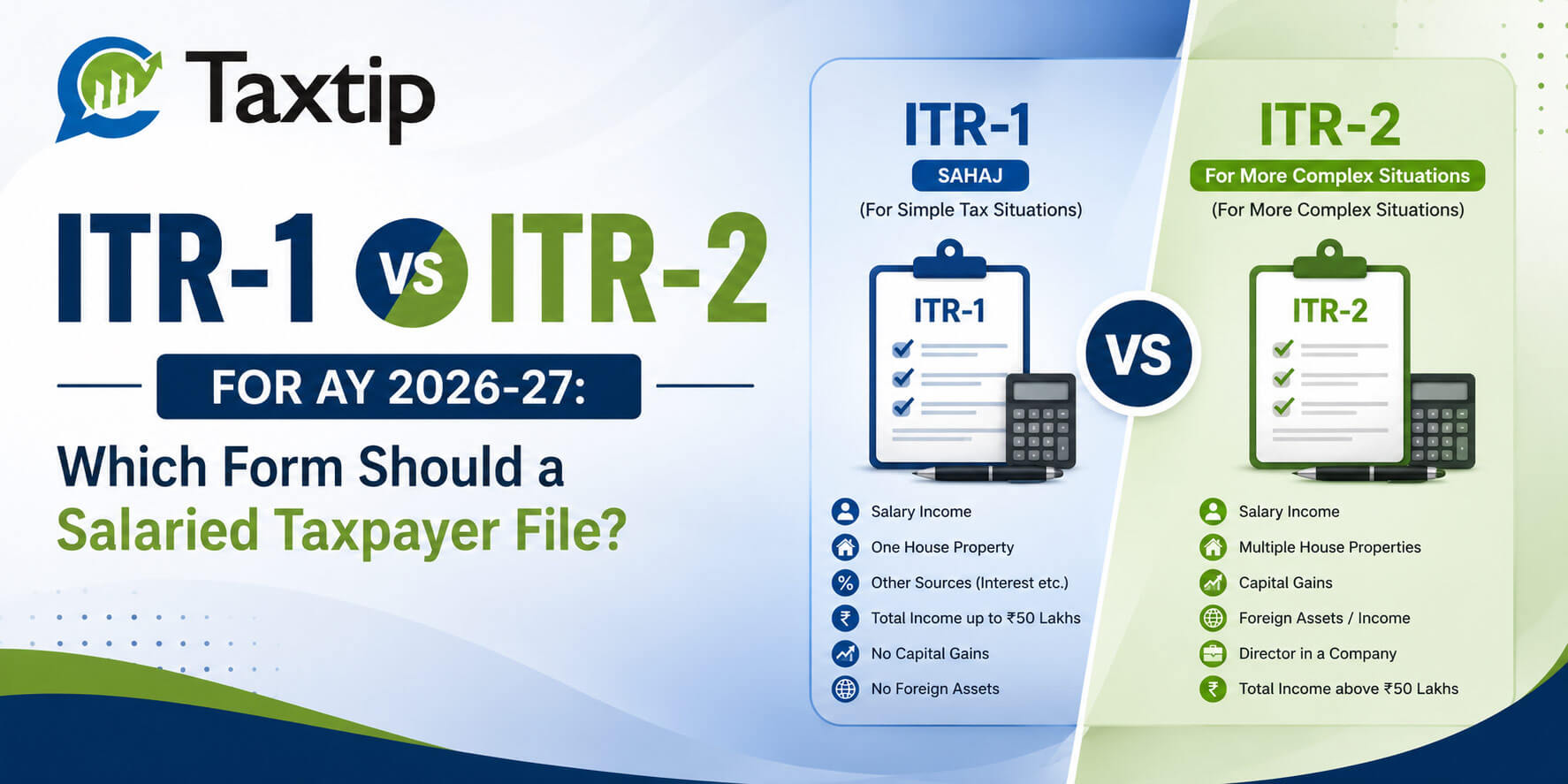
A practical, CA-reviewed comparison to help salaried employees and pensioners pick the correct return form this filing season — before the July 31 deadline.
Quick Answer
If your total income is up to ₹50 lakh and comes only from salary/pension, up to two house properties, bank/FD interest, and long-term capital gains under Section 112A not exceeding ₹1.25 lakh (with no losses to carry forward) — file ITR-1. If you have a third house property, capital gains outside these limits, foreign income or assets, are a company director, hold unlisted equity shares, or have agricultural income above ₹5,000 — file ITR-2.
Filing Deadline for AY 2026-27
For salaried individuals and pensioners filing ITR-1 or ITR-2, the due date for Financial Year 2025-26 (Assessment Year 2026-27) is 31 July 2026. This is the last filing season governed by the Income Tax Act, 1961 — returns for income earned from 1 April 2026 onward will fall under the Income Tax Act, 2025 and won’t be due until 2027.
Consequences of missing 31 July 2026
- A belated return can still be filed up to 31 December 2026, but with a late fee under Section 234F — ₹1,000 if total income is up to ₹5 lakh, ₹5,000 if above.
- Interest @ 1% per month on any unpaid tax under Section 234A.
- Loss of the right to carry forward certain losses (e.g., capital losses, business losses).
- Belated filers cannot opt for the old tax regime for that year.
What is ITR-1 (Sahaj)?
ITR-1, commonly called Sahaj, is the simplest return form, meant for resident individuals (Resident and Ordinarily Resident) with straightforward income. It cannot be used by Non-Resident Indians (NRIs) or Resident-but-Not-Ordinarily-Resident (RNOR) taxpayers, regardless of income level.
Eligibility for ITR-1 (AY 2026-27)
Total income within ₹50 lakh
Gross total income from all eligible heads combined must not exceed ₹50 lakh for the financial year.
Up to two house properties
Self-occupied, rented, or deemed-let-out — income or loss from up to two properties can now be reported directly in ITR-1.
Limited LTCG under Section 112A
Long-term capital gains from listed equity shares or equity mutual funds, capped at ₹1.25 lakh, with no brought-forward or carry-forward capital losses.
Agricultural income up to ₹5,000
Beyond this threshold, the taxpayer must move to ITR-2 even if all other conditions are met.
You cannot use ITR-1 if you are/have:
- A director in any company
- Held unlisted equity shares at any time during the year
- Foreign income, foreign bank accounts, or foreign assets (including financial interest in any entity outside India)
- Income taxed under Section 89A (retirement benefit accounts held abroad)
- Tax deducted under Section 194N (large cash withdrawals)
- Income where tax has been deferred on ESOPs from an eligible start-up
- Income from business or profession, lottery, racehorses, or other gambling activities
- A third house property, or capital gains outside the ITR-1 limits described above
What is ITR-2?
ITR-2 is meant for individuals and Hindu Undivided Families (HUFs) who have income beyond what ITR-1 permits, but who do not have income from business or profession. It has no income ceiling and is used heavily by salaried employees with more complex investment portfolios, multiple properties, or cross-border interests.
Who should file ITR-2
Three or more house properties
Any salaried individual owning three or more properties, regardless of income level, must file ITR-2.
Capital gains beyond ITR-1 limits
Short-term capital gains, gains from property sales, unlisted shares, debt funds, or LTCG under Section 112A exceeding ₹1.25 lakh.
Foreign income or assets
Foreign bank accounts, foreign equity/ESOPs, overseas property, or signing authority in a foreign account (Schedule FA disclosure).
Company directorship
Any individual holding directorship in a company, listed or unlisted, must file ITR-2 (or ITR-3, if there is also business income).
Unlisted equity shares
Holding shares of an unlisted company at any point during the year takes you out of ITR-1, even without a sale.
Income above ₹50 lakh
Even with otherwise simple salary and one house property, crossing ₹50 lakh total income requires ITR-2.
New Changes to ITR-1 for AY 2026-27 NEW
The CBDT notified the ITR forms for AY 2026-27 on 30 March 2026. Two changes meaningfully widen who can now use ITR-1 instead of ITR-2:
Position until AY 2025-26
- Only one house property allowed in ITR-1
- Any capital gain — however small — forced a move to ITR-2
- 28-digit Aadhaar Enrolment ID was accepted as a substitute for Aadhaar number
Position from AY 2026-27
- Up to two house properties can be reported in ITR-1
- LTCG under Section 112A up to ₹1.25 lakh (listed equity/equity mutual funds) is now allowed in ITR-1, provided there are no losses to carry forward
- Only a valid 12-digit Aadhaar number is accepted — enrolment IDs are no longer valid
- Deductions under Sections 80C–80U must be selected from a dropdown specifying the exact sub-section
- The TDS schedule now requires the specific deduction section (e.g., 192, 194A) to be quoted
- Rental income reporting now requires tenant PAN/Aadhaar/TAN details where applicable
Practical effect for existing clients
Several clients who were pushed onto ITR-2 in earlier years purely because of a second house property or a small equity LTCG can legitimately move back to ITR-1 this year. This simplifies filing and pre-fill accuracy, but always re-check the full eligibility list before switching — a single disqualifying item (e.g., unlisted shares or directorship) overrides these relaxations.
ITR-1 vs ITR-2: Side-by-Side Comparison
| Parameter | ITR-1 (Sahaj) | ITR-2 |
|---|---|---|
| Residential status | Resident & Ordinarily Resident only | Resident, RNOR, or Non-Resident |
| Total income ceiling | Up to ₹50 lakh | No ceiling |
| House property income | Up to 2 properties | Any number of properties |
| Capital gains | Only LTCG u/s 112A up to ₹1.25 lakh, no carry-forward losses | All capital gains — STCG, LTCG (any amount), property, unlisted shares, debt funds |
| Business/professional income | Not allowed | Not allowed (use ITR-3/ITR-4 instead) |
| Directorship in a company | Not allowed | Allowed |
| Unlisted equity shares held | Not allowed | Allowed |
| Foreign income/assets | Not allowed | Allowed (Schedule FA applies) |
| Agricultural income | Up to ₹5,000 | Any amount |
| Cash withdrawal TDS (Sec 194N) | Not allowed | Allowed |
| Relative complexity | Simple, largely pre-filled | Detailed schedules (CG, FA, AL, etc.) |
| Due date, AY 2026-27 | 31 July 2026 | 31 July 2026 |
Common Salaried-Taxpayer Scenarios
Salary + one self-occupied house + FD interest, income ₹18 lakh
File ITR-1. Textbook case — all income sources and the total fall well within the permitted limits.
Salary + a self-occupied flat + a second, rented-out flat
File ITR-1 (new for AY 2026-27) — provided total income is within ₹50 lakh and there are no other disqualifying items such as brought-forward losses on the property.
Salary + LTCG of ₹90,000 from equity mutual funds, no other capital losses
File ITR-1 — this LTCG falls within the new ₹1.25 lakh cap under Section 112A.
Salary + LTCG of ₹2.4 lakh from equity, or any short-term capital gains
File ITR-2 — the LTCG exceeds the ₹1.25 lakh ceiling, and STCG of any amount is outside ITR-1’s scope entirely.
Salaried employee who is also an independent director on a company board
File ITR-2, even if all other income is simple salary and bank interest — directorship alone disqualifies ITR-1.
Salary + ESOPs of a foreign parent company held/vested abroad
File ITR-2 — foreign asset holding requires Schedule FA disclosure, which ITR-1 does not support.
What Happens If You File the Wrong Form?
Filing income tax returns in the wrong form is treated by the Department as a defective return under Section 139(9). Practically, this plays out as follows:
Risks of an incorrect ITR form
- The Department issues a defective-return notice, typically giving 15 days to correct and refile.
- If not rectified within the allowed time (or an extension isn’t granted), the return can be treated as if it was never filed — reviving Section 234F penalty exposure and interest.
- Refunds get delayed pending correction.
- Disclosures like foreign assets or directorship, if omitted because the wrong (simpler) form was used, can separately expose the taxpayer to scrutiny and penalty under the Black Money Act, where applicable — this is a matter we increasingly see raised in assessment and appellate proceedings.
Where a return has already been filed on the wrong form and the error is discovered afterward, a revised return under Section 139(5) can be filed up to 31 March 2027 for AY 2026-27, correcting the form and the disclosures together.
Common Questions
I filed ITR-2 last year only because of a second house property. Can I switch to ITR-1 this year?
Yes. If the second house property or a small Section 112A LTCG (up to ₹1.25 lakh) was the only reason you were on ITR-2, both are now accommodated in ITR-1 for AY 2026-27, provided every other eligibility condition is met.
Can I file ITR-1 without Form 16?
Yes. Salary slips, Form 26AS, and the Annual Information Statement (AIS) can be used to reconstruct salary and TDS details if Form 16 is delayed or unavailable, though it is always advisable to reconcile with Form 16 once issued.
Does holding a single house property jointly with a spouse affect the choice of form?
Practice on this point is not entirely uniform across guidance materials, and it is a frequent source of defective-return notices. We recommend clients confirm their specific fact pattern with us before filing rather than relying on generic portals, particularly where co-ownership involves unequal shares or a home loan split between owners.
I have a Section 87A rebate claim under the new regime — does that change which form I use?
No. The Section 87A rebate is a tax-computation matter within whichever form applies based on your income sources; it does not itself alter ITR-1 vs ITR-2 eligibility.
What if my income sources change mid-year — say, I start holding unlisted ESOPs in December?
Eligibility is tested for the entire financial year. Holding unlisted equity shares at any point during FY 2025-26 rules out ITR-1 for the whole year, even if the shares were acquired late in the year.