
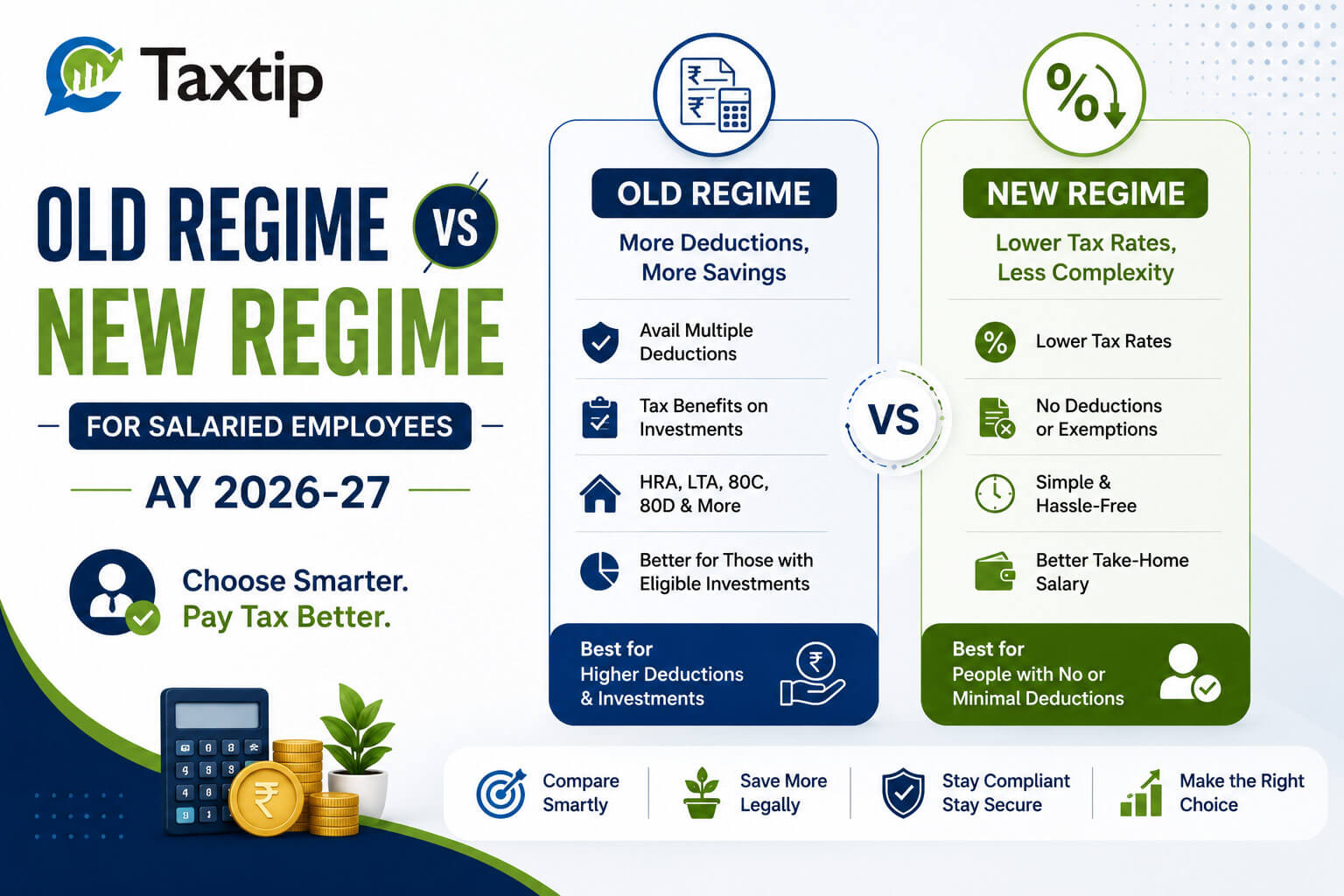
Slab rates, standard deduction, Section 87A rebate, deductions, and a practical decision framework for salaried employees and pensioners filing for FY 2025-26.
Quick Answer
The New Tax Regime is the default for AY 2026-27 and generally works better for salaried employees with few deductions — it now makes taxable income up to ₹12 lakh effectively tax-free (up to roughly ₹12.75 lakh gross salary, after the ₹75,000 standard deduction). The Old Regime still wins for employees with large deduction claims — typically a home loan on a self-occupied property, full Section 80C investments, health insurance, and House Rent Allowance — where combined deductions exceed roughly ₹4–4.5 lakh. There is no one-size-fits-all answer; it depends entirely on each employee’s actual numbers.
New Regime Slab Rates — AY 2026-27
Budget 2026 made no changes to the slab structure introduced in Budget 2025 — these rates continue unchanged for FY 2025-26 (AY 2026-27). The New Tax Regime applies uniformly to all individuals regardless of age; there is no higher exemption limit for senior or super-senior citizens.
| Taxable Income Slab | Rate |
|---|---|
| ₹0 – ₹4,00,000 | Nil |
| ₹4,00,001 – ₹8,00,000 | 5% |
| ₹8,00,001 – ₹12,00,000 | 10% |
| ₹12,00,001 – ₹16,00,000 | 15% |
| ₹16,00,001 – ₹20,00,000 | 20% |
| ₹20,00,001 – ₹24,00,000 | 25% |
| Above ₹24,00,000 | 30% |
Add 4% Health & Education Cess on the tax so computed. A standard deduction of ₹75,000 applies to salary and pension income before these slabs are applied.
Old Regime Slab Rates — AY 2026-27
The Old Regime retains its long-standing slab structure and, unlike the new regime, offers higher basic exemption limits for senior citizens.
| Taxable Income Slab | Individuals < 60 yrs | Senior Citizens (60–79 yrs) | Super Senior (80+ yrs) |
|---|---|---|---|
| Up to ₹2,50,000 | Nil | Nil | Nil |
| ₹2,50,001 – ₹3,00,000 | 5% | Nil | Nil |
| ₹3,00,001 – ₹5,00,000 | 5% | 5% | Nil |
| ₹5,00,001 – ₹10,00,000 | 20% | 20% | 20% |
| Above ₹10,00,000 | 30% | 30% | 30% |
Add 4% Health & Education Cess. A standard deduction of ₹50,000 applies to salary and pension income, along with the full range of deductions and exemptions discussed below.
Deductions & Exemptions Available
This is where the two regimes diverge most sharply — the old regime’s higher slab rates are offset (often more than offset) by deductions that the new regime largely does not permit.
Available Under Old Regime
- Standard deduction — ₹50,000
- Section 80C — up to ₹1.5 lakh (PPF, ELSS, life insurance, principal repayment of home loan, etc.)
- Section 80D — health insurance premium (₹25,000/₹50,000 depending on age)
- Section 80CCD(1B) — additional ₹50,000 for NPS contribution
- Section 24(b) — home loan interest on self-occupied property, up to ₹2 lakh
- House Rent Allowance (HRA) exemption
- Leave Travel Allowance (LTA) exemption
- Professional tax deduction
- Section 80TTA/80TTB — savings account/senior citizen interest deduction
- Section 80G — donations to eligible funds and institutions
Available Under New Regime
- Standard deduction — ₹75,000
- Section 80CCD(2) — employer’s contribution to NPS (up to prescribed limits)
- Deduction for family pension (₹25,000 or one-third, whichever is lower)
- Agniveer Corpus Fund contribution under Section 80CCH
- Interest on home loan for a let-out property (against rental income only — not for self-occupied property)
Section 80C, 80D, HRA, LTA, and self-occupied home loan interest are not available under the new regime.
Where this typically matters most
Employees paying rent and claiming HRA, those servicing a home loan on a self-occupied house, and those making full use of Section 80C and 80D limits are the ones most likely to find the old regime more favourable despite its higher slab rates. Employees with minimal investments or deductions, or those in metro cities without a housing loan, generally do better under the new regime.
Section 87A Rebate
Old Regime
- Rebate up to ₹12,500
- Applicable where taxable income does not exceed ₹5,00,000
- Effectively makes tax nil up to ₹5 lakh taxable income
New Regime
- Rebate up to ₹60,000
- Applicable where taxable income does not exceed ₹12,00,000
- Effectively makes tax nil up to ₹12 lakh taxable income (about ₹12.75 lakh gross salary after standard deduction)
- Does not apply to income taxed at special rates (e.g., certain capital gains)
The rebate is a cliff, not a slope
Once taxable income exceeds ₹12,00,000 (new regime) or ₹5,00,000 (old regime) even marginally, the rebate is lost entirely and tax is computed on the full slab structure from the first rupee — though marginal relief provisions cushion the jump immediately around the threshold. This is a common area for computation errors and worth double-checking on borderline cases.
Surcharge & Cess
| Total Income | Surcharge — Old Regime | Surcharge — New Regime |
|---|---|---|
| Above ₹50 lakh, up to ₹1 crore | 10% | 10% |
| Above ₹1 crore, up to ₹2 crore | 15% | 15% |
| Above ₹2 crore, up to ₹5 crore | 25% | 25% |
| Above ₹5 crore | 37% | Capped at 25% |
Health & Education Cess of 4% applies on the tax-plus-surcharge amount under both regimes. Marginal relief provisions ensure the surcharge does not consume more than the income exceeding each threshold. For very high earners, the new regime’s surcharge cap at 25% (versus 37% under the old regime) is a significant additional consideration beyond the slab comparison.
Default Regime & Switching Rules
New Regime is the default
Under Section 115BAC, the new regime applies automatically unless the taxpayer actively opts out while filing the return.
Salaried employees can switch every year
An employee with only salary income (no business or professional income) can choose between the old and new regime afresh each year at the time of filing the return — there is no restriction on switching back and forth.
Inform the employer for correct TDS
Employees should intimate their chosen regime to the employer at the start of the year (or when required) so that TDS on salary under Section 192 is deducted correctly through the year. The final choice can still be changed at the time of filing the return, subject to any true-up in tax liability.
Business/professional income taxpayers face restrictions
Those with business or professional income who opt out of the new regime can generally switch back to it only once in their lifetime — this restriction does not apply to salaried individuals without business income.
Breakeven: When the Old Regime Still Wins
As a working rule of thumb — to be verified against each client’s actual figures rather than applied mechanically — the old regime tends to overtake the new regime once total eligible deductions (standard deduction, 80C, 80D, home loan interest, HRA, NPS 80CCD(1B), etc.) cross approximately ₹4 lakh to ₹4.5 lakh, depending on the income level. Employees close to this range should have both computations run side by side before deciding.
Home loan + HRA + 80C
An employee claiming ₹2 lakh home loan interest, ₹1.5 lakh under 80C, and a meaningful HRA exemption will very often be better off under the old regime.
Minimal deductions
An employee with no home loan, no HRA claim, and only modest 80C investments will almost always do better under the new regime’s lower rates and higher rebate ceiling.
Senior citizens with passive income
Senior citizens relying on interest income and the higher old-regime exemption limits (₹3 lakh/₹5 lakh) should specifically compare both regimes — the age-based exemption is unavailable under the new regime.
Worked Examples
| Case | Gross Salary | Old Regime Tax (approx.) | New Regime Tax (approx.) | Better Option |
|---|---|---|---|---|
| No HRA/home loan, minimal 80C | ₹12,00,000 | ~₹1,45,600 | Nil (rebate) | New Regime |
| Home loan interest ₹2L + 80C ₹1.5L + 80D ₹25k | ₹15,00,000 | ~₹1,47,160 | ~₹97,500 (post standard deduction) | Depends — run both |
| High HRA city rent + full 80C/80D/NPS | ₹18,00,000 | Often lower after full deductions | Higher without deductions | Old Regime (typically) |
Figures are illustrative and rounded for comparison purposes only. Actual tax liability depends on the complete computation, including cess, applicable surcharge, and the precise deduction amounts substantiated with documentation. Always run a full computation before advising a client either way.
Common Questions
Can a salaried employee choose the old regime only for one year and switch back next year?
Yes. For individuals with salary income only (no business or professional income), the choice can be made afresh every year at the time of filing the return, with no restriction on how often it is changed.
If my employer deducted TDS assuming the new regime, can I still opt for the old regime while filing my return?
Yes. The regime chosen for TDS purposes during the year is not binding — the final regime is selected at the time of filing the ITR, and any resulting difference in tax liability is settled through self-assessment tax or a refund.
Does the new regime allow any deduction for a home loan at all?
Only for a let-out (rented) property, where interest can be set off against the rental income received. Interest on a home loan for a self-occupied property is not deductible under the new regime.
Is HRA available under the new regime?
No. HRA exemption under Section 10(13A) is available only under the old regime.
Do senior citizens get any special benefit under the new regime?
No age-based higher exemption limit applies under the new regime — the ₹4 lakh nil-tax threshold is the same for all individuals regardless of age. The higher exemption limits (₹3 lakh for 60–79 years, ₹5 lakh for 80+ years) are available only under the old regime.