
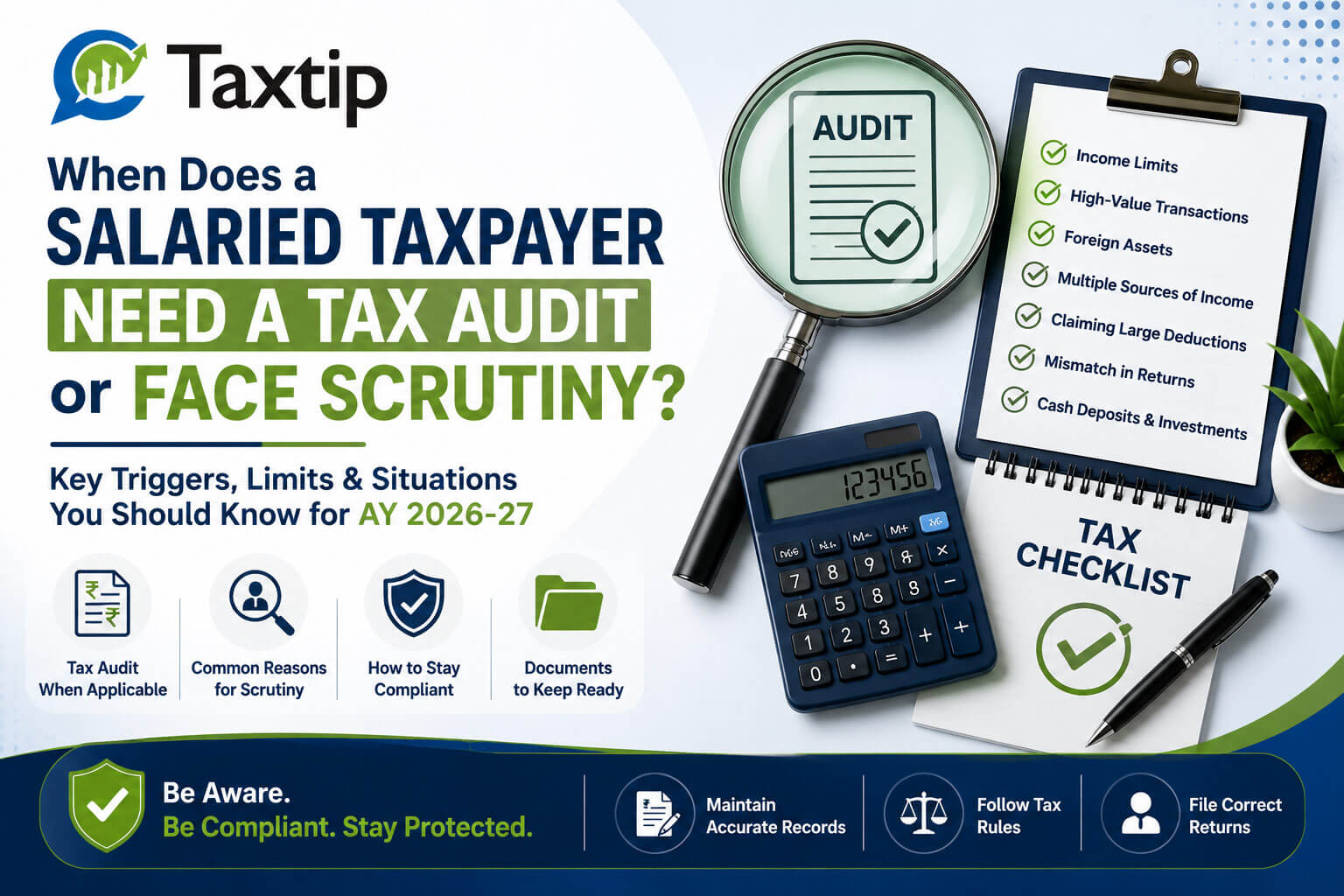
Two different questions salaried employees often confuse — Section 44AB audit applicability, and the common post-filing scrutiny triggers under CASS for AY 2026-27.
Quick Answer: Two Different Questions
Tax audit (Section 44AB) is almost never triggered by salary income alone — it applies only when a salaried person also has business or professional income above prescribed thresholds, most commonly through F&O or intraday trading. Scrutiny (Section 143(2)) is a separate, post-filing process where the return itself — regardless of audit status — is picked up for detailed examination, usually because of a data mismatch against AIS/Form 26AS or a red flag under the department’s risk-based CASS system. A taxpayer can face scrutiny without ever needing a tax audit, and vice versa.
Tax Audit — Does It Ever Apply to a Salaried Person?
A pure salaried employee with no other income never needs a tax audit — salary is not a business or professional receipt, and Section 44AB simply does not apply to it. The question arises only when the same individual also has business or professional income — most often a side consultancy, freelance work, or trading activity — on top of their salary.
| Category | Audit Threshold | Enhanced Threshold |
|---|---|---|
| Business (general) | Turnover exceeds ₹1 crore | ₹10 crore, if cash receipts and cash payments are each ≤5% of total |
| Profession (consultancy, freelancing, etc.) | Gross receipts exceed ₹75 lakh | No enhanced digital threshold available for professionals |
| Presumptive scheme opt-out (Sec 44AD/44ADA) | Audit mandatory if profit declared is below the presumptive rate and total income exceeds the basic exemption limit | Applies regardless of turnover |
| Section 44AD 5-year lock-in exit | Audit mandatory if presumptive scheme was opted in any of the preceding 5 years and is now exited by declaring lower profit | — |
The Most Common Trigger: F&O and Intraday Trading HIGH RISK
By far the most frequent way an otherwise straightforward salaried client ends up needing a tax audit is through derivatives trading. This is also the single most common area of confusion and error we see in salaried clients’ returns.
F&O is business income, not capital gains
Futures & Options trading on a recognised exchange is treated as non-speculative business income under Section 43(5), reported in Schedule BP of ITR-3 — not as capital gains in Schedule CG.
Intraday equity is speculative
Intraday (non-delivery) equity trades fall under speculative business income — a distinct category with its own loss set-off rules, separate from F&O.
Turnover ≠ contract value
Turnover for audit purposes is the absolute sum of profits and losses on each trade, plus option premium received on sale — not the notional value of contracts traded. Getting this wrong is the most common client-side error.
The trap most salaried F&O traders fall into
A salaried employee with a modest F&O turnover (well under ₹1 crore) can still be forced into a mandatory audit if they declare a loss or low profit while their total income (salary + other heads) exceeds the basic exemption limit, and they either previously opted for the Section 44AD presumptive scheme or are now declaring profit below the presumptive rate. Many first-time traders discover this only after filing, when the return is treated as defective for missing an audit report.
Filing ITR-3 without the mandatory Balance Sheet, Profit & Loss account, or audit report (where applicable) results in a defective return notice under Section 139(9). Wrongly filing ITR-2 instead of ITR-3 for F&O income is an equally common error that produces the same result.
Tax Audit Deadlines & Penalty for AY 2026-27
Audit report (Form 3CB-3CD) due 30 September 2026
The tax audit report must be filed by a practising Chartered Accountant before the ITR itself can be validly submitted.
ITR due 31 October 2026 for audit cases
Taxpayers requiring a tax audit get an extended filing deadline compared to the 31 July date for pure salaried filers.
Penalty for non-compliance — Section 271B
The lower of ₹1.5 lakh or 0.5% of turnover, if an audit that was required is not obtained and the report not furnished in time — waivable only on demonstrated reasonable cause.
Scrutiny — CASS and Section 143(2)
Once a return is filed, it passes through several layers of automated checks before — in a small minority of cases — being selected for detailed scrutiny under Section 143(2). Selection today is overwhelmingly driven by the Computer Assisted Scrutiny Selection (CASS) system, which uses risk-based parameters and data analytics rather than manual, subjective selection.
Section 143(1)(a) — automated intimation
A preliminary, automated check comparing your return against AIS/26AS data, which may propose an adjustment. This is the first and most common level of departmental response — answerable, not adversarial.
e-Verification Scheme
For lower-grade mismatches, the department invites an explanation or an updated return before formal scrutiny proceedings begin — a chance to correct course early.
Section 143(2) — formal scrutiny
A detailed examination of the return, conducted almost entirely through the Faceless Assessment Scheme under Section 144B — no physical interaction, all communication via the e-Proceedings tab with a Document Identification Number (DIN).
Common Post-Filing Triggers for Salaried Taxpayers
| Trigger | Why It Gets Flagged |
|---|---|
| Interest, dividend, or capital gains not reported | Banks, RTAs, and brokers report these to AIS regardless of whether the taxpayer includes them — the single most common trigger, easy to miss on savings/FD interest and small equity gains |
| HRA claimed without matching rent data | High HRA exemption claims are increasingly cross-checked against landlord PAN disclosures and rent receipts, especially where the landlord doesn’t report matching rental income |
| Large or unusual deductions | Chapter VI-A claims (80C, 80D, etc.) that are disproportionate to income, or round-figure claims without supporting proof, draw automated attention |
| High-value transactions reported via SFT | Cash deposits aggregating ₹10 lakh+ in savings accounts, ₹50 lakh+ in current accounts, property transactions of ₹30 lakh+, and share/mutual fund/bond purchases of ₹10 lakh+ all land in AIS whether or not the underlying income is reported |
| Refund claim disproportionate to income profile | Large refund claims relative to declared income and TDS pattern are a standard risk parameter |
| Undisclosed foreign assets or income | Automatic exchange of information agreements mean foreign bank accounts, ESOPs, or property are increasingly visible to the department independent of self-disclosure |
| Multiple employers, income not aggregated | Job changes during the year where previous employer income wasn’t declared to the new employer often produce a salary-vs-TDS mismatch across Form 16s |
| Recurring issue from an earlier year | Where an addition made in a prior assessment has become final, the same issue recurring in the current year is a recognised trigger for compulsory selection |
The department often already has the figures
By the time a return is filed, AIS typically already reflects most third-party-reported income. A return that reconciles cleanly to what AIS/26AS already shows is the single most effective way to reduce scrutiny exposure — this is worth checking as a matter of routine before every filing, not just when something feels unusual.
Limited vs Complete Scrutiny
Limited Scrutiny
- Confined to a specific, identified mismatch or issue — e.g., a salary-vs-TDS difference or an unverified deduction claim
- The Assessing Officer generally cannot expand scope beyond the identified issue without separate authorisation
- Most salaried-taxpayer scrutiny falls in this category
Complete Scrutiny
- A full examination of the entire return, not limited to one issue
- Triggered by specific parameters set annually by CBDT — search/survey cases, recurring additions, or law-enforcement intelligence on tax evasion
- Far less common for straightforward salaried profiles without business income
Notice Timelines to Know
| Stage | Timeline |
|---|---|
| Section 143(2) scrutiny notice | Must be served within 3 months from the end of the financial year in which the return was furnished |
| Assessment order under Section 143(3) | Generally to be passed within 12 months from the end of the relevant assessment year |
| Response to a Section 143(1)(a) proposed adjustment | Within the window stated in the intimation — typically 30 days |
| Updated return, Section 139(8A) | Available up to 48 months from the end of the relevant assessment year, with additional tax, to correct a genuine omission before it escalates |
If You Receive a Notice: First Steps
Verify the notice is genuine
Confirm it carries a valid Document Identification Number (DIN), verifiable on the income tax e-filing portal. Notices without a valid DIN are, with very limited exceptions, not valid.
Identify exactly what is being questioned
Read the notice carefully — is it a 143(1)(a) automated adjustment, an e-Verification query, or a formal 143(2) scrutiny notice? Each calls for a different response track and timeline.
Gather source documents, not summaries
Bank statements, contract notes, TDS certificates, investment proofs, and rent receipts — not just an Excel working — since the Assessing Officer’s view treats summaries as claims to be verified, not evidence in themselves.
Respond within the stated window
Timely, complete responses resolve the large majority of mismatches without escalation. Missed deadlines are what convert a routine query into a more serious proceeding.
Get professional representation for anything beyond a simple mismatch
Once a matter moves to formal scrutiny or involves a disputed addition, professional representation protects your position far better than a self-drafted response — this is where we’d typically step in for clients.
Common Questions
I have a small F&O loss this year. Do I definitely need an audit?
Not necessarily — it depends on your turnover, your total income, and whether you’ve used the presumptive scheme in the past five years. This is genuinely fact-specific and should be evaluated individually rather than assumed either way.
Does claiming a large refund automatically trigger scrutiny?
Not automatically, but a refund that looks disproportionate to your income and TDS pattern is one of several risk parameters the system weighs — it is a contributing factor, not a standalone trigger in isolation.
If I receive a Section 143(1)(a) intimation, is that the same as scrutiny?
No. It is an earlier, automated stage proposing an adjustment based on data mismatches. Responding accurately and promptly at this stage is usually enough to close the matter without it escalating to formal Section 143(2) scrutiny.
Can I revise my return if scrutiny has already started on a specific issue?
Generally, a return cannot be revised for the specific issues under active scrutiny. This is exactly the kind of situation where professional advice before responding matters — the available options depend on the stage and nature of the proceeding.
Does having a tax audit automatically increase scrutiny risk?
Not directly — audit and scrutiny are governed by different provisions and different triggers. That said, a case involving business income (which is what typically brings audit into play) does tend to carry a somewhat more detailed data footprint than pure salary, simply because there is more to reconcile.