
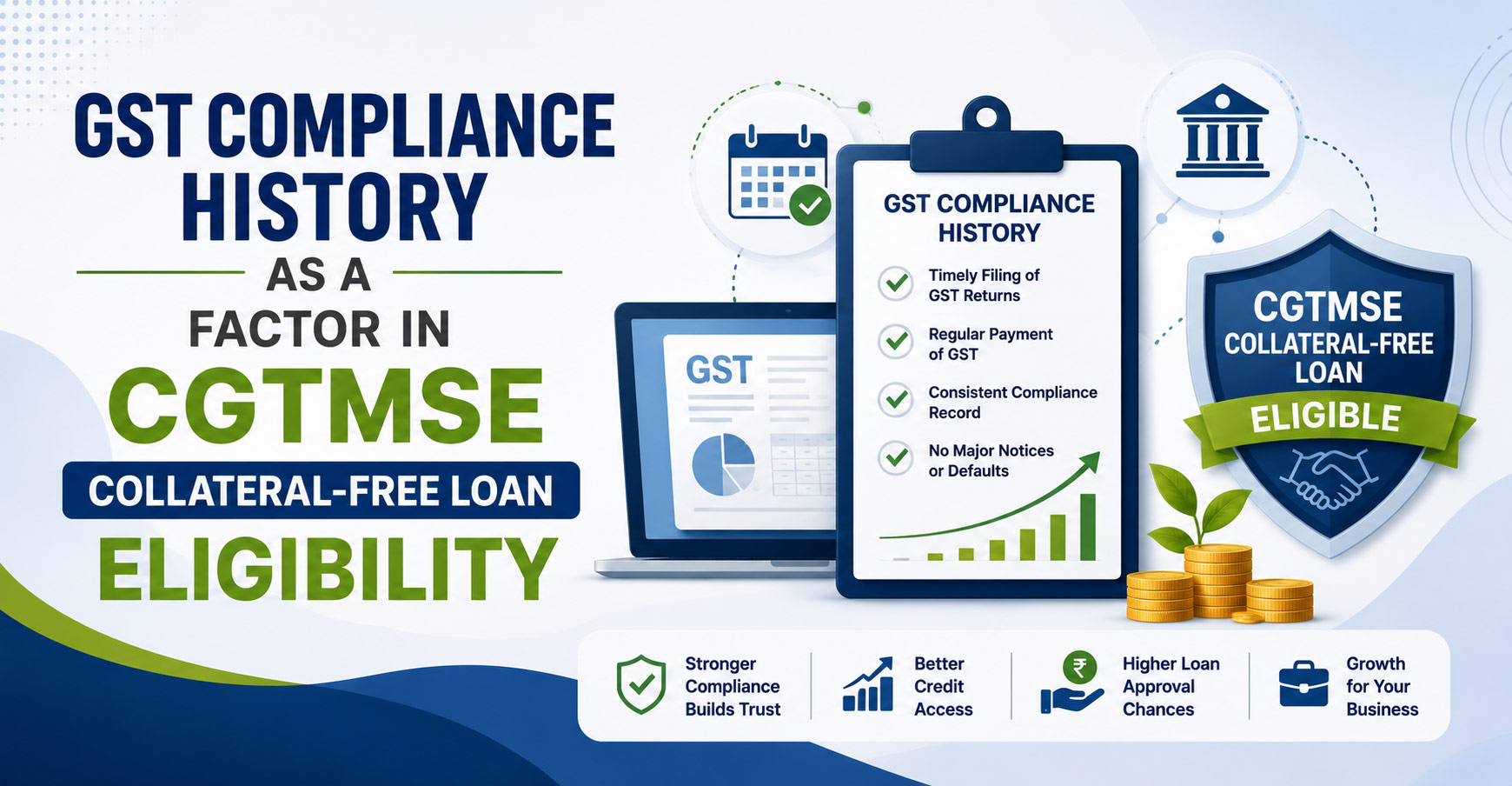
CGTMSE removes the need to pledge property — it does not remove underwriting rigour. With no collateral cushion to fall back on if a loan turns bad, lenders lean harder on exactly the kind of independently verifiable data GST returns provide. Here’s how compliance history shapes CGTMSE outcomes in practice.
What CGTMSE Actually Is — And Isn’t
The Credit Guarantee Fund Trust for Micro and Small Enterprises (CGTMSE), set up jointly by the Ministry of MSME and SIDBI, is a credit guarantee mechanism — not a direct lender. A business doesn’t apply to CGTMSE for a loan; it applies to a bank or NBFC that is a registered Member Lending Institution (MLI), and if the loan is sanctioned, the MLI separately seeks guarantee cover from CGTMSE. The guarantee — typically in the range of 75% to 85% of the amount in default, and up to ₹10 crore of exposure under the current framework — only becomes relevant if the borrower actually defaults.
In one line: CGTMSE changes who absorbs the loss if a loan goes bad — it does not change how carefully the lender assesses the borrower before sanctioning it. If anything, the absence of collateral makes the underlying credit data work harder.
Why GST History Matters More, Not Less, Without Collateral
In a conventional secured loan, if a borrower’s cash flow story turns out to be weaker than represented, the bank still has a mortgaged asset to fall back on. In a CGTMSE-backed facility, there is no such asset — only the CGTMSE guarantee, which covers a portion of the loss after the fact and does not compensate for a bad initial credit decision. This is precisely why lenders scrutinise cash-flow-based, independently verifiable data more intensely for collateral-free facilities, and GST returns sit at the center of that scrutiny.
As covered in our companion piece on how lenders read GST returns generally, banks now triangulate GST-declared turnover against bank credits and ITR income as a matter of course. For CGTMSE applications specifically, this triangulation isn’t just one input among many — it functions as the substitute for the collateral cushion that’s absent from the structure.
Independent verification
Unlike self-prepared projections, GST returns are filed with the government and cross-checked against supplier filings — making them harder to manipulate convincingly than internal financial statements alone.
Genuine turnover stability
Without collateral to fall back on, lenders need confidence that declared turnover reflects a real, sustainable trading pattern — not a one-time spike engineered ahead of a loan application.
Repayment capacity proxy
Consistent GST filing and tax payment discipline function as an early, low-cost proxy for how disciplined a business will be about servicing a new loan obligation.
Eligibility Basics
| Criterion | Requirement |
|---|---|
| Business classification | Micro or Small Enterprise under the MSMED Act — manufacturing investment up to ₹10 crore, services up to ₹5 crore; Medium enterprises fall outside the standard CGTMSE guarantee |
| Udyam Registration | Mandatory — there is no CGTMSE guarantee eligibility without a valid Udyam Registration Certificate |
| Eligible sectors | Manufacturing, services, and retail trade; agriculture and educational institutions are generally excluded |
| Entity type | Proprietorships, partnerships, private limited companies, and LLPs are all eligible, whether new (greenfield) or existing units |
| Lending channel | Only through a CGTMSE-registered Member Lending Institution — a bank, NBFC, or eligible financial institution |
| Guarantee coverage | Typically 75-85% (up to 90% for certain categories), capped at ₹10 crore of guaranteed exposure |
Standard documentation for a CGTMSE-backed proposal includes Udyam Registration, KYC, GST registration and returns, ITR and audited financials (where applicable), 12 months of bank statements, and CMA data or a detailed project report — the same core file used for any working capital or term loan appraisal, just without a collateral valuation report attached.
Where GST Data Enters the CGTMSE Decision
Vintage and filing history as a threshold check
Lenders — particularly on the NBFC route — commonly look for a minimum of 6-12 months of GST filing history as a baseline signal of an operating, formalised business, even for otherwise newer entities that lack a longer track record.
Turnover verification against the proposed facility size
GST-declared turnover is used to sanity-check whether the requested loan quantum is proportionate to the actual scale of business activity — a mismatch here is one of the fastest ways a proposal gets right-sized downward before it reaches sanction.
Consistency with CMA data and the business plan
Where a CA has prepared CMA data or a project report projecting future turnover, that projection is tested against actual historical GST filings — an ambitious projection unsupported by GST history invites additional scrutiny rather than confidence.
Filing discipline as a qualitative risk marker
Beyond the numbers themselves, how consistently and timely GST returns have been filed feeds into the lender’s broader read on management discipline — a factor that matters even more where no collateral exists to discipline the relationship after disbursement.
Risk Category, Guarantee Fee & Compliance
The Annual Guarantee Fee (AGF) that a borrower ultimately bears under CGTMSE is charged on the outstanding loan amount and varies with tenure and risk structuring. While the fee itself is governed by CGTMSE’s own fee schedule rather than a GST-specific formula, the underlying risk assessment that determines facility structuring, pricing, and sanctioned quantum at the lender’s end is directly shaped by the same turnover-stability and compliance-discipline signals GST data provides.
The practical takeaway
A borrower with clean, consistent GST filings and a turnover history that credibly supports the loan quantum requested is likely to see a smoother, faster sanction process and a facility structured closer to what was actually requested — even though CGTMSE coverage percentages themselves are formula-driven and not directly tied to a GST compliance score.
Common Rejection Reasons Tied to GST Data
Even though CGTMSE loans are structurally collateral-free, banks continue to apply strict credit assessment — and a meaningful share of otherwise-genuine businesses get rejected or delayed not because they’re ineligible in principle, but because their documentation doesn’t hold together.
Turnover mismatch across documents
GST-declared turnover, ITR income, and CMA data projections that don’t reconcile with each other are among the most common triggers for delay or downsizing of the sanctioned amount.
Insufficient GST filing history
Businesses without a credible filing track record — particularly newer entities — often need to compensate with a stronger project report and, where available, alternative transaction history, to meet lender comfort levels.
Incomplete or inconsistent documentation
Missing GST returns for part of the required period, or filings that don’t align with bank statement patterns, are flagged as structural weaknesses in the proposal rather than minor paperwork gaps.
A CA’s CGTMSE-Readiness Checklist
- Confirm valid, active Udyam Registration is in place before initiating any CGTMSE-backed loan discussion
- Compile GST returns for the full period the lender is likely to request — typically the last 1-2 years, or the full operating history for newer entities
- Reconcile GST-declared turnover against bank credits and ITR income before submission, and prepare documented explanations for any variance
- Ensure CMA data and business plan projections are anchored to actual historical GST turnover trends, not detached from them
- Review the GST filing history for gaps, late filings, or nil returns, and be ready to explain any irregularity with genuine business context
- Size the loan request proportionately to what the GST turnover history can credibly support — an oversized ask against thin GST history invites downsizing or rejection
- Confirm sector eligibility and business classification (Micro/Small) align with both Udyam registration and the CGTMSE guarantee structure being sought
- Assemble the complete standard file — KYC, Udyam, GST returns, ITR, bank statements, financials, and project report — before approaching the Member Lending Institution, rather than submitting incrementally
Quick FAQs
Does CGTMSE itself check GST compliance directly?
CGTMSE provides guarantee cover based on the lender’s sanction — it does not independently underwrite the borrower. GST compliance history is assessed by the Member Lending Institution (the bank or NBFC) as part of its own credit appraisal before the loan is even proposed for CGTMSE coverage.
Can a business with less than a year of GST filing history still qualify?
Yes, particularly through the NBFC lending route, where 6-12 months of GST filing or verifiable transaction history can be sufficient — though bank-based CGTMSE lending typically expects a longer operational track record.
Does strong GST compliance reduce the guarantee fee under CGTMSE?
The Annual Guarantee Fee follows CGTMSE’s own fee schedule based on loan amount, tenure, and category rather than a direct GST compliance score. However, strong GST-backed credit data improves the underlying loan approval, sizing, and terms set by the lender itself.
What if our GST turnover doesn’t fully match our audited financials?
Minor differences from timing, exempt supplies, or non-GST income are normal and explainable. Significant, undocumented gaps are treated as a red flag and should be reconciled and clearly explained in the loan proposal before submission, not left for the lender to question.