
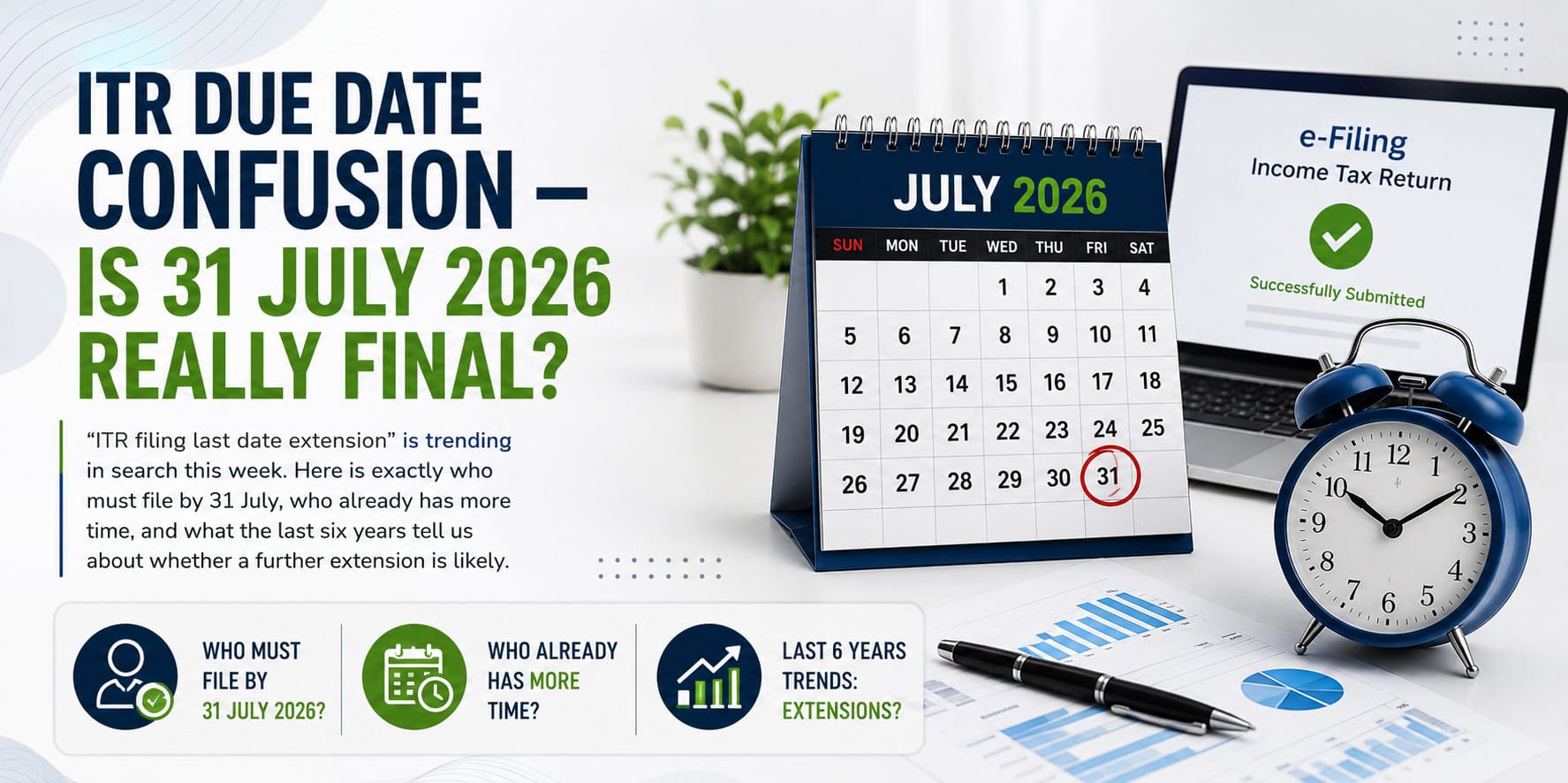
“ITR filing last date extension” is trending in search this week. Here is exactly who must file by 31 July, who already has more time, and what the last six years tell us about whether a further extension is likely.
Why There’s Confusion This Year
Every year around this time, search interest in “ITR due date extended” spikes — and this year is no exception. On the morning of 28 July 2026, phrases like “ITR filing last date extension” and “ITR due date extension” registered as breakout searches on Google Trends, even though the Income Tax Department has not issued any notification extending the 31 July 2026 deadline.
Part of the confusion comes from the fact that AY 2026-27 is a transition year. The Income Tax Act, 2025 came into force from 1 April 2026, but income earned in FY 2025-26 is still governed entirely by the old Income Tax Act, 1961 — so this is effectively the last filing season under the familiar 1961 framework. At the same time, the Department has already staggered due dates by ITR form this year, which is a departure from the single-deadline approach of earlier years and adds to the sense that “something has changed.”
Actual Due Dates by Category — AY 2026-27
Unlike in earlier years, there is no single “ITR due date” this year. The date that applies to you depends on which ITR form you use and whether your accounts require an audit.
| Taxpayer Category | Applicable Form | Due Date | Status |
|---|---|---|---|
| Salaried individuals, pensioners, simple capital gains cases | ITR-1 / ITR-2 | 31 July 2026 | Deadline in 3 days |
| Business / profession income — no tax audit required | ITR-3 / ITR-4 | 31 August 2026 | Already extended |
| Businesses, professionals & companies requiring tax audit | ITR-3 / ITR-5 / ITR-6 | 31 October 2026 | Standard |
| Taxpayers required to furnish a transfer pricing report | ITR-3 / ITR-6 | 30 November 2026 | Standard |
| Belated / late return (any category) | Applicable form | 31 December 2026 | Late fee applies |
| Revised return (any category) | Applicable form | 31 March 2027 | Extended window |
The key point: the “31 July” deadline that is trending in search only applies to ITR-1 and ITR-2 filers. Non-audit business and professional taxpayers filing ITR-3/ITR-4 already have until 31 August 2026 — the Department effectively pre-empted part of the usual extension demand by building the extra month in from the start.
Current Status: Is 31 July Extended?
As of 27–28 July 2026, no extension has been notified
- The CBDT has not issued any circular or press release extending the 31 July 2026 deadline for ITR-1 and ITR-2 filers.
- Filing volumes suggest most eligible taxpayers under these two forms have already filed, which reduces (but does not eliminate) the pressure for a last-minute extension.
- Taxpayers should proceed on the assumption that 31 July 2026 is the operative date unless an official notification says otherwise.
Practically speaking, this means interest under Section 234A will begin accruing from 1 August 2026 on any unpaid self-assessment tax for ITR-1/ITR-2 filers who have not filed by the deadline, and a late return filed after 31 July will attract fees under Section 234F, unless a fresh notification is issued before the date passes.
Extension History — What the Last Six Years Show
The recurring “will it be extended” question isn’t irrational — it’s grounded in recent precedent. The Department has extended the individual ITR deadline in five of the last six assessment years, most recently for AY 2025-26, when the original 31 July 2025 date was pushed to 15 September 2025 because of extensive changes to the ITR forms and delays in TDS credit reflecting in Form 26AS. That deadline was then pushed by one further day after taxpayers reported technical glitches on the e-filing portal in the final stretch.
Arguments for another extension
- Extensions have happened in 5 of the last 6 years — taxpayers have come to expect it.
- Portal load traditionally spikes hardest in the final 48–72 hours before a deadline.
- First filing season straddling the transition to the Income Tax Act, 2025 has created general compliance uncertainty.
Arguments against an extension this year
- The Department has already granted a staggered extra month to non-audit business/professional filers (ITR-3/ITR-4), addressing the group most likely to need extra time.
- A very large share of ITR-1/ITR-2 filers have already filed and verified their returns well ahead of the date.
- ITR forms and utilities were not subject to the kind of late-stage structural overhaul seen in AY 2025-26, which was the primary trigger for that year’s extension.
Why 2026 May Be Genuinely Different TRACK THIS
The core distinction this year is that the Department moved from a single blanket deadline to a category-wise, staggered due-date structure — ITR-1/ITR-2 by 31 July, non-audit ITR-3/ITR-4 by 31 August, audit cases by 31 October, and transfer-pricing cases by 30 November. This structure already absorbs much of the pressure that historically built up around a single date, which is the usual trigger for a CBDT extension. That said, past extensions have also come from unrelated causes — portal glitches, natural disasters, or representations from professional bodies — so a genuine, last-mile extension for ITR-1/ITR-2 filers cannot be ruled out entirely. Clients should not plan their compliance around the assumption of one.
What Happens If You Miss the 31 July Deadline
Late fee under Section 234F
Up to ₹5,000 for most taxpayers (₹1,000 if total income is below ₹5 lakh), payable before filing a belated return.
Interest under Section 234A
1% per month (or part of a month) on any unpaid self-assessment tax, running from 1 August 2026 until the tax is actually paid.
No switch to the old tax regime
A belated return filed after the due date forfeits the option to choose the old tax regime for that year, for taxpayers with business/professional income.
Loss of carry-forward benefits
Certain losses (business loss, capital loss) cannot be carried forward to future years if the original return is filed late.
A belated return can still be filed up to 31 December 2026, and if an error is later discovered, a revised return can be filed up to 31 March 2027 — a longer window than the 31 December cut-off used in earlier cycles.
What You Should Do Right Now
Confirm which due date applies to you
Check whether your correct form is ITR-1/ITR-2 (31 July) or ITR-3/ITR-4 non-audit (31 August) — don’t assume the trending “31 July” headline applies to your case.
Pay any outstanding self-assessment tax before 31 July
Even if you expect an extension, paying the tax due avoids Section 234A interest regardless of what happens to the filing deadline itself.
File and e-verify — don’t stop at submission
A return is treated as filed only once e-verified (within 30 days). Complete both steps rather than leaving verification for later.
Track only official CBDT/Income Tax Department channels
Rely on notifications from incometax.gov.in or official CBDT press releases — not social media speculation — before changing your filing plan.
Common Questions
Has the ITR due date for AY 2026-27 been extended?
As of the most recent update, no. The 31 July 2026 deadline for ITR-1 and ITR-2 filers stands, and taxpayers should file on that assumption unless the CBDT issues a fresh notification.
Does the 31 July deadline apply to everyone?
No. It applies only to ITR-1 and ITR-2 filers. Non-audit business and professional taxpayers filing ITR-3/ITR-4 have until 31 August 2026, and audit cases have until 31 October 2026.
Should I wait for an extension before filing?
This is not advisable. Extensions are not guaranteed, and waiting risks exposure to late fees and interest if none is announced. Filing early also avoids portal congestion, which has historically worsened in the final 48 hours before a deadline.
Why does this keep happening every year?
A mix of genuine causes — ITR form changes, portal capacity issues, TDS credit mismatches — combined with the fact that a large share of taxpayers file in the final week, which creates recurring pressure for extensions regardless of whether the underlying cause repeats each year.