
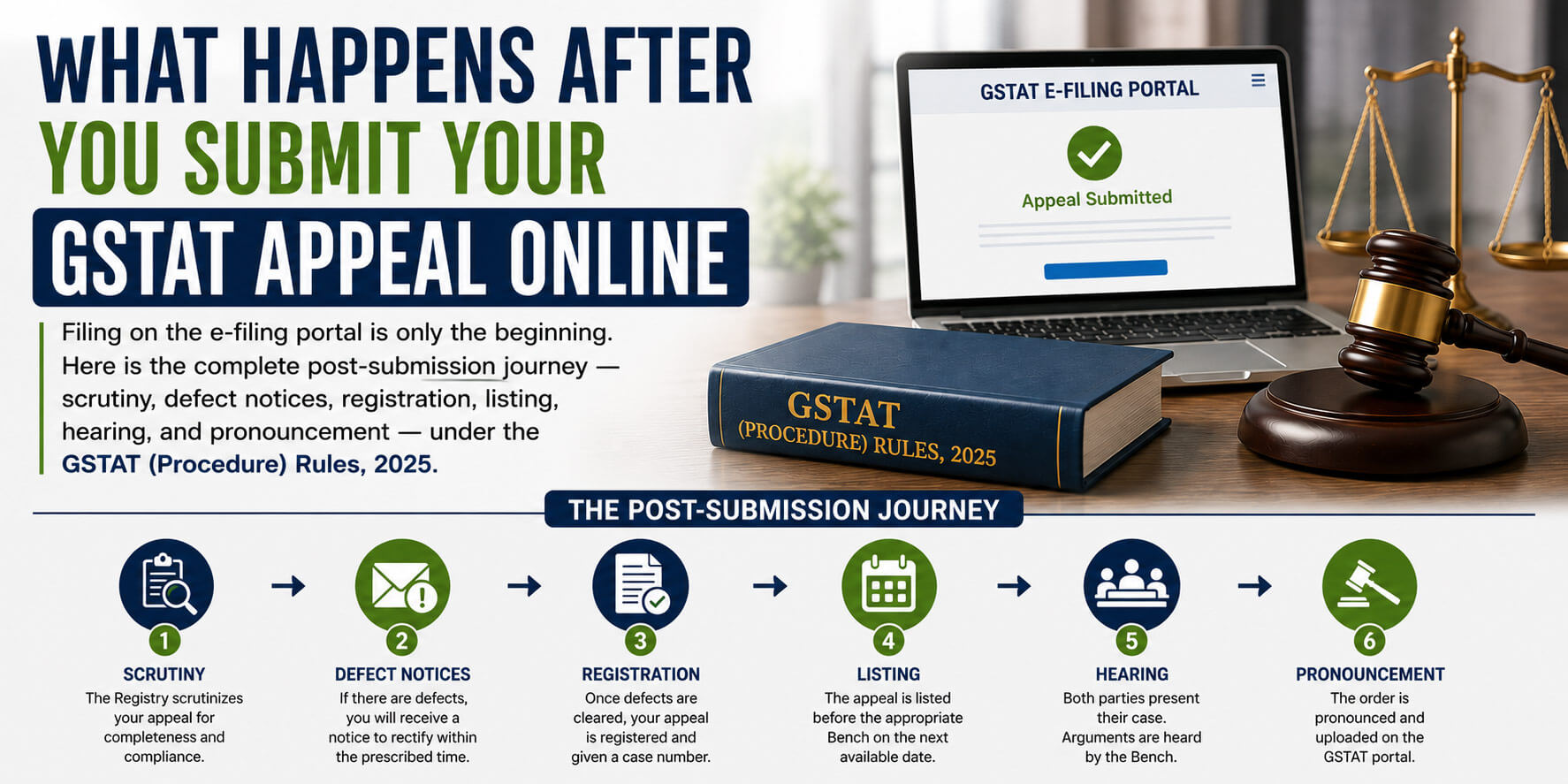
Filing on the e-filing portal is only the beginning. Here is the complete post-submission journey — scrutiny, defect notices, registration, listing, hearing, and pronouncement — under the GSTAT (Procedure) Rules, 2025.
Step 1 — Acknowledgment of Filing
The moment your appeal, complete with Form GSTAT-01, the certified copy of the impugned order, pre-deposit proof, and all supporting documents, is uploaded on the GSTAT e-filing portal, the system generates an electronic acknowledgment of submission. This is not the same as formal registration — it simply confirms that your filing has reached the registry and is queued for scrutiny. Filing is entirely electronic under the Rules; there is no physical counter-filing option.
Step 2 — Registrar’s Scrutiny
Every appeal received is scrutinised by the Registrar (or Deputy/Assistant Registrar) for procedural completeness before it is taken on record. This is a quasi-judicial screening function, comparable to registry scrutiny in a High Court. The Registrar checks for:
Form completeness
Whether Form GSTAT-01 has been filled correctly, with a proper cause title and consecutively numbered paragraphs — each ground of appeal is required to be a self-contained paragraph, not bundled together.
Pre-deposit proof
Whether adequate proof of the mandatory Section 112(8) pre-deposit has been furnished, correctly calculated and paid through the Electronic Cash Ledger.
Bench jurisdiction
Whether the appeal has been filed before the correct State Bench or the Principal Bench, based on the jurisdiction of the order under appeal.
Language & translation
Since GSTAT proceedings are conducted in English, any order or document in a regional language must be accompanied by a certified English translation, agreed by both parties or certified true by an authorised translator.
File everything upfront — there is no later “paper book” stage
Unlike some older tribunal practices where supporting documents could be compiled into a paper book after filing, GSTAT requires all documents relied upon to be filed at the time of the appeal itself. The Registrar can return the appeal for missing documents, and a re-submission may be assigned a fresh number — so treat the initial upload as final, not provisional.
Step 3 — Defect Notices & Curing Defects
If the scrutiny turns up a defect — an incomplete form, a missing document, insufficient pre-deposit proof, a translation gap, or wrong bench jurisdiction — the Registrar issues a defect notice electronically through the portal rather than accepting the appeal as filed.
| Type of Issue | Process | Rectification Window |
|---|---|---|
| Substantive defect (missing documents, incomplete form, insufficient pre-deposit, wrong bench) | Electronic defect notice issued via portal | Up to 30 days from notice, at the Registrar’s discretion, under the currently notified Rules |
| Minor clerical, arithmetical, or grammatical errors | Registrar may correct directly, without notice — but only before the respondent has appeared | No separate window; corrected administratively |
| Corrections sought after respondent has appeared | Requires a formal application and a hearing — cannot be corrected administratively at this stage | As directed by the Bench |
Cured defects don’t cost you your filing date: where a defect is properly cured within the permitted window, the date of original submission is retained as the effective date of filing — not the date on which the defect was cured. This matters significantly for limitation purposes, so curing a defect promptly and correctly is worth prioritising over rushing an incomplete fix.
Watch for an amended timeline
A GSTAT procedure committee has recommended shortening the defect-cure window to 15 working days (extendable up to 45 days with a personal hearing, on request) from the currently notified 30-day window. As of this writing, this remains a recommendation pending formal notification — practitioners should confirm the applicable window on the GSTAT portal or official notifications before relying on either figure.
If the defect is not cured within the applicable window, the appeal may be returned or, in more serious cases, rejected — leaving the appellant to refile, with the attendant risk of a limitation problem if the original filing date is lost.
Step 4 — Registration & Appeal Number
Once the Registrar is satisfied that the appeal is complete and compliant, it is formally registered and assigned a unique appeal number. This is the point at which your matter is genuinely “on the Tribunal’s books” — the case file is opened, and the appeal enters the Tribunal’s case management system for listing.
Step 5 — Admission & Respondent’s Reply
After registration, the respondent (typically the department, where the appeal is filed by the taxpayer) is given the opportunity to file a reply. In some matters, the Bench formally hears the parties on admission before allowing the appeal to proceed to a full hearing — the Bench retains the discretion, after hearing the concerned party, to allow registration of the appeal to stand or to reject it if it finds the appeal is not maintainable.
Step 6 — Cause List & Listing for Hearing
Registered appeals are listed for hearing through a daily cause list prepared by the registry — the same mechanism used in High Courts and other tribunals. Bench sittings generally run in two sessions, roughly 10:30 AM to 1:30 PM and 2:30 PM to 4:30 PM, with the administrative office open longer for filing and registry work. Practitioners should track the cause list on the GSTAT portal regularly rather than waiting for a separate individual notice, since listing can move relatively quickly once an appeal is registered.
Step 7 — Interlocutory Applications
At any point after filing, a party may need interim relief — a stay application, a request for condonation of delay, an application to bring additional evidence on record, or another form of interim direction. These are handled through interlocutory applications, filed separately with their own fee (₹5,000 per application, payable via Bharatkosh), and heard by the Bench on their own footing rather than being folded automatically into the main appeal timeline.
GSTAT’s inherent powers
Beyond the specific procedures set out in the Rules, GSTAT retains inherent powers — akin to a civil court under the Code of Civil Procedure — to summon documents on its own motion, enforce attendance, examine witnesses, extend time on just terms, and pass such orders as are necessary to prevent abuse of process or to serve the interests of justice. This is a meaningful safety valve where a situation isn’t squarely covered by the specific Rules.
Step 8 — The Hearing Itself
Public hearing, appellant first
Hearings are public by default. The appellant is heard first, followed by the respondent, with an opportunity for a rejoinder where the Bench considers it necessary — broadly mirroring standard appellate practice.
Representation requires a vakalatnama
Authorised representatives — advocates, chartered accountants, or other eligible practitioners — must file a vakalatnama or equivalent authorisation before appearing, and a formal dress code applies.
Adjournments are capped
A maximum of three adjournments per party is permitted, and each request requires written reasons — a deliberate design choice to prevent GSTAT proceedings from drifting the way some legacy tribunal matters historically did.
Non-appearance can be fatal — but is recoverable
If a party fails to appear, the Tribunal may proceed ex parte or dismiss the appeal for default. Restoration is possible, but only on a proper showing of sufficient cause — don’t treat non-appearance as low-risk.
Step 9 — Order & Pronouncement
Once the hearing concludes, the Tribunal is required to pronounce its order within 30 days of the date of final hearing, excluding vacations and holidays. If a Member from the original Bench that heard the matter is unavailable at the time of pronouncement, another duly authorised Member may pronounce the order in their place — this keeps disposal moving without being held hostage to a single Member’s availability.
Step 10 — After the Order
Communication of the order
Once pronounced, the order is prepared, verified, and formally communicated to both parties by the registry, following an internal scrutiny and initialling process before dispatch.
Rectification of a mistake
If the order contains an apparent mistake, a rectification application can be filed under Section 112(10) of the CGST Act — a nil-fee application has been proposed for this specific category under recent recommended amendments.
Further appeal, if aggrieved
A party dissatisfied with the GSTAT order has recourse to the High Court under Section 112 of the CGST Act — but only on a substantial question of law, since GSTAT itself is the last fact-finding authority in GST litigation.
Compliance tracking
Where a High Court or Supreme Court subsequently passes an interim or final order in proceedings arising from a GSTAT decision, that order is placed before the President and the same Bench for information, and the Registrar is specifically tasked with drawing attention to any compliance directions.
Common Questions
How long does it typically take to get an appeal number after filing?
This depends on whether the appeal clears scrutiny cleanly. A complete, well-prepared filing can be registered relatively quickly; a defective one will take longer, since the defect-notice-and-cure cycle adds real time before registration is complete.
Can I submit additional documents after filing if I later realise something is missing?
Only in limited circumstances, through a formal application, and generally before the respondent has fully engaged with the matter. Treat the initial filing as your complete evidentiary submission rather than relying on being able to supplement it later.
What happens if I miss a hearing date?
The Tribunal may proceed ex parte or dismiss the appeal for default. Restoration is possible on showing sufficient cause, but it is an avoidable risk — track the cause list actively rather than relying on a separate personal notice.
Is there a limit on how many times I can seek an adjournment?
Yes — a maximum of three adjournments per party, each requiring written reasons. Plan hearing preparation on the assumption that adjournments will not be freely available.