
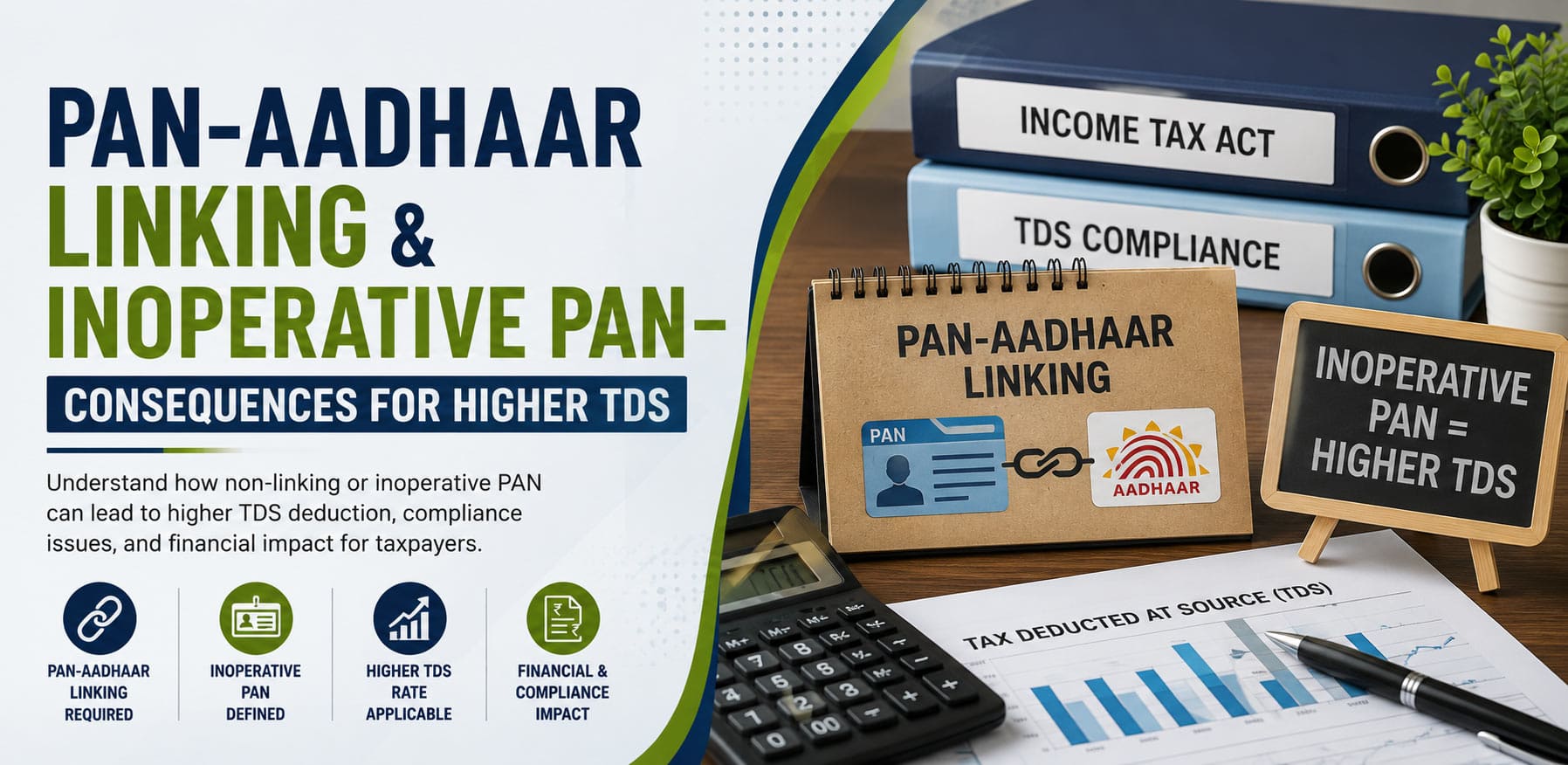
An inoperative PAN is treated as no PAN at all — triggering TDS at up to 20%, blocked refunds, and frozen financial transactions. Here’s the full picture and how to fix it.
Legal Basis & Deadline
Under Section 139AA(2A) of the Income Tax Act, every person allotted a PAN as on 1 July 2017, who is eligible to obtain Aadhaar, must link the two. The Central Board of Direct Taxes extended the final linking deadline to 31 December 2025 — PANs not linked by that date became inoperative from 1 January 2026, under Rule 114AAA.
Consequences of an Inoperative PAN
The law treats an inoperative PAN exactly as though no PAN had been furnished at all — the effect cascades across filing, refunds, and everyday financial transactions.
Cannot file ITR or receive refunds
Income tax returns cannot be filed with an inoperative PAN, and any pending refunds are withheld — with no interest payable for the period the PAN remains inoperative.
TDS/TCS at the highest rate
Payers are required to deduct or collect tax at the higher rate prescribed under Section 397(2) (old: Sections 206AA/206CC) — this can mean up to a fifth of your income withheld until the PAN is restored.
Banking & investment restrictions
Cannot open a new bank account (other than a Basic Savings Bank Deposit Account), apply for a credit card, open a demat/securities account, purchase mutual fund units above ₹50,000, or trade unlisted company shares above ₹1,00,000 per transaction.
Form 15G/15H rejected
Declarations to prevent TDS on interest income are not accepted against an inoperative PAN — the higher deduction applies regardless of what the form would otherwise entitle you to.
Higher TDS/TCS — The Numbers
| Category | Old Provision (1961 Act) | New Provision (2025 Act) | Rate |
|---|---|---|---|
| TDS without valid/operative PAN | 206AA | 397(2) | Up to 20% |
| TCS without valid/operative PAN | 206CC | 397(2) | Twice the rate, or 5% — higher; capped at 20% |
This isn’t a one-time hit — it applies to every payment while the PAN stays inoperative
Salary, bank/FD interest, dividends, contractor payments, professional fees — every payment subject to TDS during the inoperative window is deducted at the elevated rate. Excess TDS credited can eventually be claimed as a refund, but only once the PAN is active again and a return can be filed.
How to Reactivate an Inoperative PAN
Pay the ₹1,000 late fee
Pay via the e-Pay Tax facility on the Income Tax e-filing portal, under Minor Head 500 (Other Receipts), through Challan ITNS 280 — this is levied under Section 234H.
Submit the Link Aadhaar request
Once the fee payment is credited (allow a few working days), submit the linking request on the e-filing portal — enter PAN and Aadhaar details and complete OTP verification.
Wait for reactivation
The status typically changes from “Inoperative” to “Active” within 7 to 30 days. Higher TDS/TCS continues to apply throughout this waiting period.
CBDT Circular 9/2025 — relief for deductors
Where a PAN was inoperative at the time of a payment but is subsequently made operative within the prescribed timeline, the deductor or collector is not treated as a defaulter for having applied normal (rather than the higher inoperative-PAN) rates — a useful protection for payers who process transactions before a PAN’s status is fully synced.
Who Is Exempt From Linking
The following categories, per Notification No. 37/2017 (continuing to operate under the Income-tax Act, 2025), are not required to link PAN with Aadhaar and their PAN does not become inoperative for this reason:
Non-residents
Individuals qualifying as non-resident under the Income Tax Act are exempt from the linking requirement.
Not a citizen of India
Foreign nationals holding a PAN who are not Indian citizens fall outside the mandatory linking requirement.
Aged 80 years or above
Individuals who were 80 years of age or older at any time during the relevant previous year are exempt.
Residents of specified states
Residents of Assam, Jammu & Kashmir, and Meghalaya, as specified in the exemption notification, are exempt from the mandatory linking requirement.
Checklist for Deductors
Always verify PAN validity before processing large payments
- Check PAN status on incometax.gov.in before applying standard TDS/TCS rates — an inoperative PAN silently converts a routine deduction into a compliance risk for the deductor too.
- Link PAN with Aadhaar checks apply equally to vendors, contractors, and employees — build this into onboarding, not just annual reviews.
- Rely on CBDT Circular 9/2025 relief only where the PAN is subsequently made operative within the specified timeline — don’t assume blanket protection for every inoperative-PAN payment.
- Form 15G/15H submissions against an inoperative PAN should be treated as invalid — apply the higher rate regardless of the form.
Common Questions
Is there a penalty just for having an inoperative PAN, beyond the higher TDS?
The reactivation itself carries a ₹1,000 fee under Section 234H. Beyond that, the “penalty” is functional — blocked refunds, restricted transactions, and higher TDS/TCS until the PAN is active again, rather than a separate punitive fine.
If my PAN becomes inoperative mid-year, is all TDS deducted that year at the higher rate?
Only TDS/TCS on payments made during the period the PAN was inoperative attracts the higher rate. Once reactivated, subsequent payments revert to normal rates.
Can excess TDS deducted during the inoperative period be claimed back?
Yes — once the PAN is active and you’re able to file your ITR, the excess TDS credited under your PAN can be claimed as a refund in the normal course.
Does linking PAN with Aadhaar after the deadline avoid the higher TDS rate going forward?
Yes. Once the PAN is reactivated, it is treated as operative for future transactions, and standard TDS/TCS rates apply from that point onward — the higher rate only applied during the inoperative window itself.