
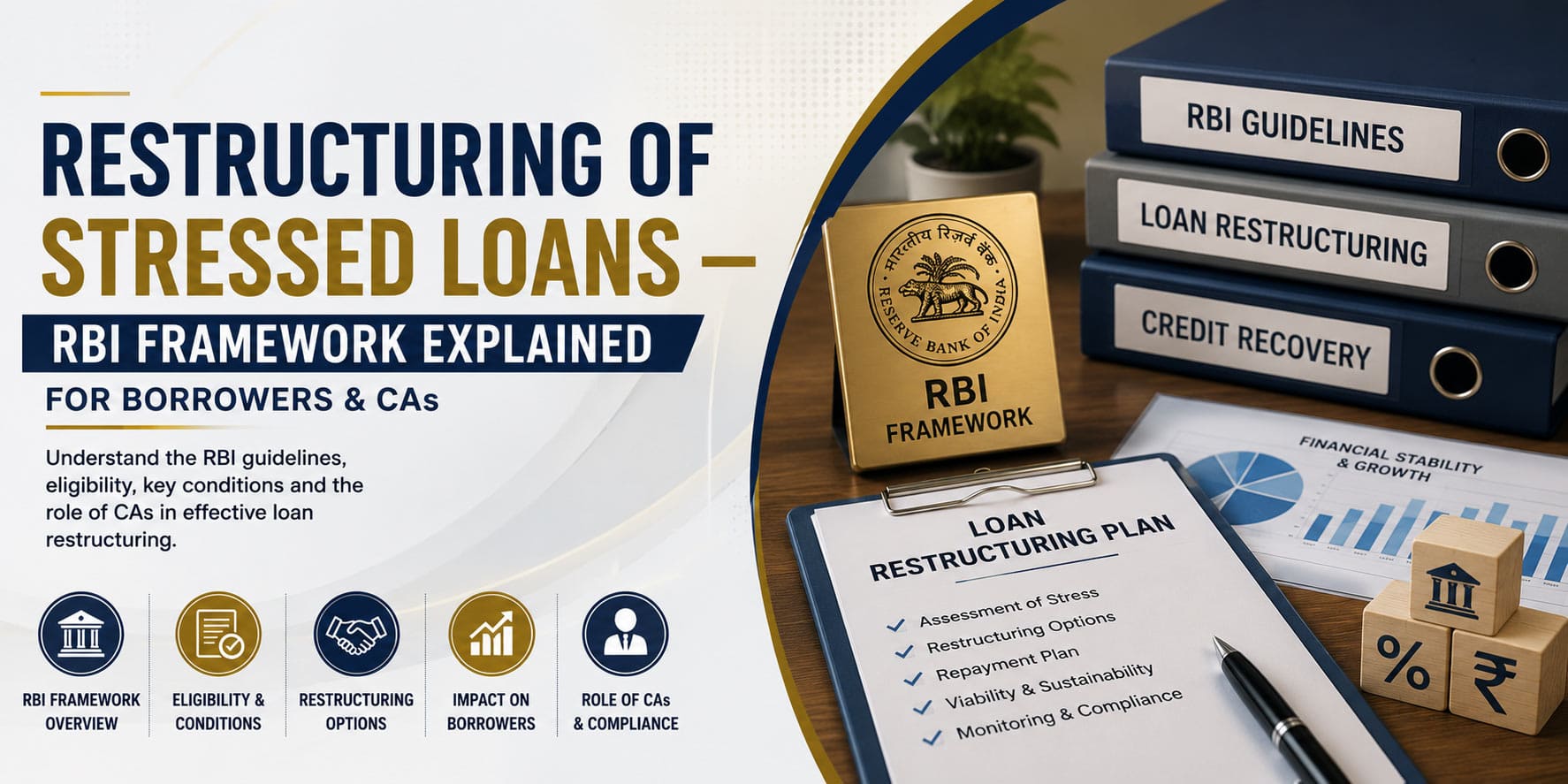
Early recognition beats late resolution, every time. Here’s how RBI’s Prudential Framework actually works — SMA staging, resolution timelines, and where MSME borrowers get specific relief.
The Current Framework — What Replaced What
Following the Supreme Court’s April 2019 order striking down RBI’s earlier February 2018 circular, RBI issued the Prudential Framework for Resolution of Stressed Assets Directions, 2019 — the framework that withdrew a whole generation of scheme-based restructuring tools (Corporate Debt Restructuring, Strategic Debt Restructuring, S4A, Joint Lenders’ Forum, the 5/25 flexible structuring scheme) in favour of a single, principle-based approach built around early identification and lender discretion.
This 2019 framework remains the conceptual backbone of stressed asset resolution today, though RBI has progressively layered updates onto it — most significantly the Resolution of Stressed Assets Directions, 2025, which introduces new rules (including restrictions on selling specified non-financial assets back to defaulting borrowers, effective 1 October 2026) and 2026 amendments extending relief mechanisms to borrowers affected by natural calamities.
SMA Staging — Catching Stress Early
A single missed payment doesn’t make a loan a Non-Performing Asset. RBI requires lenders to classify every loan into a Special Mention Account (SMA) category the moment repayment is overdue, well before NPA classification, so that corrective action can begin early.
| Category | Overdue Period | What It Signals |
|---|---|---|
| SMA-0 | 0–30 days | Earliest stage — repayment resolution should ideally begin here |
| SMA-1 | 31–60 days | Increasing stress — lenders must actively assess the cause and begin corrective dialogue |
| SMA-2 | 61–90 days | Final stage before NPA classification — resolution planning should be well underway by this point |
Default is reported the moment any lender in a consortium flags it
Once an account is reported SMA-0 by even a single lender in a multi-bank or consortium arrangement, resolution must begin across the lending group — this is a meaningful tightening compared to older frameworks, and it means a delay with one lender can trigger obligations toward all of them.
The Resolution Process
Default is identified and reported
Lenders must promptly classify and report the account as SMA and, for exposures of ₹5 crore and above, report defaults to RBI’s Central Repository of Information on Large Credits (CRILC) on a weekly basis.
The Review Period begins
Lenders undertake a review of the borrower’s account and decide on the resolution strategy — whether to pursue restructuring, a resolution plan under the Inter-Creditor Agreement, or recovery/insolvency proceedings.
Resolution Plan is designed and independently validated
For larger exposures, the plan requires Independent Credit Evaluation (ICE) by credit rating agencies — two separate ICEs for aggregate exposure of ₹500 crore and above, one for smaller exposures — before implementation.
Implementation, or escalating provisioning if delayed
If a resolution plan isn’t implemented within the prescribed timeline, additional provisioning kicks in — typically 20% even while the account remains standard, rising to 35% if implementation is delayed by a further year. This escalating cost is deliberately designed to discourage indefinite delay.
Account upgrade, once earned
A restructured account can be upgraded back to “standard” once the borrower demonstrates a track record of timely repayment and has paid at least 10% of the outstanding principal at the time of resolution (relaxed from an earlier 20% requirement) — subject to maintaining a minimum investment-grade credit rating.
Inter-Creditor Agreement (ICA)
Where multiple lenders are involved, the Inter-Creditor Agreement is the contractual mechanism binding all lenders to a common resolution approach, so a single dissenting lender cannot indefinitely block a plan the majority supports.
Majority approval binds all lenders
A resolution plan approved by lenders representing at least 60% by number and 75% by value of total outstanding credit facilities becomes binding on all lenders in the ICA, including dissenting ones.
Independent Credit Evaluation
Larger accounts require independent validation of the resolution plan’s viability by credit rating agencies before implementation — a safeguard against resolution plans that merely defer, rather than genuinely address, the underlying stress.
MSME-Specific Relief
RBI has periodically opened dedicated one-time restructuring windows specifically for MSME borrowers, recognising their more limited access to formal restructuring tools compared to larger corporate borrowers.
| Scheme | Key Conditions |
|---|---|
| 2019 MSME One-Time Restructuring | Aggregate exposure up to ₹25 Crore; account standard as on the reference date; GST-registered (unless exempt); no asset classification downgrade for the restructuring itself |
| 2021 Resolution Framework 2.0 (COVID relief) | Extended similar one-time restructuring relief to MSME borrowers impacted by the pandemic, with board-approved policy requirements at each lender |
| Standard MSME restructuring (outside a relief window) | Any restructuring outside a specific RBI relief window requires immediate downgrade to NPA (sub-standard), upgradable only after demonstrated satisfactory performance |
“Satisfactory performance” has a precise meaning
For an upgrade back to standard classification, no interest or principal payment can remain overdue for more than 30 days during the specified monitoring period. For cash credit/overdraft accounts, this means outstanding must not exceed the sanctioned limit or drawing power (whichever is lower) for more than 30 days at a stretch.
What’s Changed for 2025-26
Resolution of Stressed Assets Directions, 2025
Introduces final prudential norms prohibiting banks, small finance banks, and NBFCs from selling specified non-financial assets (SNFAs, taken over from defaulting borrowers) back to the same defaulting borrower or related parties — effective 1 October 2026, with legacy SNFAs required to comply by 30 September 2027.
NBFC Amendment Directions, 2026 — calamity relief
A new Chapter VI-A introduces a framework specifically for resolving borrower stress caused by natural calamities and similar disruptive events, including provisions for sanctioning additional finance and adjusting insurance proceeds against restructured accounts.
Sector-wide EWS integration
Housing finance companies and other NBFC categories have been separately directed to adopt formal Early Warning Signal frameworks, reinforcing that stress recognition is expected well before formal SMA/NPA classification across the lending ecosystem, not just at scheduled commercial banks.
Common Questions
Does restructuring always require an immediate NPA downgrade?
Outside a specific RBI-notified relief window (like the periodic MSME one-time restructuring schemes), yes — any restructuring generally requires the account to be downgraded to a non-performing “sub-standard” classification, upgradable only after demonstrated satisfactory performance.
Can a single dissenting lender block a resolution plan?
No — under the Inter-Creditor Agreement mechanism, a plan approved by lenders representing at least 60% by number and 75% by value of outstanding facilities binds all lenders in the ICA, including those who dissented.
What happens if a resolution plan isn’t implemented on time?
Escalating additional provisioning kicks in for the lender — typically 20% even while the account remains standard, rising further if implementation is delayed by more than a year — a deliberate incentive against indefinite delay in resolving stress.
Is there a current one-time MSME restructuring window open?
Check the latest RBI notifications directly, since these windows are opened periodically in response to specific economic conditions (as with the 2019 and 2021 schemes) rather than existing as a standing, permanently available facility.