
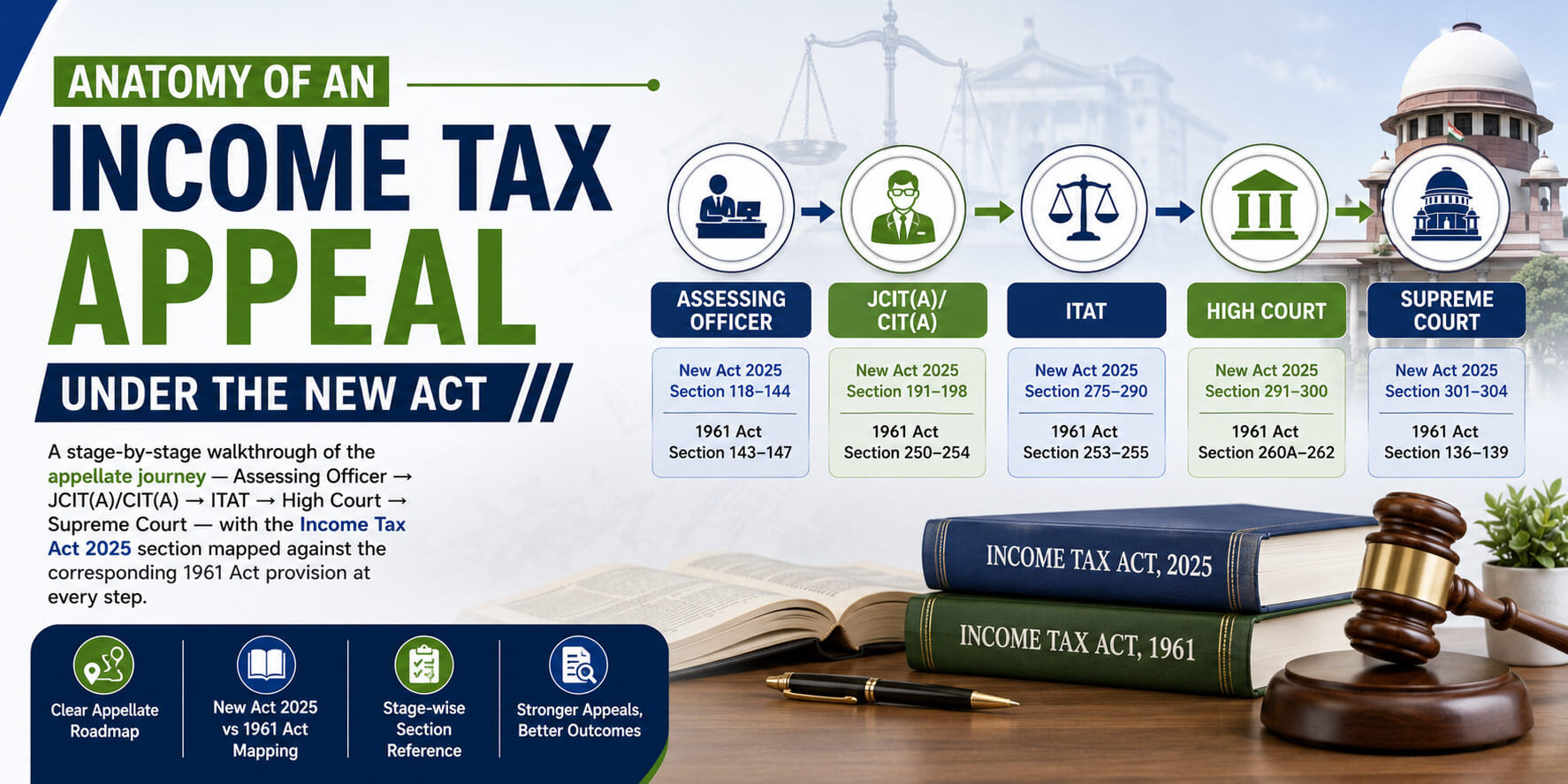
A stage-by-stage walkthrough of the appellate journey — Assessing Officer → JCIT(A)/CIT(A) → ITAT → High Court → Supreme Court — with the Income Tax Act 2025 section mapped against the corresponding 1961 Act provision at every step.
The Appellate Hierarchy at a Glance
The single most reassuring fact for anyone transitioning their practice to the Income Tax Act, 2025 is this: the appellate architecture has not changed. The sequence remains Assessing Officer → Joint Commissioner (Appeals) or Commissioner (Appeals) → Income Tax Appellate Tribunal (ITAT) → High Court → Supreme Court, and the powers of each forum — to confirm, reduce, enhance or annul an assessment, admit additional grounds, call for a remand report, rectify mistakes, and grant stay subject to conditions — remain materially the same. What has changed is purely the section numbering and, in places, the form used to invoke each remedy.
No structural change, same limitation periods
CBDT’s own FAQ on the transition confirms there is no structural change in the appellate hierarchy, no change in appellate powers or procedure, and no change in limitation periods for filing appeals between the two Acts. This is a renumbering and consolidation exercise, not a redesign of the remedy.
The New Act’s Consolidated Chapter NEW
Under the 1961 Act, appeal and revision provisions were scattered — Sections 246, 246A, 249, 250, 251, 253, 254, 255, 260A, 261, 263, 264 and more, interspersed with unrelated provisions. The 2025 Act gathers the entire remedial framework — first appeals, Tribunal appeals, High Court/Supreme Court appeals, revision, the Dispute Resolution Committee, advance rulings, and litigation-deferment mechanisms — into a single consolidated chapter on Appeals, Revision and Alternate Dispute Resolution.
Income Tax Act 1961
- Appealable orders — JCIT(A): Section 246
- Appealable orders — CIT(A): Section 246A
- Form & limitation for appeal: Section 249
- Procedure in appeal: Section 250
- Powers of CIT(A): Section 251
- Appeal to ITAT: Section 253
- Orders of ITAT: Section 254
- Procedure of ITAT: Section 255
- Appeal to High Court: Section 260A
- Appeal to Supreme Court: Section 261
- Revision (prejudicial to revenue): Section 263
- Revision (other orders): Section 264
- Deferment / collegium mechanism: Sections 158A / 158AB
Income Tax Act 2025
- Appealable orders — JCIT(A): Section 356
- Appealable orders — CIT(A): Section 357
- Form & limitation for appeal: Section 358
- Procedure in appeal: Section 359
- Powers of JCIT(A)/CIT(A): Section 360
- Appeal to Appellate Tribunal: Section 362
- Orders of Appellate Tribunal: Section 363
- Procedure of Appellate Tribunal: Section 364
- Appeal to High Court: Section 365
- Appeal to Supreme Court: Section 368
- Revision by Competent Authority: Sections 377–378
- Dispute Resolution Committee: Section 379
- Deferment / collegium mechanism: Sections 375 / 376
Verify before filing
The mapping above reflects the Act’s chapter structure and published clause-level references. Given the volume of cross-references in this chapter, always confirm the exact sub-section against the bare Act or the Department’s official section-mapping utility before it goes into a memorandum of appeal or a court filing.
Stage 1: JCIT(A) / CIT(A) — First Appeal
This is the assessee’s first port of call against an order of the Assessing Officer, and the new Act preserves the twin-track structure introduced by the 1961 Act’s Finance Act 2023 amendment — orders passed by an AO below the rank of Joint Commissioner generally go to the JCIT(A), while more senior orders and specified categories go to the CIT(A).
Determine the correct forum — Sections 356 & 357 (old 246 / 246A)
Section 356 lists orders appealable before the JCIT(A) — intimations under Section 270(1)/399(1), assessment/reassessment orders under Section 279, and rectification orders, among others, where passed by an AO below Joint Commissioner rank. Section 357 lists the CIT(A)’s jurisdiction — including orders passed by a Joint Commissioner under Section 231(4)(b), denial-of-liability orders, and assessments under Section 270(10). No appeal lies before the JCIT(A) where the order was passed by, or with the prior approval of, an authority above Deputy Commissioner rank — that routes straight to the CIT(A), just as it did under old Section 246(1)’s proviso.
File within limitation, using Form 99 — Section 358 (old 249)
The appeal must be filed within 30 days of service of the order, using Form 99 — the new form that replaces the familiar Form 35 — filed electronically. Payment of admitted tax (or advance tax, as applicable) remains a pre-condition, exactly as under old Section 249(4). Delay can be condoned on sufficient cause being shown. Note: an appeal cannot be filed where immunity under Section 440 (the under-reporting/misreporting immunity provision) has already been claimed for that order.
Hearing procedure — Section 359 (old 250)
The JCIT(A)/CIT(A) fixes a date and place for hearing, issues notice to both the appellant and the Assessing Officer, and both sides have the right to be heard in person or through an authorised representative. Further inquiry may be directed to the AO before disposal. As under the old Section 250(6A), the appellate authority is expected, where possible, to decide the appeal within one year from the end of the financial year in which it was filed.
Powers on disposal — Section 360 (old 251)
The JCIT(A)/CIT(A) retains the same wide powers as under the old Act — to confirm, reduce, enhance, or annul the assessment; to confirm or cancel an order of penalty; and, in other matters, to pass such orders as it thinks fit. Enhancement cannot be made without giving the assessee a reasonable opportunity of being heard on the point.
Stage 2: Appellate Tribunal (ITAT)
An order of the JCIT(A) or CIT(A) — or certain specified Principal Commissioner/Commissioner orders — can be carried further to the Appellate Tribunal, the last fact-finding forum in the hierarchy.
| Feature | Old Act (1961) | New Act (2025) |
|---|---|---|
| Governing section — who can appeal, against what | Section 253 | Section 362 |
| Time limit for filing | 60 days from date of communication of the order | 60 days (unchanged) |
| Cross-objection window | 30 days of receipt of notice | 30 days (Section 362(4), unchanged) |
| Departmental appeal / cross-objection fee | Nil | Nil (Section 362(2)/(4)) |
| Stay application fee | ₹500 | ₹500 (unchanged) |
| Orders of the Tribunal, rectification of mistake | Section 254 | Section 363 — 6 months from end of month of order |
| Time-bound disposal target | 4 years from end of FY in which appeal filed | 4 years (Section 363(6), unchanged) |
| Stay of demand by Tribunal | Max 365 days in aggregate, 20% deposit/security condition | Max 365 days aggregate; 180-day initial order, 20% deposit/security condition (Section 363) |
| Procedure of the Tribunal, benches, special bench | Section 255 | Section 364 |
Stay conditions are unchanged, but worth restating
Under Section 363, the Tribunal may grant a stay of up to 180 days at a time, conditional on a deposit of at least 20% of the disputed tax/interest/fee/penalty or furnishing of equivalent security, with the appeal expected to be disposed of within that period. Extensions require the assessee to have complied with the original conditions and to show the delay is not attributable to them — the aggregate stay period across extensions is capped, mirroring the position that developed under the old Section 254(2A) after its various amendments.
Stage 3: High Court & Supreme Court
Beyond the Tribunal, the remedy narrows to questions of law only — the High Court and Supreme Court do not re-examine facts settled by the Tribunal except in limited circumstances (perversity, no evidence, etc.).
High Court — Section 365 (old 260A)
An appeal lies to the High Court from an ITAT order only if the Court is satisfied the case involves a substantial question of law. Either the assessee or the Principal Chief Commissioner/Chief Commissioner/Principal Commissioner/Commissioner may appeal, within 120 days of receipt of the order, by way of a memorandum of appeal precisely stating the substantial question of law. Condonation is available on sufficient cause — all consistent with the old Section 260A position.
Supreme Court — Section 368 (old 261)
A further appeal lies to the Supreme Court from any judgment of the High Court delivered on an appeal under Section 365, in cases the High Court certifies as fit for appeal — or, in practice, more commonly via a Special Leave Petition under Article 136 of the Constitution, which sits outside the Act itself.
Stay of Demand — Old vs New
Stay of the disputed demand is often the most urgent, practical issue in any appeal — and it operates at more than one level.
| Forum | Old Act Basis | New Act Basis | Typical Condition |
|---|---|---|---|
| Assessing Officer (pending first appeal) | Section 220(6) | Corresponding recovery-chapter provision under the new Act | Deposit of 20% of disputed demand is the administrative norm (per CBDT Office Memoranda), subject to AO’s discretion |
| JCIT(A) / CIT(A) | No express statutory stay power; exercised via inherent/incidental powers and CBDT instructions | Position continues on the same basis under Sections 356–360 | Case-specific; often routed back to AO/administrative instructions |
| Appellate Tribunal | Section 254(2A) | Section 363 | 20% deposit or equivalent security; max 180 days per order, 365 days aggregate |
Stay is not automatic at any stage
Filing an appeal does not, by itself, stay recovery proceedings at any level of the hierarchy. A separate stay application — with the 20% deposit norm firmly in practitioners’ minds when negotiating with the AO or arguing before the Tribunal — is essential at each stage where recovery action is a live risk.
Revision, DRC & Litigation-Deferment Tools
The appeal ladder is not the only route out of a dispute. The new Act’s consolidated chapter also carries forward — and renumbers — several parallel or alternate remedies worth having in the toolkit.
Revision — Sections 377–378 (old 263/264)
The Principal Commissioner/Commissioner’s power to revise an order prejudicial to revenue, and the assessee’s remedy to seek revision of other orders, both continue under the same broad framework, now consolidated as the Competent Authority’s revisionary powers.
Dispute Resolution Committee — Section 379
The DRC mechanism for eligible small/medium taxpayers with returned income up to the prescribed threshold and disputed additions below the prescribed limit continues as an alternate, faster route than a full appeal.
Litigation deferment — Sections 375/376 (old 158A/158AB)
Section 375 preserves the assessee-driven mechanism to defer a question identical to one already pending before a higher forum in the assessee’s own case. Section 376 preserves the collegium-based mechanism governing whether the Department itself should file a further appeal where an identical question is already pending elsewhere — both aimed squarely at reducing repetitive litigation.
Advance Rulings — Board for Advance Rulings
The advance ruling mechanism, now administered through the Board for Advance Rulings, continues to let specified categories of applicants obtain certainty on a proposed transaction before it is undertaken — a proactive alternative to after-the-fact litigation.
Transition: Which Act Governs Your Appeal?
This is the question that comes up in almost every live file right now, and CBDT’s own FAQ addresses it directly.
Pending appeals as on 1 April 2026 continue under the old Act
Section 536(2)(e) expressly provides that any proceeding pending before an income-tax authority, the Appellate Tribunal, or a Court shall continue and be disposed of as if the new Act had not been enacted — no fresh appeal needs to be filed, and no re-filing under new section numbers is required for matters already in the pipeline.
Assessment year determines the governing law, not the filing date
An appeal against an assessment order for AY 2024-25 or AY 2025-26 is governed by the 1961 Act even if it is filed after 1 April 2026, because Section 536(2)(c) directs that proceedings for a tax year beginning before 1 April 2026 be carried out under the repealed Act.
An ITAT remand does not create a fresh cause under the new law
Where the Tribunal remands a matter for an earlier tax year on or after 1 April 2026, the Assessing Officer’s order giving effect must still strictly follow the 1961 Act’s procedural and substantive provisions — the remand does not migrate the proceeding into the new Act’s framework.
Forum transfer provisions continue
The old Act’s mechanism for transferring an appeal between JCIT(A) and CIT(A) (old Section 246(2)/(3)) continues under Section 356(3)(a) and 356(3)(b) of the new Act, for cases governed by the new Act.
Practitioner’s Checklist
Identify the governing Act first
Before drafting a single ground of appeal, confirm whether the underlying tax year falls before or after 1 April 2026 — this single fact determines every subsequent section reference in the memorandum.
Match the order to the correct first-appeal forum
Check the rank of the officer who passed the order against Sections 356/357 (new) or 246/246A (old) before deciding between JCIT(A) and CIT(A) — filing before the wrong forum costs time even where it is eventually corrected by transfer.
Use Form 99, not Form 35, for new-Act appeals
Form 99 has replaced Form 35 for appeals under Sections 356/357. Ensure the admitted-tax pre-condition is met and that immunity under Section 440 has not already been claimed for the same order, since that bars the appeal.
File a separate stay application at every stage
Do not assume the appeal itself halts recovery. Apply for stay before the AO pending first appeal, and again before the Tribunal under Section 363 if the matter proceeds that far, budgeting for the 20% deposit norm.
Frame the High Court appeal around a substantial question of law
Since Section 365 (like old Section 260A) restricts High Court appeals to substantial questions of law, resist the temptation to re-argue facts already settled by the Tribunal — frame the memorandum precisely around the legal question.
Common Questions
Do I need to refile a pending CIT(A) appeal under the new Act?
No. Appeals pending as on 1 April 2026 continue to be disposed of under the 1961 Act by virtue of Section 536(2)(e) — no fresh filing is needed and old section references remain valid for that matter.
Which form should I use for a fresh appeal filed today?
For orders governed by the Income Tax Act, 2025 (broadly, tax years beginning on or after 1 April 2026), use Form 99. For orders still governed by the 1961 Act (earlier tax years), continue using Form 35, even if the appeal is being filed after 1 April 2026.
Has the monetary threshold for departmental appeals changed?
The Act’s general provisions on monetary limits for appeals continue to operate alongside CBDT’s periodically revised low-tax-effect circulars, which are administrative instructions rather than provisions embedded in the Act itself — always check the currently applicable circular rather than relying on the Act’s text alone for this figure.
Can I still approach the High Court on a question of fact?
No. Both under the old Section 260A and the new Section 365, the High Court’s jurisdiction is confined to substantial questions of law arising from the Tribunal’s order — questions of fact settled by the Tribunal are ordinarily final, subject to very limited exceptions such as perversity of finding.