
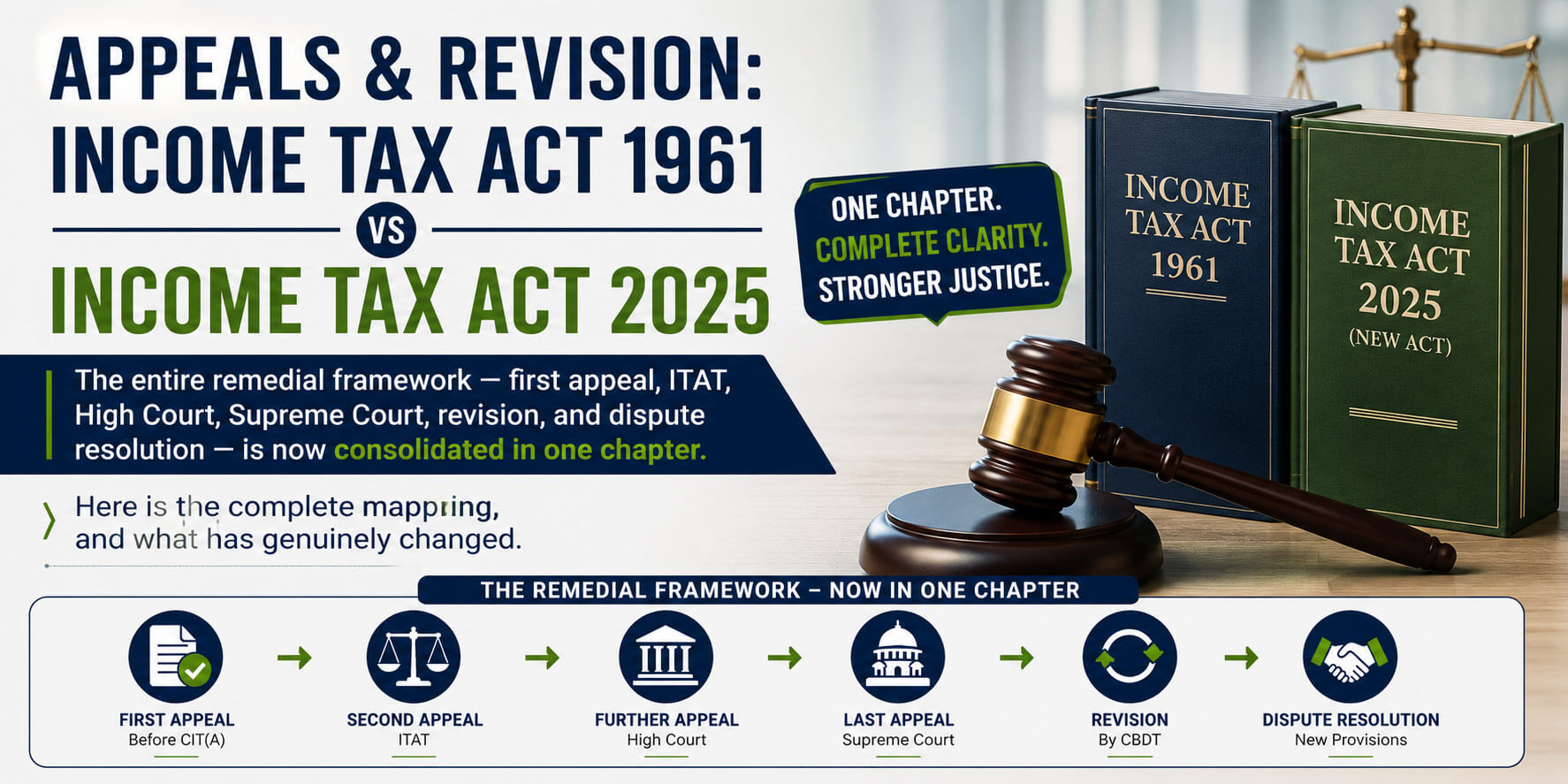
The entire remedial framework — first appeal, ITAT, High Court, Supreme Court, revision, and dispute resolution — is now consolidated in one chapter. Here is the complete mapping, and what has genuinely changed.
Chapter XVIII at a Glance
Under the 1961 Act, the appeal and revision framework was spread across Chapters XX (Appeals and Revision) and related provisions — Sections 246A, 248, 249, 250, 253, 254, 260A, 261, 263, 264, and more. The Income Tax Act, 2025 consolidates this entire remedial architecture into a single chapter: Chapter XVIII, “Appeals, Revisions and Alternate Dispute Resolutions.” This is one of the more practically useful consolidations in the new Act for litigation practitioners, since the full appellate ladder now sits in one continuous block of sections.
First Appeal — Joint Commissioner (Appeals) / Commissioner (Appeals)
| Old Section (1961) | Provision | New Section Range (IT Act 2025) |
|---|---|---|
| 246A | Orders appealable to Commissioner (Appeals) | 356–360 |
| 248 | Appeal by a person denying liability to deduct tax | |
| 249 | Form of appeal and limitation period | |
| 250 | Procedure in appeal before Commissioner (Appeals) |
Confirmed sub-mapping: old Section 246(2) and 246(3), governing transfer of pending appeals between JCIT(A) and CIT(A), now correspond specifically to new Section 356(3)(a) and Section 356(3)(b) respectively.
Appeal to the Appellate Tribunal (ITAT)
| Old Section (1961) | Provision | New Section Range (IT Act 2025) |
|---|---|---|
| 253 | Appeals to the Appellate Tribunal — appealable orders | 361–364 |
| 254 | Orders of the Appellate Tribunal |
Appealable orders before ITAT continue to include, among others, a rectification order passed by the first appellate authority, an order under the appeal-procedure provision itself, and specified penalty orders — the categories of appealable orders are carried forward without material narrowing.
Further Appeals — High Court & Supreme Court
| Old Section (1961) | Provision | New Section Range (IT Act 2025) |
|---|---|---|
| 260A | Appeal to High Court — substantial question of law | 365–368 |
| 261 | Appeal to Supreme Court |
The restriction that a High Court appeal lies only on a “substantial question of law” — not on findings of fact — continues unchanged under the new Act.
Revision & Alternate Dispute Resolution
| Old Section (1961) | Provision | New Section Range (IT Act 2025) |
|---|---|---|
| 263 / 264 | Revision by the Principal Commissioner / Commissioner (Competent Authority) | 377–378 |
| — | Dispute Resolution Committee mechanism | 379 |
| — | Mechanism for avoiding repetitive litigation on identical questions of law | 375–376 |
A genuinely new addition
Sections 375–376, dealing specifically with avoiding repetitive litigation where an identical question of law is already pending or decided, are a structural addition consolidating what was previously handled through ad hoc CBDT circulars and case-management practice rather than a dedicated statutory mechanism.
What Has NOT Changed
Appellate hierarchy
The sequence remains identical: Assessing Officer → JCIT(A)/CIT(A) → ITAT → High Court → Supreme Court. There is no structural change to this ladder.
Limitation periods
The time limits for filing an appeal at each stage remain unchanged from the 1961 Act framework.
Powers of appellate authorities
Powers to confirm, reduce, enhance, or annul an assessment; admit additional grounds; call for a remand report; rectify mistakes; and grant stay subject to conditions all continue materially unchanged.
Procedural framework
The overall procedural framework governing how an appeal is conducted before each forum remains substantively the same as under the 1961 Act.
Which Act Governs a Pending Appeal?
Section 536(2)(c) and 536(2)(e) of the new Act provide that proceedings relating to tax years beginning before 1 April 2026 continue to be governed by the 1961 Act. This has two practical consequences that litigation practitioners should note carefully:
An appeal pending as on 1 April 2026 continues under the old Act
If a CIT(A) appeal is pending as of the commencement date, it continues to be decided under the Income Tax Act, 1961, not the new Act — quote old section numbers throughout.
Remand proceedings follow the year under appeal, not the remand date
If ITAT remands a matter on or after 1 April 2026 in respect of an earlier assessment year (say AY 2023-24), the remand proceedings continue to be governed by the 1961 Act — the date of remand does not trigger a switch to new-Act numbering.
Common Questions
Does the appellate hierarchy change under the new Act?
No. The sequence Assessing Officer → JCIT(A)/CIT(A) → ITAT → High Court → Supreme Court remains structurally identical.
My client’s CIT(A) appeal is pending as of 1 April 2026 — which Act applies?
It continues to be governed by the Income Tax Act, 1961, under the savings clause at Section 536(2)(c). Continue drafting and citing using the old section numbers for that matter.
Has the “substantial question of law” threshold for High Court appeals changed?
No. A High Court appeal under the new Section 365–368 range continues to lie only on a substantial question of law, consistent with old Section 260A.
Is there a new mechanism for cases involving an identical, already-settled legal question?
Yes. New Sections 375–376 introduce a structured mechanism specifically to avoid repetitive litigation where the same question of law is already pending before, or has been decided by, a jurisdictional court — worth exploring where a client has a batch of similar matters.