
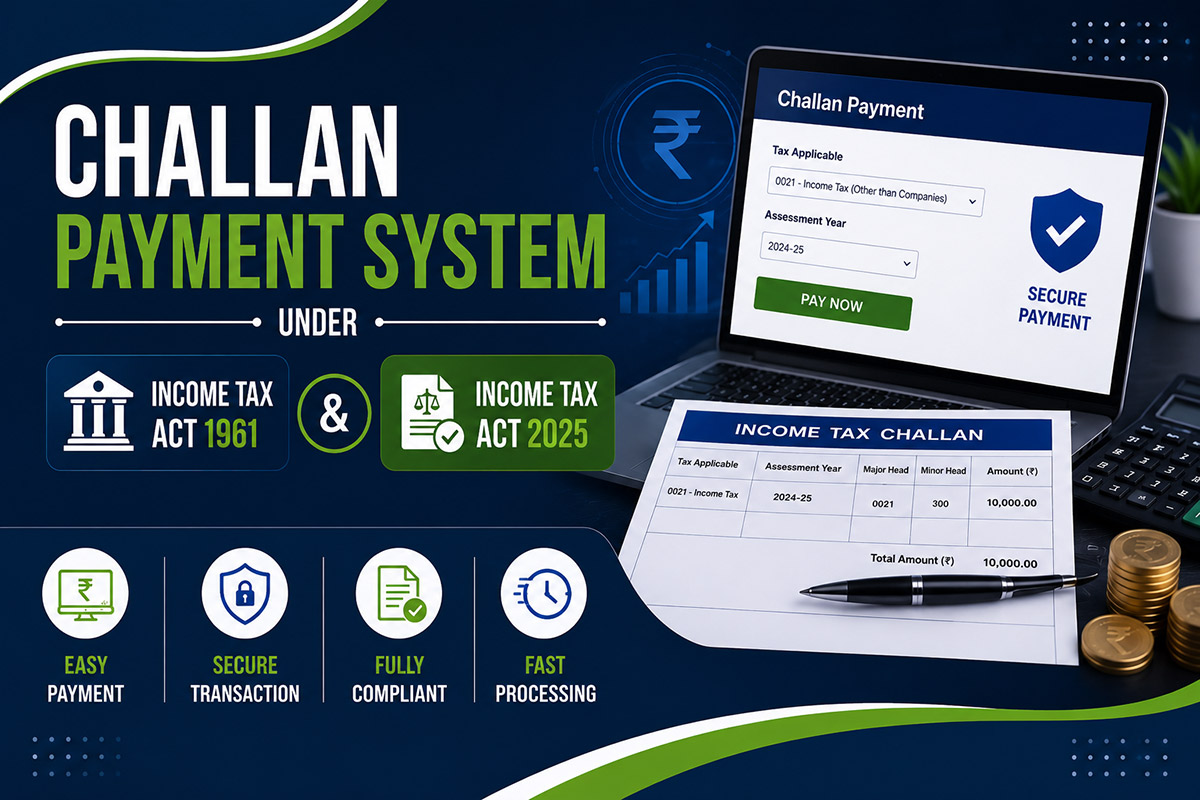
A complete reference to India’s income tax challan framework — types of challans, payment procedures, online steps, corrections, due dates, and the key changes introduced under the new Income Tax Act 2025.
What is a Tax Challan?
A tax challan is an official instrument prescribed by the Income Tax Department of India that a taxpayer uses to remit income tax, TDS (Tax Deducted at Source), TCS (Tax Collected at Source), advance tax, self-assessment tax, or any other direct tax dues to the government. Think of it as the formal receipt-cum-instruction document that ensures your payment is attributed to the correct taxpayer, the correct tax head, and the correct assessment year.
“A challan is not merely a payment receipt — it is the bridge between a taxpayer’s obligation and the government’s ledger. Errors in the challan can cause mismatches in Form 26AS, delayed refunds, and compliance notices.”
All direct tax challans in India are routed through the OLTAS (Online Tax Accounting System), which records every tax payment in real time. Once a challan is paid, a unique BSR Code (Basic Statistical Return code of the bank branch), challan serial number, and deposit date are generated. These three details form the challan identification number (CIN) used in all subsequent tax filings.
Types of Income Tax Challans
The Income Tax Department prescribes four primary challans for direct tax payments. Each challan covers a specific category of payment, and using the correct challan for each payment type is mandatory.
| Challan | Used By | Type of Payment | Old Section Reference | New Section (IT Act 2025) |
|---|---|---|---|---|
| ITNS 280 | Individuals, HUF, Firms, Companies | Advance Tax, Self-Assessment Tax, Surcharge, Interest, Penalty | Sections 207–209, 140A, 234A/B/C | Sections 263–270 (IT Act 2025) |
| ITNS 281 | TDS/TCS Deductors & Collectors | TDS deposits (salary, non-salary, foreign) and TCS deposits | Sections 192–196D, 206C | Sections 392–394 (IT Act 2025) |
| ITNS 282 | Individuals, Institutions | Securities Transaction Tax, Wealth Tax, Gift Tax, Other Direct Taxes | Various | Mapped under IT Act 2025 schedules |
| ITNS 283 | Banks, Employers (historical) | Banking Cash Transaction Tax, Fringe Benefits Tax (legacy) | Abolished provisions | Legacy use only |
ITNS 280 — Direct Tax Payments by Taxpayers
ITNS 280 is the most widely used challan by individual and corporate taxpayers. It is used to pay taxes that arise out of an individual’s own tax liability — as opposed to TDS where a third party deducts and pays on your behalf.
When to use ITNS 280
Advance Tax
Tax paid in four instalments during the financial year by taxpayers whose estimated tax liability exceeds ₹10,000 in a year.
Self-Assessment Tax
Tax paid at the time of filing ITR to make up the shortfall between total tax liability and taxes already paid (TDS + advance tax).
Corporate Tax
Regular income tax and MAT (Minimum Alternate Tax) paid by companies on their taxable income.
Surcharge & Cess
Health and Education Cess (4%) and surcharge applicable on high-income taxpayers, paid along with base tax.
Interest & Penalties
Interest under Sections 234A (filing delay), 234B (advance tax default), 234C (instalments) and related penalties.
Regular Assessment Tax
Tax demanded in an assessment order raised by the Income Tax Officer after scrutiny or regular assessment proceedings.
Key fields in ITNS 280
| Field | What to fill | Common mistakes |
|---|---|---|
| PAN | Your 10-digit Permanent Account Number | Entering wrong PAN; credit goes to the wrong taxpayer |
| Assessment Year (AY) | Year for which tax is being paid (e.g., AY 2026-27 for FY 2025-26) | Selecting current FY instead of AY; creates mismatch in Form 26AS |
| Tax Applicable | 0020 for companies; 0021 for non-companies | Companies selecting 0021 or vice versa |
| Type of Payment | 100 (Advance Tax), 300 (Self-Assessment Tax), 400 (Regular Assessment Tax), 106 (Surcharge), 107 (Education Cess) | Using code 300 when making instalment advance tax payments |
| Bank & Mode | Net banking or NEFT/RTGS; select authorised bank | Using non-authorised bank leading to failed credit |
Advance Tax Instalment Schedule (FY 2025-26)
On or before 15 June
At least 15% of total estimated tax liability for the year must be paid by this date.
On or before 15 September
Cumulative payment must reach at least 45% of total estimated tax liability.
On or before 15 December
Cumulative payment must reach at least 75% of total estimated tax liability.
On or before 15 March
Remaining balance — cumulative payment must reach 100% of total estimated tax liability.
Senior citizens and presumptive taxpayers
Senior citizens (aged 60 or above) who do not have income from business or profession are exempt from paying advance tax. Similarly, taxpayers who opt for the presumptive taxation scheme under Section 44AD/44ADA may pay their entire advance tax in a single instalment by 15 March.
ITNS 281 — TDS and TCS Deposits
ITNS 281 is used exclusively by deductors and collectors to remit tax deducted or collected at source to the government. It is a compliance-critical challan — any delay in deposit of TDS after deduction attracts interest, and non-deposit can expose the deductor to prosecution.
Key fields in ITNS 281
| Field | What to fill | Notes |
|---|---|---|
| TAN | Tax Deduction Account Number (10-digit) | Mandatory; without TAN, payment cannot be processed |
| Tax Applicable | 0020 (Company deductors), 0021 (Non-company deductors) | Companies paying TDS on behalf of employees use 0020 |
| Type of Payment | 200 (TDS/TCS payable by taxpayer), 400 (TDS/TCS regular assessment demand) | Use 200 for routine monthly TDS deposits |
| Nature of Payment | Section code (e.g., 192 / 194A / 194C etc. under old act; corresponding new section under IT Act 2025) | Select the specific section under which TDS was deducted |
| Financial Year | FY in which TDS was deducted (not AY) | Unlike ITNS 280, this is the financial year, not assessment year |
| Surcharge / Education Cess | Applicable for TDS on non-residents; generally NIL for resident deductions | For NRI TDS, surcharge applies based on income slab |
TDS deposit due dates
| Type of Deductor | Month of Deduction | Due Date for Deposit |
|---|---|---|
| Government offices (without challan) | Any month | Same day as deduction |
| Government offices (with challan) | April – February | 7th of the following month |
| All other deductors | April – February | 7th of the following month |
| All deductors | March | 30th April (special extension) |
| TDS on purchase of property (194IA) | Any month | 30 days from end of the month of deduction |
| TDS on rent by non-deductor individuals (194IB) | Last month of FY / last month of tenancy | 30 days from end of such month |
ITNS 282 & ITNS 283 — Other Direct Taxes
ITNS 282 — Securities Transaction Tax and Other Taxes
ITNS 282 is used for a range of other direct tax payments that do not fall under income tax or TDS/TCS. Key payments made via this challan include:
Securities Transaction Tax (STT)
Paid by stock exchanges and mutual funds on taxable securities transactions — purchase/sale of equity shares, derivatives, and units.
Commodities Transaction Tax (CTT)
Levied on taxable commodity derivatives transactions and deposited by recognised commodity exchanges.
Wealth Tax (historical)
Wealth tax was abolished from FY 2015-16, but ITNS 282 may still be used for legacy assessments and outstanding demands relating to earlier years.
Gift Tax (historical)
Like wealth tax, gift tax has been abolished but ITNS 282 handles any historical payments or revised assessments.
ITNS 283 — Fringe Benefits Tax and Banking Cash Transaction Tax
ITNS 283 was introduced for payment of Fringe Benefits Tax (FBT), which was levied on employers for benefits provided to employees, and Banking Cash Transaction Tax (BCTT). Both taxes have since been abolished — FBT from FY 2009-10 and BCTT from FY 2009-10. ITNS 283 is retained in the system only for historical assessments, penalties, and revised demands relating to years when these taxes were in effect.
Key Changes Under the Income Tax Act 2025 New
The Income Tax Act, 2025 consolidates and restructures the entire income tax law. While the challan forms (ITNS 280, 281, 282, 283) themselves remain as the payment instruments, several underlying provisions that govern when and how tax is paid have been renumbered and in some cases reorganised.
Income Tax Act, 1961
- Advance tax provisions: Sections 207–219
- Self-assessment tax: Section 140A
- Interest for default in advance tax: Sections 234B, 234C
- Interest for delay in filing: Section 234A
- TDS sections: 192–196D
- TCS section: 206C
- PAN furnishing: Section 206AA
- OLTAS governed under departmental circulars and Finance Act provisions
Income Tax Act, 2025
- Advance tax provisions: Sections 263–270
- Self-assessment tax: Section 267
- Interest for default in advance tax: Sections 414, 415
- Interest for delay in filing: Section 413
- TDS sections: 392–393
- TCS section: 394
- PAN furnishing: Section 397(2)
- Digital payment infrastructure formalised under new Act provisions
Structural changes affecting challan payments
| Aspect | IT Act 1961 | IT Act 2025 | Practical Impact |
|---|---|---|---|
| Section numbering | Legacy numbers (140A, 207, 234B, etc.) | New numbers (267, 263, 414, etc.) | Challan forms updated to reference new section codes. Both systems cross-referenced in returns. |
| TDS nature of payment codes | Based on old sections (194A, 194C, etc.) used in ITNS 281 | New section references (393(1), 393(3), etc.) | ITNS 281 nature-of-payment drop-down updated. Return codes 1004–1092 (as in TDS rate chart) are carried forward. |
| Digital / e-payment mandate | Mandatory for companies and tax-audit cases; optional for others | Expanded digital payment mandate; physical challans further discouraged | Most taxpayers should use the IT portal’s e-Pay Tax facility. Bank branch payments being phased down. |
| Interest computation | Sections 234A, 234B, 234C | Sections 413, 414, 415 | Same rates and logic; only section references change. Interest is computed at 1% per month or part thereof. |
| Challan correction | Via TIN-NSDL / Assessing Officer | Integrated correction mechanism via IT portal (formalised) | Taxpayers can initiate most corrections directly on incometax.gov.in without visiting bank branch. |
Transition period — dual references
During the transition (FY 2025-26 and 2026-27), both old section references (from IT Act 1961) and new references (IT Act 2025) will appear in challans, TDS certificates, and IT portal drop-downs. Taxpayers and practitioners should verify that the correct assessment year and section are selected in every challan to avoid mismatches in Form 26AS and AIS.
How to Pay Tax Challans Online (Step-by-Step)
The Income Tax Department’s e-Pay Tax facility on incometax.gov.in is the primary channel for online challan payments. The process is the same for ITNS 280 (direct tax) and ITNS 281 (TDS/TCS). Here is the complete process:
Log in to the Income Tax Portal
Visit incometax.gov.in and log in using your PAN/Aadhaar and password. For TDS payments, log in using your TAN credentials. First-time users must register before proceeding.
Navigate to e-Pay Tax
Go to: e-File → e-Pay Tax. Click on “New Payment” to initiate a fresh challan. You can also view previously generated challans and make payments against saved drafts.
Select the correct challan type
The system displays all applicable challan types. Select:
- Income Tax — for ITNS 280 (advance tax, self-assessment tax, etc.)
- TDS on Sale of Property — for Section 194IA (property buyer) using a separate simplified form
- TDS / TCS — for ITNS 281 deposits by registered deductors
Fill challan details carefully
Enter the Assessment Year (for ITNS 280) or Financial Year (for ITNS 281), the type of payment code, and the breakup of the tax amount across heads: Basic Tax, Surcharge, Health & Education Cess, Interest, and Penalty (where applicable).
Select payment method and bank
Choose from the available payment modes:
- Net banking — directly through your bank’s internet banking portal (most common)
- Debit card — for individuals at select authorised banks
- RTGS / NEFT — generate a mandate form and process via your bank
- Pay at bank counter — for taxpayers not using online banking (physical challan)
- Payment Gateway — credit card or UPI (introduced with expanded e-pay mandate)
Confirm and complete payment
Review all details — PAN/TAN, assessment year, amount, type of payment — before confirming. You will be redirected to your bank’s payment page. On successful payment, the bank generates the BSR code, challan serial number, and deposit date.
Download the challan counterfoil
After payment, download or save the challan counterfoil (also called the payment receipt or OLTAS challan). This document contains the CIN (BSR Code + Challan Serial No. + Date) which must be quoted when filing your ITR or TDS return.
Verify in Form 26AS / AIS
The payment typically reflects in your Form 26AS / AIS within 3–5 working days after the bank processes it. Always verify before filing your return to ensure the credit is correctly mapped to your PAN and the correct assessment year.
Double-check these before every payment
- PAN (for ITNS 280) or TAN (for ITNS 281) — a wrong PAN/TAN means someone else gets the credit.
- Assessment Year vs Financial Year — ITNS 280 needs AY (one year ahead); ITNS 281 needs FY (current year).
- Type of payment code — advance tax (100) is different from self-assessment tax (300).
- Amount breakup — ensure tax, surcharge, cess, interest, and penalty are entered in the correct fields, not clubbed together.
Challan Payment Due Dates at a Glance
| Payment Type | Challan | Due Date | Consequence of Delay |
|---|---|---|---|
| Advance Tax — 1st instalment | ITNS 280 | 15 June | Interest u/s 234C @ 1%/month |
| Advance Tax — 2nd instalment | ITNS 280 | 15 September | Interest u/s 234C @ 1%/month |
| Advance Tax — 3rd instalment | ITNS 280 | 15 December | Interest u/s 234C @ 1%/month |
| Advance Tax — 4th instalment | ITNS 280 | 15 March | Interest u/s 234C @ 1%/month |
| Self-Assessment Tax | ITNS 280 | Before filing ITR (31 July for individuals) | Interest u/s 234A and 234B |
| TDS deposit — April to February | ITNS 281 | 7th of following month | Interest @ 1.5%/month u/s 201(1A) |
| TDS deposit — March | ITNS 281 | 30 April | Interest @ 1.5%/month u/s 201(1A) |
| TDS on property purchase (194IA) | ITNS 281 | 30 days from month end | Interest + penalty |
| TCS deposit | ITNS 281 | 7th of following month (30 April for March) | Interest @ 1%/month u/s 206C(7) |
Challan Correction — Fixing Errors After Payment
Mistakes in challan details happen — a wrong PAN, incorrect assessment year, or wrong type of payment code can cause serious mismatches in your tax records. The Income Tax Department provides a structured challan correction mechanism, available both online (via the IT portal) and through the bank branch.
What can be corrected?
| Field | Correction Route | Time Limit |
|---|---|---|
| PAN / TAN | Bank branch (within 7 days of payment) or IT portal online correction | Within 7 days of challan deposit |
| Assessment Year | Bank branch (within 7 days) or via Assessing Officer request | Within 7 days; AO route available beyond 7 days |
| Amount of tax / breakup | Bank branch within 7 days; beyond that, through Assessing Officer | 7 days (bank); no hard limit via AO |
| Type of payment code | Bank branch or online correction portal | Within 7 days of payment |
| Major / Minor head code | Bank branch within 3 months; Assessing Officer thereafter | Within 3 months via bank; AO route available later |
| Name of taxpayer | Via Assessing Officer only (not bank) | As per AO discretion |
Online correction steps (IT portal)
Log in to incometax.gov.in
Navigate to Services → Challan Correction (available for e-payment challans processed through the IT portal).
Enter challan details
Provide the BSR code, challan serial number, challan date, and PAN/TAN as appearing on the original challan counterfoil.
Select the field to correct
Choose the specific field requiring correction (Assessment Year, Type of Payment, etc.). Enter the correct value and submit the correction request.
Track and verify
The correction is typically processed within 5–7 working days. Verify the updated status in Form 26AS or AIS after processing.
Correction via bank branch
For corrections within 7 days of payment, visit the bank branch where the challan was deposited. Carry the original challan counterfoil and submit a written correction request with supporting documents (PAN card copy, request letter). The bank will process the correction through the OLTAS system and issue a revised challan counterfoil.
Penalties and Interest for Challan Defaults
The Income Tax Act prescribes specific interest and penalty provisions for defaults in tax payment, TDS deposit, and related challan obligations. These provisions are carried over into the IT Act 2025 with updated section numbers.
Section 234A / IT Act 2025: Sec. 413
Interest for delay in filing income tax return. Calculated @ 1% per month (or part thereof) on the outstanding tax liability from the due date of filing to the actual filing date.
Section 234B / IT Act 2025: Sec. 414
Interest for default or shortfall in advance tax payment. Applicable when advance tax paid is less than 90% of the assessed tax. Charged @ 1% per month from 1 April of the assessment year to the date of assessment or actual payment.
Section 234C / IT Act 2025: Sec. 415
Interest for deferment of advance tax instalments. Charged @ 1% per month for 3 months on the shortfall in each instalment. Not applicable if total advance tax paid during the year is ₹10,000 or less.
Section 201(1A) — TDS default
Interest for late deduction of TDS: 1% per month from the date on which TDS was deductible to actual deduction. Interest for late deposit after deduction: 1.5% per month from deduction date to deposit date.
Section 220(2) — Regular assessment demand
Interest on tax demands raised in assessment orders, if not paid within 30 days of the notice of demand. Charged @ 1% per month until the demand is paid.
Section 271C — TDS not deducted
Penalty equal to the amount of TDS not deducted (i.e., 100% of TDS), in addition to any interest. Levied by the Assessing Officer on finding that TDS should have been deducted but was not.
Criminal prosecution for wilful TDS default
- Under Section 276B of the Income Tax Act 1961 (retained under IT Act 2025), failure to deposit TDS after deduction is a criminal offence.
- Punishment: rigorous imprisonment of 3 months to 7 years along with fine.
- This applies to situations where TDS has been deducted from payments (e.g., salary, rent) but the deductor wilfully fails to deposit it with the government.
- The prosecution is in addition to, not in place of, interest and penalty provisions.
How to Verify Your Challan Payment
After making a challan payment, it is essential to verify that the credit has been correctly recorded against your PAN/TAN and the correct assessment year. There are three ways to do this:
Form 26AS (Annual Tax Statement)
Log in to incometax.gov.in → View Form 26AS. Part A shows TDS, Part C shows self-assessment and advance tax payments. Payments usually reflect within 3–7 working days.
AIS (Annual Information Statement)
Available under Services → AIS on the IT portal. Provides a comprehensive view of all financial transactions including tax payments, reported in real time with feedback functionality.
TIN-NSDL Challan Status Enquiry
Visit tin.tin.nsdl.com → Challan Status Enquiry. Enter BSR code, challan date, serial number, and amount to verify payment status directly in the OLTAS system.
Bank / Net Banking Statement
Your bank statement or net banking portal will show the successful debit. Keep the challan counterfoil (PDF) downloaded at the time of payment as primary evidence.
Frequently Asked Questions