
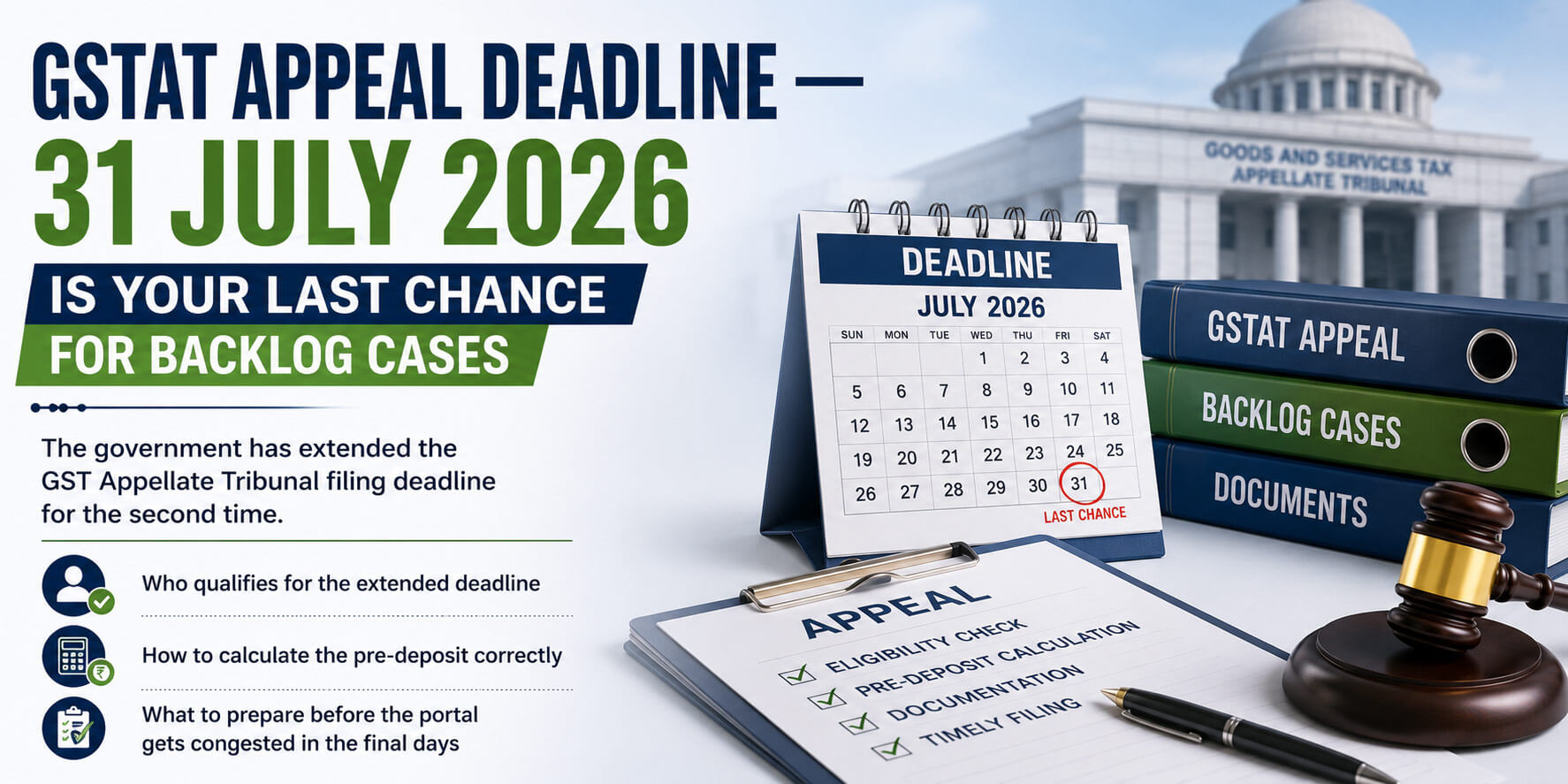
The government has extended the GST Appellate Tribunal filing deadline for the second time. Here is who qualifies, how to calculate the pre-deposit correctly, and what to prepare before the portal gets congested in the final days.
What Has Been Notified
By notification dated 30 June 2026, the Ministry of Finance’s Department of Revenue extended the last date for filing appeals and applications before the GST Appellate Tribunal (GSTAT) in specified backlog cases from 30 June 2026 to 31 July 2026. This notification supersedes an earlier one dated 17 September 2025, which had originally fixed 30 June 2026 as the cut-off. This is the second time the government has had to intervene on this deadline, and the stated reason is the same both times: a sharp last-minute surge in filings causing congestion on the GSTAT e-filing portal.
Who Must File by 31 July 2026
The 31 July deadline is specifically a backlog-clearance date. It does not apply to every GSTAT appeal — only to older orders where the normal Section 112 limitation period has already expired or is running out. Orders issued after the cut-off dates below continue to follow the standard statutory timelines.
| Filing Type | Applicable Provision | Condition | Deadline |
|---|---|---|---|
| Appeal against Appellate/Revisional Authority order | Section 112(1) | Order communicated before 1 May 2026 | 31 July 2026 |
| Appeal against Appellate/Revisional Authority order | Section 112(1) | Order communicated on/after 1 May 2026 | 3 months from date of communication |
| Application relating to specified orders | Section 112(3) | Order passed before 1 February 2026 | 31 July 2026 |
| Application relating to specified orders | Section 112(3) | Order passed on/after 1 February 2026 | 6 months from date of the order |
In practice: if your client received an adverse First Appellate Authority or Revisional Authority order some time ago and has been waiting for GSTAT to become operational before filing the second appeal, this is very likely the backlog category — and 31 July 2026 is a hard cut-off unless further extended.
Why the Deadline Was Extended Twice
GSTAT was constituted to give taxpayers a dedicated appellate forum for GST disputes, replacing the earlier practice of approaching High Courts directly — a route that was expensive and often took years to resolve. The Tribunal only became operational in late 2025, with Justice (Retd.) Sanjaya Kumar Mishra as President. Because of the years-long gap between the introduction of GST in 2017 and GSTAT actually becoming functional, a very large backlog of eligible appeals built up, and the government set a one-time window to let taxpayers file these older matters.
The first cut-off (30 June 2026) triggered a rush in the final fortnight, with the portal struggling under peak daily volumes. Trade associations and tax consultants represented to the government that more time was needed, resulting in the one-month extension to 31 July 2026. Whether a further extension follows the same pattern is uncertain — the government has explicitly advised taxpayers not to wait for the last date.
Pre-Deposit — How to Calculate It Correctly
A GSTAT appeal will not be admitted unless the mandatory pre-deposit under Section 112(8) has been paid. Getting this calculation wrong is one of the most common reasons appeals are rejected at the admission stage, so this deserves careful attention before filing.
Admitted amount — pay in full
Any part of the tax, interest, fine, fee, or penalty that the appellant does not dispute must be paid in full before filing.
Disputed tax — 10% additional
A further 10% of the remaining disputed tax must be paid, over and above the 10% already deposited at the first appeal stage under Section 107(6).
Penalty-only orders
For orders demanding only penalty with no tax component (post Finance Act 2025, effective 1 October 2025), a 10% pre-deposit on the penalty amount applies.
Statutory cap
The GSTAT pre-deposit is capped at ₹20 crore each for CGST and SGST, and ₹40 crore for IGST — payable through the Electronic Cash Ledger.
Automatic stay on recovery
Once the correct pre-deposit is paid, Section 112(9) deems recovery of the balance disputed demand to be stayed until the appeal is disposed of — no separate stay application to GSTAT is required. Note also that appeals involving tax, ITC, fine, fee, or penalty of ₹50,000 or less may be refused admission by GSTAT under Section 112(2).
Documents & Checklist Before You File
Certified copy of the impugned order
The order passed by the First Appellate Authority (Section 107) or Revisional Authority (Section 108) that is being appealed.
Proof of pre-deposit already paid at the first appeal stage
Challan evidencing the 10% deposit made under Section 107(6), needed to correctly compute the additional GSTAT-stage deposit.
Grounds of appeal and statement of facts
Drafted with reference to the specific findings being challenged — a generic or copy-paste ground of appeal is a common reason for adverse outcomes at the Tribunal stage.
Pre-deposit challan for the GSTAT stage
Paid through the Electronic Cash Ledger before submission — the appeal will not be admitted without this.
Authorisation and Vakalatnama/Power of Attorney
For representation before the Tribunal, since GSTAT proceedings follow formal tribunal procedure.
Filing Process on the GSTAT Portal
All GSTAT filings are electronic — the Tribunal has been designed to be paperless from inception, with document upload built into the e-filing portal. Taxpayers should generate their filing token well in advance, as per the current advisory on the GSTAT portal, rather than attempting this in the final 24–48 hours when volumes are expected to peak again.
Don’t wait for the last date
- The portal saw its heaviest congestion in the final fortnight before the earlier 30 June deadline — expect the same pattern before 31 July.
- Filing well ahead of the deadline also gives time to correct pre-deposit errors, which can otherwise result in an appeal being treated as not properly filed.
- Keep acknowledgement receipts and payment challans safely — these are your primary proof of timely filing if the portal experiences downtime near the deadline.
What Happens If You Miss the Deadline
GSTAT has discretion under Section 112(6) to condone delay of up to three additional months where sufficient cause is shown, but this is not automatic — it requires a specific condonation application with supporting reasons, and admission remains at the Tribunal’s discretion. For backlog cases specifically tied to the one-time 31 July 2026 window, relying on condonation is materially riskier than filing on time, since the deadline itself already represents an extended concession by the government. Where the underlying dispute is significant in value, waiting is rarely advisable.
Common Questions
Does the 31 July 2026 deadline apply to all GSTAT appeals?
No. It applies specifically to backlog cases — appeals against orders communicated before 1 May 2026, and applications relating to orders passed before 1 February 2026. Orders issued after these dates follow the standard 3-month (or 6-month) limitation period from the date of the order.
Can the deadline be extended again?
It has already been extended once, from 30 June to 31 July 2026, in response to portal congestion. A further extension cannot be ruled out, but the government has explicitly discouraged last-minute filing and there is no guarantee of another extension.
What if I already filed a writ petition in High Court instead of waiting for GSTAT?
This needs to be assessed case by case. Depending on the stage of the writ proceedings and the specific relief sought, it may be appropriate to pursue the GSTAT route for the second appeal while addressing the writ separately — this is a matter for case-specific legal advice.
Is the pre-deposit refundable if the appeal succeeds?
Yes. Under Section 115 of the CGST Act, if the pre-deposit becomes refundable following a favourable order, interest is payable from the date of payment to the date of refund at the rate specified under Section 56.