
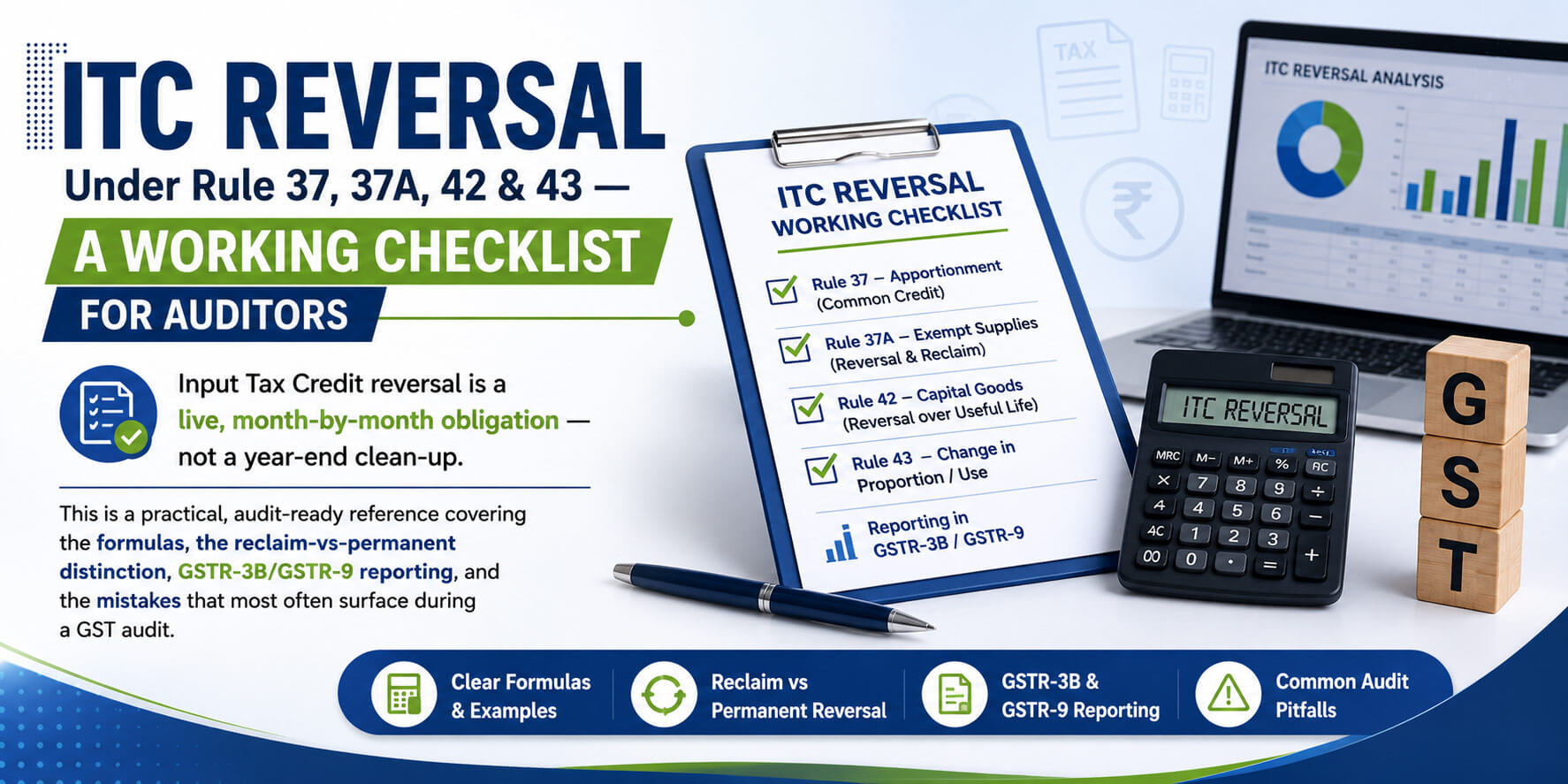
Input Tax Credit reversal is a live, month-by-month obligation — not a year-end clean-up. This is a practical, audit-ready reference covering the formulas, the reclaim-vs-permanent distinction, GSTR-3B/GSTR-9 reporting, and the mistakes that most often surface during a GST audit.
Overview: What Triggers a Reversal
Input Tax Credit under GST is conditional, not absolute. Section 16(2) of the CGST Act sets out cumulative conditions a recipient must satisfy to retain credit — a valid tax invoice, receipt of goods or services, tax actually paid by the supplier to the government, and filing of the relevant return. When any of these conditions lapses after credit has already been availed, the law requires the credit to be reversed — effectively “paid back” through GSTR-3B.
Reversal obligations arise from several distinct triggers, each governed by its own rule and mechanics. For audit purposes, the four that dominate day-to-day compliance are Rules 37, 37A, 42, and 43 — alongside Section 17(5) blocked credits, which auditors should always check in parallel.
| Rule / Section | Trigger | Nature |
|---|---|---|
| Rule 37 | Payment to supplier not made within 180 days of invoice date | Reclaimable |
| Rule 37A | Supplier reports the invoice but fails to pay tax via GSTR-3B by 30 September of the following FY | Reclaimable |
| Rule 38 | ISD reversal, apportioned proportionately among recipient units | Permanent |
| Rule 42 | Common inputs/input services used partly for taxable, partly for exempt/non-business supplies | Permanent |
| Rule 43 | Common capital goods used partly for taxable, partly for exempt supplies | Permanent |
| Sec 17(5) | Blocked credits — motor vehicles, club memberships, certain food & beverage, works contract, etc. | Permanent |
Reclaimable vs. Permanent Reversals
This distinction is the single most important thing to get right during an audit, because it drives both the accounting treatment and the ongoing tracking obligation.
Reclaimable (Rules 37 & 37A)
- Credit is temporarily reversed and can be re-availed once the underlying condition is cured
- Rule 37: reclaim once payment is made to the supplier
- Rule 37A: reclaim once the supplier files the pending GSTR-3B and pays the tax
- Must be tracked through the Electronic Credit Reversal and Re-claimed Statement (ECRRS)
Permanent (Rules 38, 42, 43 & Sec 17(5))
- Credit reversed here cannot be reclaimed under any circumstance
- Must be treated as a cost/expense in the books, not carried as a receivable
- Rule 42/43 annual true-up can still swing the number, but the reversed portion itself is gone
- Reported once and closed — no future reclaim entry required
Auditor’s first check
Confirm that reclaimable reversals (Rule 37/37A) are not being written off as permanent expenses, and that permanent reversals (Rule 42/43) are not sitting in a “recoverable” ledger waiting for a reclaim that will never come. This single mis-classification is one of the most common errors found during GST audits.
Rule 37 — The 180-Day Payment Rule
Section 16(2)(b) read with Rule 37 requires that where a recipient has availed ITC but has not paid the supplier — the invoice value plus tax — within 180 days of the invoice date, the credit availed must be reversed in the GSTR-3B of the month following expiry of that 180-day period.
ITC to Reverse = ITC Availed × (Unpaid Amount incl. Tax ÷ Invoice Value incl. Tax)
Partial payment = partial reversal
Only the proportion of the invoice value left unpaid triggers reversal — a partial payment does not force a reversal of the entire credit, only the unpaid share.
Interest applies
Interest under Section 50(3) runs at 18% per annum from the date the credit was originally credited to the Electronic Credit Ledger until the date of reversal or payment, whichever is earlier.
Retention money is not exempt
A common misconception: contractual retention money withheld from a supplier does not escape the 180-day clock. If it isn’t paid, the proportionate ITC must still be reversed.
Rule 37A — Supplier Non-Filing
Rule 37A addresses a different risk entirely: the supplier has correctly reported the invoice in their GSTR-1/IFF (so it appears in your GSTR-2B), but has failed to actually pay the tax by filing GSTR-3B for that period by 30 September following the end of the financial year. In such cases, the recipient is required to reverse the corresponding ITC.
Track vendor filing status through the year
Reconciling GSTR-2B alone isn’t enough — auditors should verify whether the supplier has actually filed GSTR-3B for the period the invoice pertains to, not just reported it in GSTR-1.
Flag reversal obligation post-30 September
If the supplier still hasn’t filed by 30 September of the following financial year, the recipient must reverse the ITC in the return for the month in which this deadline falls.
Reclaim once the supplier files
The credit can be reclaimed in a subsequent period once the supplier files the pending GSTR-3B and pays the tax — track this through the ECRRS ledger.
Why this rule catches auditors off guard
Ignoring Rule 37A is a frequent failure point because businesses assume GSTR-2B reflection is sufficient proof of eligibility. It isn’t — GSTR-2B reflects invoice reporting, not tax payment. This gap often surfaces in bulk during the September reconciliation cycle, producing large, unexpected reversals if not tracked monthly.
Rule 42 — Common Inputs & Input Services
Rule 42 applies where inputs or input services are used partly for taxable supplies (including zero-rated) and partly for exempt supplies or non-business purposes. The mechanism works through a structured attribution formula, computed monthly and trued up annually.
T = Total input tax credit
T1 = Credit specifically for non-business use
T2 = Credit specifically for exempt supplies
T3 = Blocked credit under Section 17(5)
C1 = T − (T1 + T2 + T3) → credited to Electronic Credit Ledger
T4 = Credit specifically for taxable supplies
C2 = C1 − T4 → common credit remaining
D1 = C2 × (Exempt Turnover ÷ Total Turnover) → attributable to exempt supplies
D2 = 5% of C2 → deemed credit for non-business use (only if T1 not separately identified)
C3 = C2 − (D1 + D2) → final eligible common credit
D2 is a fallback, not a default
The 5% deemed reversal (D2) applies only when the taxpayer has not separately and specifically identified inputs/input services used for non-business purposes. Where T1 is properly identified, D2 does not apply — this prevents double reversal.
Monthly, then trued up annually
D1 and D2 reversals happen every month based on that month’s turnover ratio, but must be recomputed at year-end against actual annual figures — any shortfall must be paid with interest; any excess can be claimed back.
Rule 43 — Common Capital Goods
Rule 43 governs reversal for capital goods used partly for taxable and partly for exempt supplies. Because capital goods are used over an extended period, the law treats them differently — spreading the credit, and any reversal, over a deemed useful life of 5 years (60 months).
Classify capital goods at acquisition
Determine at the time of purchase whether the capital good is used exclusively for taxable supplies, exclusively for exempt supplies, or for common use — this classification drives the entire reversal treatment.
Spread common-use credit over 60 months
For capital goods used for common purposes, the credit is deemed to be used equally over 5 years, and the reversal attributable to exempt supplies is computed and reversed every month for the remaining useful life.
Watch for a change in use
Where a capital good initially used exclusively for taxable supplies is later also put to exempt use, monthly reversal computation must begin from the point of change — a frequent audit miss when asset usage evolves mid-life.
Annual true-up under Rule 43(2)
Like Rule 42, the Rule 43 reversal must also be trued up annually against the actual turnover ratio for the year, with any shortfall paid via GSTR-3B along with applicable interest.
GSTR-3B, ECRRS & GSTR-9 Reporting
Correct reporting matters as much as correct computation — misreporting a reversal in the wrong table is itself a common source of notices.
| Table / Statement | Used For |
|---|---|
| GSTR-3B Table 4(B)(1) | Permanent reversals — Rule 42, Rule 43, Section 17(5) blocked credits |
| GSTR-3B Table 4(B)(2) | Reclaimable reversals — Rule 37, Section 16(2)(b)/16(2)(c) related reversals |
| GSTR-3B Table 4(A)(5) | Reclaim of ITC previously reversed under Table 4(B)(2), once conditions are met |
| GSTR-3B Table 4(D)(1) | All reclaimed ITC amounts must also be reflected here for cross-verification |
| ECRRS | Electronic Credit Reversal and Re-claimed Statement — tracks every reversal and reclaim against each other on the portal |
| GSTR-9 / 9C | Annual reconciliation of reversed and reclaimed ITC against books — a key audit working paper |
Audit tip: The ECRRS ledger is designed to make inconsistencies between reversal and reclaim entries visible to the department automatically. Any mismatch between what’s reversed in Table 4(B)(2) and what’s later reclaimed in Table 4(A)(5)/4(D)(1) should be reconciled before filing GSTR-9, not discovered by a notice.
The Working Audit Checklist
A practical sequence to run through for each period under audit:
- Reconcile Purchase Register against GSTR-2B for the period, flagging any invoices not reflected
- Review supplier GSTR-3B filing status for every invoice claimed as ITC — not just GSTR-1/IFF reporting (Rule 37A exposure)
- Age all unpaid vendor invoices past 150 days to flag upcoming 180-day Rule 37 triggers before they crystallise
- Verify partial-payment invoices are reversed only proportionately, not reversed in full or missed entirely
- Confirm interest under Section 50(3) has been computed and paid on all Rule 37/37A reversals
- Re-verify Section 17(5) blocked credit categories against the purchase ledger — motor vehicles, club memberships, food & beverages, works contract, construction-related credits
- Recompute Rule 42 common credit reversal (T1–T4, D1, D2) for at least one sample month and compare to the taxpayer’s working
- Confirm D2 (5% deemed reversal) is applied only where T1 has not been separately identified — check for double reversal
- Trace capital goods additions during the year and confirm correct classification (exclusive taxable / exclusive exempt / common)
- Recompute Rule 43 monthly reversal for a sample capital asset and verify the 60-month spread is being correctly applied
- Check for any mid-life change in capital goods use that should have triggered a fresh reversal computation
- Perform the Rule 42/43 annual true-up computation and compare against what was actually reversed through the year
- Reconcile Table 4(B)(1) and 4(B)(2) of GSTR-3B against books — confirm permanent vs. reclaimable classification is correct
- Trace all Table 4(A)(5)/4(D)(1) reclaim entries back to an original Table 4(B)(2) reversal — flag orphan reclaims
- Cross-check the ECRRS ledger on the portal against the taxpayer’s internal reversal/reclaim tracker for the full year
- Prepare GSTR-9/9C working papers with a clear, itemised RCM and ITC reversal reconciliation schedule
Common Mistakes Auditors Should Flag
No ageing alert system
Businesses without an automated 150/170-day ageing alert on vendor payments routinely discover Rule 37 exposure only after the 180-day window has already lapsed, adding avoidable interest cost.
Treating GSTR-2B as sufficient
Assuming an invoice reflected in GSTR-2B is automatically “safe” ignores Rule 37A entirely — GSTR-2B shows reporting, not payment, and vendor GSTR-3B status still needs independent tracking.
Mixing reclaimable and permanent reversals
Booking a Rule 42/43 permanent reversal as a recoverable asset, or writing off a Rule 37 reclaimable reversal as a permanent expense, distorts both the books and the GSTR-9 reconciliation.
Static capital goods classification
Treating a capital good’s original use classification as permanent, without monitoring for a change in use over its 5-year life, is a frequent source of under-reversal caught only at audit or assessment.
Quick FAQs
Can Rule 37 reversal be done through Form DRC-03?
No. DRC-03 is meant for voluntary payment of tax liability or payment in response to a show-cause notice. ITC reversal under Rule 37 must be reported through GSTR-3B, not DRC-03.
Is interest payable on Rule 42/43 reversals the same way as Rule 37?
Interest exposure primarily arises where a reversal was due but not made in time — including shortfalls identified at the Rule 42/43 annual true-up. Since Rule 42/43 reversals are permanent in nature, any delay in reversing the correct amount during the year, followed by a true-up shortfall, attracts interest on that shortfall.
Does Rule 37A apply even if the recipient has no way of knowing the supplier hasn’t filed?
Yes — the obligation is on the recipient to track and reverse ITC where the supplier has not filed GSTR-3B by 30 September of the following financial year, regardless of the recipient’s independent knowledge. This is precisely why ongoing vendor compliance monitoring is essential, not optional.
What’s the single most valuable audit working paper for ITC reversal?
A month-wise reconciliation schedule that separately tracks Rule 37, 37A, 42, and 43 reversals against the ECRRS ledger and GSTR-3B Table 4(B) entries — cross-referenced to the GSTR-9 annual return — is the most defensible working paper if the position is later questioned in assessment.