
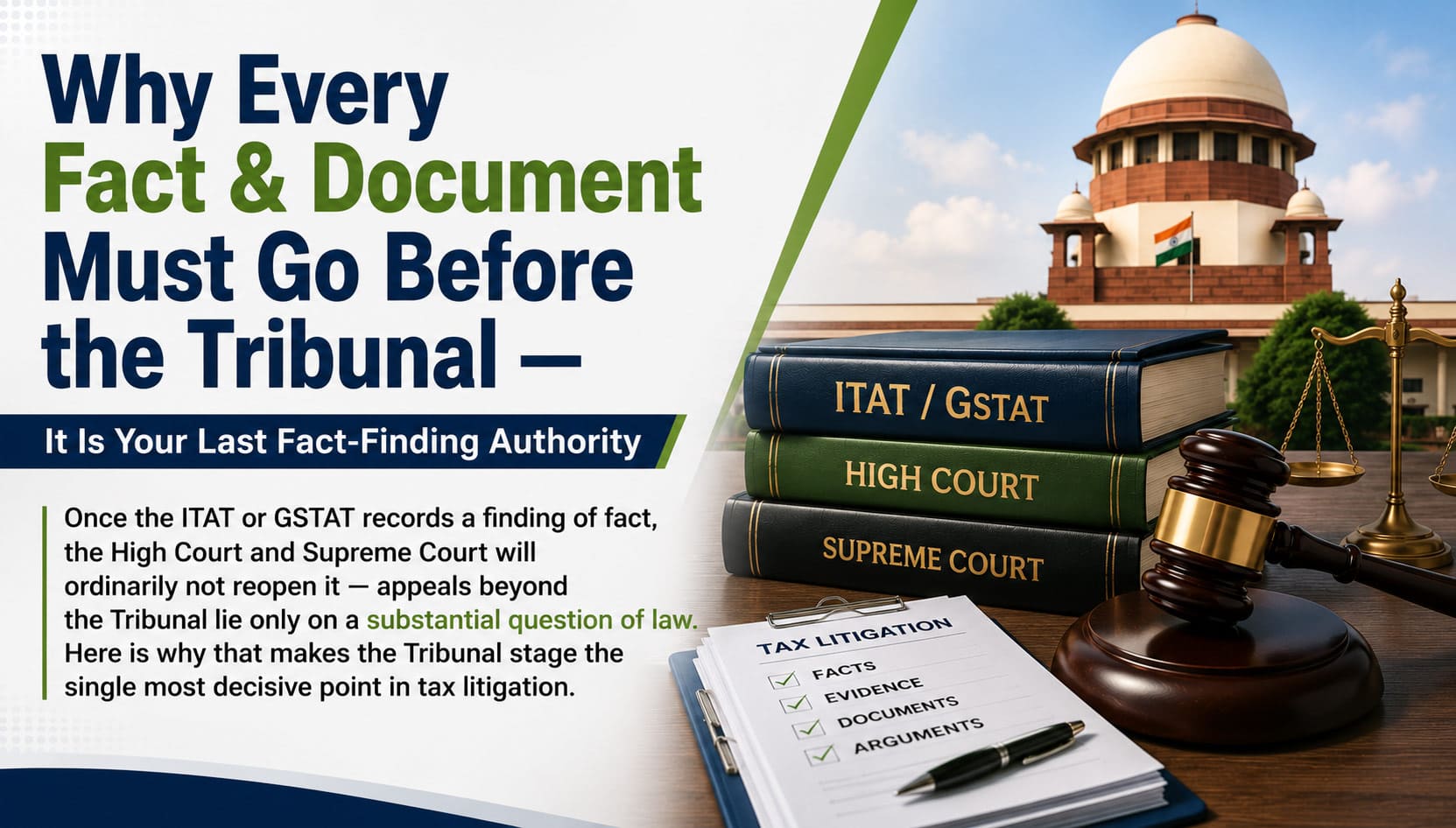
Once the ITAT or GSTAT records a finding of fact, the High Court and Supreme Court will ordinarily not reopen it — appeals beyond the Tribunal lie only on a substantial question of law. Here is why that makes the Tribunal stage the single most decisive point in tax litigation.
The Appellate Hierarchy — Where Facts Get Locked In
Both the income-tax and GST appellate structures follow the same basic shape: an assessment or adjudication order, a first appeal to a departmental appellate authority, a second appeal to a Tribunal, and only then a further appeal to the High Court and Supreme Court. What changes as a matter moves up this ladder is not just the forum — it is the very nature of what that forum is permitted to examine.
AO / CIT(A) / ITAT
- Full jurisdiction over both facts and law
- Can examine evidence, call for records, assess credibility of documents and witnesses
- Can enhance, reduce, confirm, or annul an assessment based on the facts before it
- The last forum where a fresh factual dispute can genuinely be won or lost
High Court / Supreme Court
- Jurisdiction restricted to a “substantial question of law”
- Does not re-appreciate evidence or reweigh facts already found by the Tribunal
- Bound by the Tribunal’s findings of fact unless they are perverse — arrived at without evidence, or in defiance of it
- Cannot ordinarily entertain new documents or facts never placed before the Tribunal
The Legal Basis: Why the High Court and Supreme Court Won’t Reopen Facts
Under the Income Tax Act, an appeal from the Tribunal to the High Court lies only where the case involves a substantial question of law — this is the express statutory language, carried forward without change from the old Act into the new. The same restriction governs a further appeal to the Supreme Court. This is not a technicality; it reflects a deliberate design choice: Parliament intended the Tribunal, as a specialised, quasi-judicial body staffed by both judicial and accountant members, to be the final forum equipped to weigh evidence, assess the genuineness of transactions, and determine facts. The higher courts exist to correct errors of law, not to conduct a second trial on facts.
The practical consequence: if a document was never filed, a fact was never argued, or a witness was never produced before the Tribunal, there is generally no second chance to introduce it later. The High Court will ask whether the Tribunal’s conclusion on the facts before it was legally sustainable — not whether a different, better-documented case might have succeeded.
What the Courts Have Actually Said
ITAT as final fact-finding authority
The Supreme Court’s ruling in the K.C. Builders line of cases, and the settled position followed by numerous High Courts since, treats findings of fact recorded by the Tribunal as conclusive and binding — not merely on the tax proceeding itself, but on subsequent proceedings that turn on the same facts.
Plenary powers — but only on facts already on record
In CIT v. Mahalakshmi Textile Mills Ltd (1967) 66 ITR 710 (SC), the Supreme Court held that the Tribunal has wide powers to grant relief on a legal ground arising from facts already on record, even where that ground was not specifically raised before the Assessing Officer. The qualifying phrase matters: the ground must arise from facts already on record. The Tribunal’s flexibility on legal argument does not extend to entertaining facts that were never placed before it.
Transfer pricing — a clear illustration
Indian High Courts have repeatedly held that once the Tribunal, as the last fact-finding authority, determines an arm’s length price on the evidence before it, no further question of law typically arises from that determination — the matter effectively reaches finality at the Tribunal stage.
Additional grounds vs additional facts
Courts have consistently distinguished between admitting a new legal argument on existing facts (generally permitted) and admitting new facts or evidence for the first time at a later stage (generally not permitted, and only through a formal, exceptional route).
What the Tribunal Itself Can — and Cannot — Do With Late Evidence
Even at the Tribunal stage itself, there is no automatic right to introduce fresh documentary evidence that was not filed before the Assessing Officer or the first appellate authority. Additional evidence before the Tribunal is governed by a specific procedural rule (Rule 29 of the Income Tax Appellate Tribunal Rules, and the equivalent procedure under the GSTAT Procedure Rules), and is admitted only in limited circumstances — typically where the lower authority refused to admit evidence that ought to have been admitted, or where the Tribunal itself requires the document to pronounce judgment, or to enable it to pass an order, or for other substantial cause. It is not a mechanism to make good gaps in a case that could and should have been addressed earlier.
“We’ll produce it later” is a genuine risk, not a safe strategy
- Additional evidence applications are decided at the Tribunal’s discretion, not as of right.
- A Tribunal that admits late evidence typically remands the matter back to the Assessing Officer for verification — adding years to a dispute that could have been resolved at first instance.
- Where late evidence is refused admission, the assessee is often left with no live remedy at all, since the High Court will not entertain it either.
The Real Cost of an Incomplete Record
Consider a typical unexplained cash credit dispute under the deeming provisions. If confirmations, bank statements, and proof of the creditworthiness and identity of the lender are not placed before the Assessing Officer and reinforced before the CIT(A), and the matter proceeds to the Tribunal on an incomplete record, the Tribunal will decide the addition purely on what is before it. If the Tribunal upholds the addition for want of evidence, the assessee’s remedy before the High Court is effectively closed — the absence of evidence is itself treated as a finding of fact, and “the assessee had the documents but simply did not file them in time” is not a substantial question of law.
An adverse factual finding becomes near-permanent
Once the Tribunal records that a transaction was not proved genuine, or that a claim was not substantiated, that finding effectively closes the door on the merits for all future stages of the same dispute.
Legal arguments cannot rescue a weak factual record
A sound legal argument built on an incomplete factual foundation will usually fail — the Tribunal, and every forum above it, decides the case on the facts actually established, not on the facts that could have been established with better documentation.
Collateral consequences follow the same finding
A Tribunal’s factual finding on genuineness or concealment can carry over into penalty proceedings, prosecution matters, and even proceedings under other statutes — a poorly built record at the quantum stage can compound losses well beyond the original dispute.
The Same Principle Applies Under GST — GSTAT
With the GST Appellate Tribunal now operational, the identical structural logic applies to indirect tax disputes. A second appeal from GSTAT to the High Court under Section 112 of the CGST Act lies only on a substantial question of law — GSTAT sits as the highest forum on questions of fact in GST litigation, exactly as ITAT does for income tax. Every principle discussed above — the importance of a complete paper book, the restricted scope for additional evidence, and the practical finality of adverse factual findings — applies with equal force to matters before GSTAT.
A Practical Checklist for the Tribunal Stage
Build the paper book at first instance, not at appeal
Every document that could conceivably matter should be filed at the assessment or adjudication stage itself — treat the CIT(A)/first-appellate stage as the last comfortable opportunity to add to the record, not the Tribunal.
Confirm every fact you rely on is actually on record
Before finalising submissions to the Tribunal, cross-check each factual assertion in the written submission against a specific page reference in the paper book — an assertion without a record reference is vulnerable.
Get findings recorded precisely, not just outcomes
Where the Tribunal rules in your favour, ensure the order records the specific factual findings (genuineness established, documents examined, creditworthiness proved) — a favourable outcome with vague reasoning is weaker precedent-wise than one with clear factual findings.
Treat additional evidence applications as a last resort
If a genuine gap is discovered late, file a properly reasoned Rule 29 application explaining why the evidence could not be produced earlier — but plan the case so this is the exception, not the strategy.
Common Questions
Can I introduce a new document directly before the High Court if it strengthens my case?
Ordinarily, no. The High Court’s jurisdiction is confined to substantial questions of law arising from the record as it stood before the Tribunal; it does not admit fresh evidence in the way a trial court would.
If the Tribunal’s finding was clearly wrong on the facts, is there truly no remedy?
There is a narrow exception: where a finding of fact is “perverse” — meaning no reasonable person could have reached it on the evidence, or it was arrived at by ignoring relevant material or relying on no material at all — the High Court can treat that as itself giving rise to a substantial question of law. This is a high threshold and should never be relied upon as a substitute for building the record properly in the first place.
Does this mean legal arguments don’t matter at the Tribunal stage?
They matter greatly — but only once the facts are properly established. The Tribunal has real flexibility to entertain new legal grounds arising from facts already on record. What it does not have, and does not readily grant, is licence to receive facts that were never placed before it.