
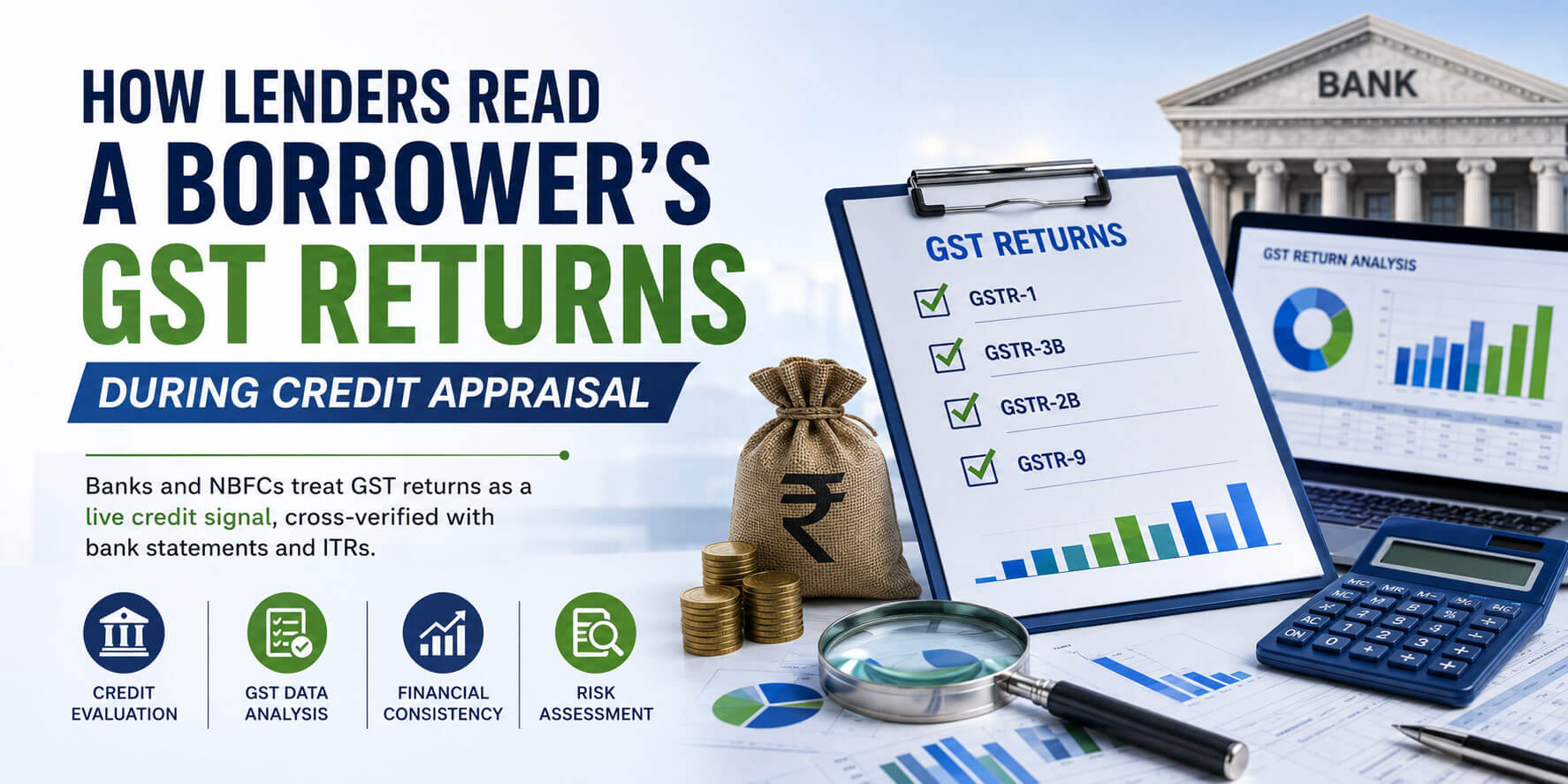
Banks and NBFCs no longer treat GST returns as a box-ticking compliance document — they treat them as a live credit signal, cross-verified line by line against bank statements and ITRs. Here’s exactly what a credit officer is looking for, and a working checklist to get ahead of it before you file the loan application.
Why GST Returns Now Drive Credit Decisions
GST filing compliance in India has climbed above 92% in recent periods, creating a dataset most credit teams now treat as a primary underwriting input rather than a secondary document. For MSME lending in particular, GST returns solve a problem banks have struggled with for decades: independently verifying a borrower’s actual turnover, rather than relying solely on self-prepared financials.
The shift is structural, not cosmetic. Credit officers increasingly pull GSTR data alongside bank statements and ITRs as three simultaneous, cross-checked data sources — and a mismatch between them is now one of the fastest ways a loan application gets delayed, downsized, or declined.
In one line: A borrower’s GST returns are no longer just proof the business exists and is compliant — they are an independent, third-party-verifiable record of turnover that lenders actively reconcile against everything else in the file.
Which Returns Lenders Pull, and Why
| Return | What It Shows | What Lenders Check |
|---|---|---|
| GSTR-1 | Outward supplies, invoice-wise | Actual sales pattern, credit terms extended to customers, buyer concentration, revenue trend month-on-month |
| GSTR-3B | Self-declared summary return — turnover, tax liability, ITC claimed, tax paid | Payment discipline, ITC-to-purchase ratio, month-on-month turnover consistency, filing timeliness |
| GSTR-2A / 2B | Auto-populated inward supplies based on supplier filings | Whether claimed ITC actually matches supplier-reported invoices — a gap signals fake or unfiled vendor invoices |
| GSTR-9 / 9C | Annual return and reconciliation statement (turnover above ₹2 crore / ₹5 crore respectively) | Annual turnover verification against audited financials — a key cross-check for larger exposures |
A useful fact to keep in mind when preparing a client’s file: GSTR-3B has been under a hard-lock rule since mid-2025 and cannot be revised after filing. This means any correction has to flow through subsequent periods or amendments — lenders reviewing historical GSTR-3B data are looking at what was actually declared at the time, not a cleaned-up version.
The Triangulation: GST vs. Bank vs. ITR
The single most consequential check in the entire appraisal is the cross-verification between three independent numbers: GST-declared turnover, actual bank credits, and ITR-reported income. These figures will never match exactly — GST turnover includes advance receipts and excludes non-revenue capital infusions that show up in bank credits — but they need to sit within a reasonable band of each other.
Average Monthly Credits (AMC)
Total bank credits divided by number of months, used as a proxy for revenue and compared against annualised GST turnover — typically expected within roughly 15-25% of each other, accounting for timing differences.
Average Monthly Balance (AMB)
Lenders generally expect AMB to sit at around 10-15% of monthly turnover — a business with high declared turnover but a razor-thin average balance signals fragile liquidity.
Debit-to-Credit Ratio
A ratio above roughly 0.95 — where debits consume nearly all credits — suggests no real buffer exists to absorb a new EMI without straining day-to-day operations.
A business declaring ₹20 lakh monthly turnover in GSTR-3B while showing ₹1 crore or more in monthly bank credits is a textbook red flag — the gap is rarely a rounding difference, and typically points to undeclared sales, inflated bank credits from unrelated sources, or an entirely different business reality than what’s on paper.
It runs both directions
A mismatch isn’t only a problem when bank credits exceed GST turnover. Inflated GST invoices designed purely to show a higher turnover for loan-sizing purposes — without matching bank inflows — are an equally common fraud pattern lenders now screen for specifically.
ITC Patterns and Vendor Authenticity
Beyond turnover, lenders increasingly scrutinise the Input Tax Credit side of the return as a window into the authenticity of a borrower’s supply chain.
ITC claimed vs. GSTR-2A/2B availability
Claimed ITC should closely track what actually appears in GSTR-2A/2B. A persistent gap above roughly 10% needs a credible explanation — it often means suppliers aren’t filing their own returns, raising questions about whether those vendors, or the invoices themselves, are genuine.
ITC vs. actual vendor payments
Every ITC claim should have a corresponding payment reflected in bank statements. Claims without a traceable payment trail invite questions about the legitimacy of the underlying purchase.
Excessive ITC relative to purchases
ITC claims that appear disproportionately high relative to the declared purchase volume are treated as a manipulation signal, not a technical anomaly to be explained away casually.
Filing Discipline as a Risk Signal
How consistently a business files — not just what it declares — has become its own credit signal.
Sudden nil or stopped filings
A business that filed on time for six months and then abruptly stops or switches to nil returns despite continued bank activity is read as a sign of cash-flow crisis or business distress — a direct red flag for default risk.
Chronic late filing
Persistently late GSTR-1/3B filing is treated as a proxy for weak financial discipline more broadly, even where the numbers themselves look acceptable.
Declining tax payment despite stable sales
Where turnover looks flat but actual tax paid trends downward, lenders read this as an early indicator of margin compression or emerging revenue decline not yet visible elsewhere in the file.
Concentration Risk & Circular Trading
Buyer concentration
Where GSTR-1 shows a large share of sales — commonly cited around 80% — flowing to a single buyer, lenders factor this into credit limits and covenants, since a payment delay from that one anchor customer can directly trigger default.
Circular trading patterns
Where Business A sells to Business B, B sells to C, and C sells back to A — with similar amounts and timing repeating across GSTR-1 filings — this is treated as artificial turnover inflation with no real economic activity behind it, and typically results in outright rejection.
Related-party inflows disguised as revenue
Regular bank credits that turn out to originate from entities controlled by a promoter’s family members, without a corresponding genuine GST transaction, are a manual-review miss that automated cross-analysis is increasingly designed to catch.
CMA Data Consistency
For working capital facilities, the Credit Monitoring Arrangement (CMA) data a CA prepares is one of the most heavily scrutinised documents in the file — and any inconsistency between the CMA data and GST returns, ITR filings, or audited financials is flagged as a deficiency that delays or complicates the appraisal.
Projected turnover in the CMA is routinely tested against historical GST returns, not just against the previous year’s audited financials — meaning a CA preparing projections needs the GST filing history reconciled and explainable before the CMA is even submitted, not after a bank query arrives.
The Account Aggregator Shift
A structural change worth watching: major banks are now live as Financial Information Providers under India’s Account Aggregator framework, and GST data integration through NeSL is progressing through pilot stages. As this matures, lenders will increasingly pull verified GST and bank data directly at the source — with borrower consent — rather than relying on uploaded documents that can be selectively curated.
The practical implication for advisors: the era of presenting a “curated” set of financials to a lender is closing. Preparing a client’s actual GST and banking position to be internally consistent — well before an application — is becoming more valuable than preparing a persuasive-looking file.
A CA’s Pre-Application Checklist
Before a client submits a loan application, run the file through this sequence — catching a mismatch here is far cheaper than explaining it to a credit officer later.
- Reconcile 12-24 months of GSTR-3B declared turnover against actual bank credit inflows for the same period, and be ready to explain any variance beyond a reasonable band
- Confirm GSTR-1 sales figures tie to the sales register and to bank credits, invoice by invoice for a sample period
- Check ITC claimed in GSTR-3B against GSTR-2A/2B availability, and flag any gap exceeding roughly 10% for explanation
- Trace a sample of ITC claims to actual vendor payments in the bank statement
- Review the filing history for late filings, nil returns, or gaps — and be prepared to explain any irregular pattern with genuine business context
- Calculate buyer concentration from GSTR-1 data and assess whether it needs to be proactively addressed in the loan proposal
- Screen for any circular pattern among related GSTINs — same amounts, same timing, round-tripping through common counterparties
- Verify GST turnover for the relevant year(s) ties to the audited financials and the CMA data projections
- Cross-check declared income in the ITR against GST turnover and bank credit patterns for consistency
- Compute AMB as a percentage of monthly turnover and the debit-to-credit ratio, and address weak liquidity signals before, not during, the appraisal
- Where discrepancies genuinely exist, prepare a clear, documented explanation (timing differences, capital infusions, advance receipts) rather than leaving the lender to guess
Quick FAQs
How much of a gap between GST turnover and bank credits is considered acceptable?
There’s no fixed statutory threshold, but in practice lenders generally expect the two figures to sit within roughly 15-25% of each other after accounting for timing differences, advance receipts, and non-revenue capital inflows. Gaps significantly beyond this band typically require detailed explanation and documentation.
Does a single instance of late GST filing seriously hurt a loan application?
An isolated instance is unlikely to be decisive on its own, but a chronic pattern of late or nil filings is read as a broader signal of financial discipline and potential distress, and will generally attract closer scrutiny of the rest of the file.
Can GSTR-3B be corrected if an earlier error is discovered before a loan application?
GSTR-3B cannot be revised after filing under the current hard-lock rule. Corrections must flow through amendments in subsequent periods. This makes it important to identify and address discrepancies well before they surface during a bank’s independent review.
Is buyer concentration always a dealbreaker?
No — it’s a risk factor lenders price into the facility through tighter covenants or lower limits rather than an automatic rejection, provided the anchor buyer relationship is genuine, well-documented, and the concentration is disclosed upfront rather than discovered during review.