
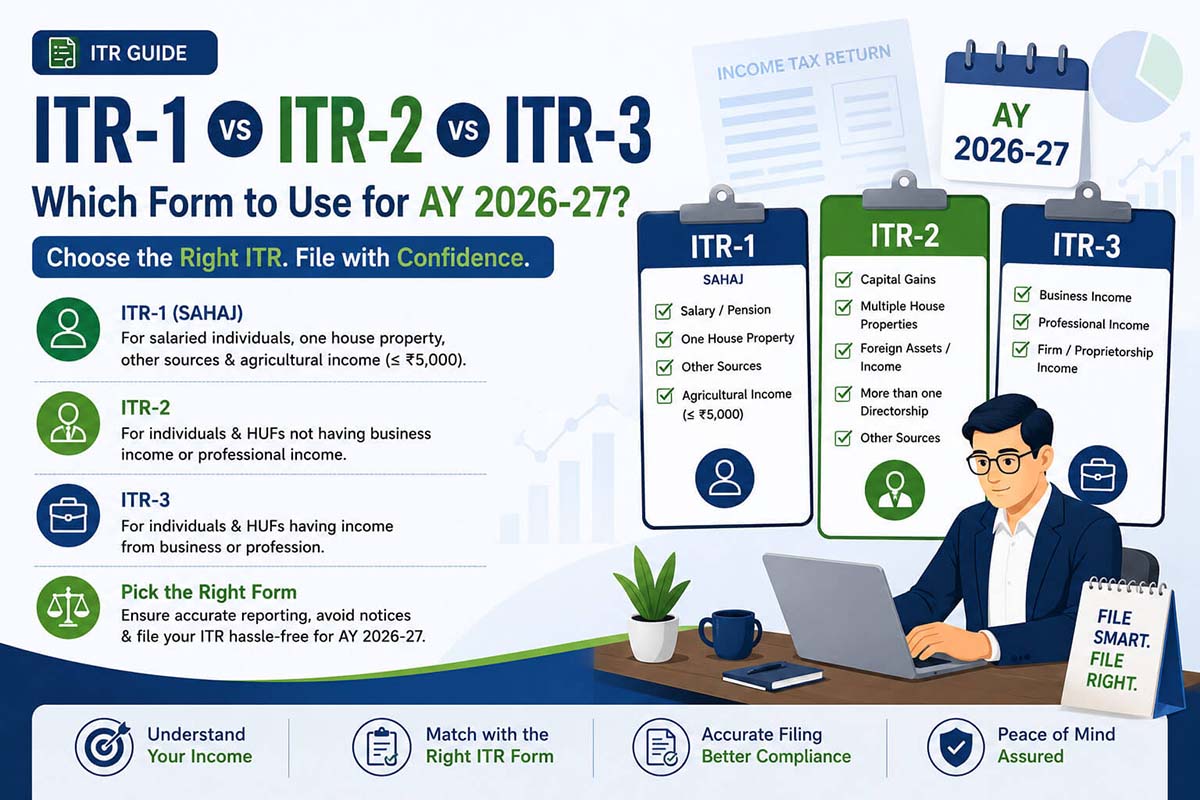
Filing the wrong ITR form makes your return defective and triggers a notice. This complete guide tells you exactly which form applies to you — including all new changes for FY 2025-26.
IT Act 2025 does NOT apply to this year’s filing
You may have read about the new Income Tax Act, 2025 which came into force from 1 April 2026. It does not affect returns being filed right now. ITR forms for AY 2026-27 cover income earned in FY 2025-26 (April 2025 to March 2026) — this income is taxed entirely under the old Income Tax Act, 1961. Old form names (ITR-1, ITR-2, ITR-3…), old section numbers (80C, 194A, 143…), and old deduction rules all continue to apply. On the IT portal, always use Tab 1 (Income Tax Act 1961) for current filings.
Quick Selector: Find Your ITR Form in 30 Seconds
Answer three questions about your income and the tool will tell you which form to use.
🔍 ITR Form Selector — AY 2026-27
Select one answer for each question. The recommendation updates instantly.
Form Overview at a Glance
There are seven ITR forms in total (ITR-1 through ITR-7). For individuals and HUFs — which covers the vast majority of taxpayers — the four relevant forms are ITR-1, ITR-2, ITR-3, and ITR-4. Here is a quick snapshot of each.
Simple Salaried
Investors & Multiple Sources
Business & Professionals
Presumptive Business
ITR-1 (Sahaj) — Who Can and Cannot Use It
ITR-1 is the simplest income tax return form, designed for resident salaried individuals with straightforward income profiles. For AY 2026-27, its scope has been significantly expanded — more taxpayers can now use it than before.
Who CAN file ITR-1 (all conditions must be met)
You can file ITR-1 if ALL of the following are true
- You are a resident individual (not NRI, RNOR, or HUF)
- Total income from all sources is ₹50 lakh or less
- Income is from salary or pension (including standard deduction)
- Income from up to two house properties — self-occupied, let-out, or one of each. NEW this year
- Income from other sources — interest (savings, FDs), family pension, dividends
- LTCG under Section 112A up to ₹1.25 lakh from listed equity shares or equity-oriented mutual funds — with no brought-forward or carry-forward capital losses. NEW this year
- Agricultural income up to ₹5,000
- You are not a director in any company
- You have not invested in unlisted equity shares
- You do not have any foreign assets or foreign income
- TDS has not been deducted under Section 194N (cash withdrawal above ₹1 crore)
- You do not have income tax deferred on ESOPs
Who CANNOT file ITR-1 — must move to a higher form
🚫 You cannot use ITR-1 if any of the following apply
- Total income exceeds ₹50 lakh
- You have income from business or profession (any amount)
- You have capital gains from property, gold, debt mutual funds, unlisted shares, or foreign assets — move to ITR-2
- LTCG under Section 112A exceeds ₹1.25 lakh — move to ITR-2
- You have any short-term capital gains — move to ITR-2
- You have carry-forward losses under any head — move to ITR-2
- You own more than two house properties — move to ITR-2
- You are a company director — move to ITR-2 (if no business income) or ITR-3
- You hold unlisted equity shares — move to ITR-2 or ITR-3
- You have foreign assets, foreign bank accounts, or foreign income — move to ITR-2
- You are an NRI or RNOR — move to ITR-2
- You have income from lottery, horse racing, or gambling — move to ITR-2
- You have Virtual Digital Asset (crypto) income — move to ITR-2 or ITR-3
🆕 The two biggest changes for ITR-1 in AY 2026-27: (1) You can now report income from two house properties instead of just one — meaning many salaried individuals with a second property no longer need to file the more complex ITR-2. (2) Small LTCG from listed equity or equity MFs (up to ₹1.25 lakh, Section 112A) can now be reported in ITR-1 directly, as long as there are no carry-forward capital losses.
ITR-2 — For Investors and Multiple Income Sources
ITR-2 is designed for individuals and HUFs who have income beyond a simple salary — particularly those with capital gains, multiple properties, foreign assets, or director status — but who do not have any business or professional income.
Who must file ITR-2
File ITR-2 if any of the following apply (and you have no business income)
- Total income exceeds ₹50 lakh
- Capital gains from property sale (Schedule CG with Sec 54/54F exemption claims)
- Capital gains from debt mutual funds, gold, unlisted shares, or other assets
- Capital gains from listed equity or equity MF where LTCG exceeds ₹1.25 lakh
- Any short-term capital gains (STCG) — from shares, property, MF, or any other asset
- Income from more than two house properties
- Income from foreign assets (bank accounts, property, investments abroad) — Schedule FA
- You are a director in a company (with no business income)
- You hold unlisted equity shares
- You are an NRI or RNOR
- You have carry-forward capital losses to set off or carry forward
- You have income from Virtual Digital Assets (crypto) — Schedule VDA
- You have income from lottery, horse racing, or gambling
- You claim double taxation relief under Section 90/90A/91
Key change in ITR-2 for AY 2026-27
The old capital gains tax rates — 15% STCG and 10% LTCG on listed equity — are no longer relevant for FY 2025-26. The Finance Act 2025 revised these rates: STCG under Section 111A is now 20% and LTCG under Section 112A is now 12.5% (without indexation benefit). The separate reporting fields for the old 15%/10% rates have been removed from ITR-2 for AY 2026-27. Capital gains must now be bifurcated by transaction date — gains arising before 23 July 2024 use old rates, and those after 23 July 2024 use new rates. This creates a split reporting requirement in Schedule CG for anyone with equity transactions spanning the Budget 2024 date.
Important: ITR-2 deadline is 31 July 2026
Unlike ITR-3 and ITR-4, whose deadline has been extended to 31 August 2026, ITR-2 retains the 31 July 2026 deadline. Salaried individuals with capital gains who would normally use ITR-2 should not assume they have until August. Missing the July 31 deadline triggers a ₹5,000 late fee under Section 234F plus interest on any tax due.
ITR-3 — For Business and Professional Income (Non-Presumptive)
ITR-3 is the form for individuals and HUFs who earn income from business or profession and are computing that income under the normal (actual books-of-accounts) method — not the presumptive scheme. It is the most comprehensive individual ITR form.
Who must file ITR-3
File ITR-3 if any of the following apply
- Income from proprietary business computed under actual books of accounts
- Income from profession — doctor, lawyer, CA, architect, engineer, consultant — not using the Section 44ADA presumptive scheme
- Partner in a firm — share of profit from a partnership firm, plus any salary/remuneration received from the firm (Section 40(b) / Section 28)
- F&O (Futures and Options) trading — treated as business income; turnover and P&L must be separately disclosed NEW field this year
- You have business income exceeding ₹50 lakh (making ITR-4 ineligible)
- You are a company director with any form of business income
- You have unlisted equity shares AND business income
- You switched from ITR-4 to ITR-3 because you opted out of the presumptive scheme and are within the 5-year lock-in period
- You have brought-forward business losses that need to be carried forward
- Any individual ineligible for ITR-1, ITR-2, or ITR-4 — ITR-3 is the residual form for individuals/HUFs
New deadline: 31 August 2026 for non-audit cases
This is a significant change introduced by the Finance Act 2026. For AY 2026-27, the due date for filing ITR-3 has been extended from 31 July to 31 August 2026 for taxpayers whose accounts are not subject to tax audit. For audit cases, the deadline remains 31 October 2026. This extension gives freelancers, consultants, F&O traders, and professionals an additional month to compile their books and file accurately.
New F&O separate disclosure in ITR-3
From AY 2026-27, ITR-3 includes a dedicated section for F&O (Futures and Options) trading income, requiring separate disclosure of F&O turnover and profit/loss in the P&L schedule. Previously, F&O income was often buried in general business income. This enhanced disclosure is aimed at improving the department’s ability to track derivatives trading income and cross-match it with exchange data.
F&O losses: report them even if you made a loss
Many F&O traders skip filing altogether if they made a net loss, believing there is no tax to pay. This is a mistake. F&O losses must be reported in ITR-3 to be eligible for carry-forward — you can carry forward business losses for 8 years and set them off against future F&O profits. If you do not file on time, the right to carry forward the loss is forfeited. Additionally, the AIS will show your F&O transactions even if you do not — creating a mismatch if no return is filed.
ITR-4 (Sugam) — Presumptive Taxation Scheme
ITR-4 is available to resident individuals, HUFs, and firms (other than LLPs) who opt for the presumptive taxation scheme — a simplified method where income is assumed to be a fixed percentage of turnover, avoiding the need for detailed books of accounts.
You can file ITR-4 if all of these are true
- Total income from all sources is ₹50 lakh or less
- Business income under Section 44AD — turnover up to ₹2 crore, declaring 6%/8% as income
- Professional income under Section 44ADA — gross receipts up to ₹75 lakh, declaring 50% as income
- Income from transport business under Section 44AE (goods vehicle operators)
- You also have income from salary, up to 2 house properties, or interest income
- LTCG under Section 112A up to ₹1.25 lakh (no carry-forward losses) NEW this year
🚫 You cannot use ITR-4 if any of these apply
- You are a company director
- You hold unlisted equity shares
- You have foreign assets
- Total income exceeds ₹50 lakh
- You have capital gains from property, debt MF, gold, or any asset other than the small equity LTCG exception
- You have a brought-forward business loss
- TDS deducted under Section 194N (large cash withdrawal)
- You have VDA (crypto) income
- You are an NRI
New mandatory disclosure in ITR-4 for AY 2026-27
From AY 2026-27, taxpayers filing ITR-4 must disclose investments made during the year in the Financial Particulars section. This is a new transparency requirement aimed at cross-checking declared income against the investment capacity of the business. Ensure your balance sheet and investment records are up to date before filing ITR-4 this year.
Key Changes in ITR Forms for AY 2026-27
CBDT notified all ITR forms on 30 March 2026 — earlier than in previous years. Beyond the expanded eligibility changes above, several structural and reporting changes apply across forms this year.
Two house properties in ITR-1 and ITR-4
Salaried taxpayers with up to two properties can now use the simpler ITR-1/ITR-4 instead of moving to ITR-2. Co-ownership reporting is also allowed in ITR-1 for the first time.
LTCG up to ₹1.25 lakh in ITR-1/ITR-4
Small LTCG from listed equity or equity MF under Section 112A (up to ₹1.25 lakh, no carry-forward losses) can now be reported in ITR-1 and ITR-4, avoiding the mandatory move to ITR-2.
New August 31 deadline for ITR-3 and ITR-4
Finance Act 2026 extended the non-audit deadline for ITR-3 and ITR-4 from 31 July to 31 August 2026. ITR-1 and ITR-2 remain at 31 July. Do not assume all forms have the same deadline.
Updated capital gains rates — split reporting
For equity transactions, gains before 23 July 2024 use old rates (STCG 15%, LTCG 10%). Gains after that date use new rates (STCG 20%, LTCG 12.5%). ITR-2 and ITR-3 require date-wise bifurcation in Schedule CG.
Tenant details now mandatory in ITR-1/ITR-4
If you receive rental income, you must now disclose tenant name, PAN, TAN, or Aadhaar. This helps the department cross-match rent deduction claims by tenants with rental income declared by landlords.
F&O separate disclosure in ITR-3
F&O trading now has dedicated fields for turnover and income in the P&L schedule of ITR-3. Previously embedded in general business income — now separately tracked.
Secondary address and contact details
All forms (ITR-1 through ITR-4) now allow a secondary mobile number, email, and address. Useful for those who move frequently or have correspondence and residential addresses that differ.
Aadhaar Enrolment ID no longer accepted
The 28-digit Aadhaar Enrolment ID is no longer valid for ITR filing. Only a valid 12-digit Aadhaar number is accepted. Ensure your Aadhaar is active and linked to your PAN before filing.
Section 80C sub-clause selection mandatory
Deductions under Sections 80C to 80U must now be selected from a dropdown menu with the exact clause/sub-section specified. This prevents inflated or incorrect deduction claims and improves verifiability.
New field: Section 234I fee on revised returns
A new fee is payable on revised returns filed after 31 December 2026 under Section 234I (Finance Act 2026 amendment). ITR forms include a dedicated disclosure field for this fee. Plan to file or revise before December 2026 to avoid it.
Side-by-Side Eligibility Comparison
| Criterion | ITR-1 | ITR-2 | ITR-3 | ITR-4 |
|---|---|---|---|---|
| Salary / pension income | ✔ Yes | ✔ Yes | ✔ Yes | ✔ Yes |
| Income limit | ≤ ₹50 lakh | No limit | No limit | ≤ ₹50 lakh |
| House properties | Up to 2 New | Any number | Any number | Up to 2 New |
| Business / professional income | ✘ No | ✘ No | ✔ Yes (actual) | ✔ Yes (presumptive) |
| LTCG (Sec 112A) from equity/MF | Up to ₹1.25L New | ✔ Any amount | ✔ Any amount | Up to ₹1.25L New |
| STCG from listed equity (Sec 111A) | ✘ No | ✔ Yes | ✔ Yes | ✘ No |
| Capital gains from property / gold / debt MF | ✘ No | ✔ Yes | ✔ Yes | ✘ No |
| Carry-forward losses | ✘ No | ✔ Yes | ✔ Yes | ✘ No |
| Foreign assets / foreign income | ✘ No | ✔ Yes | ✔ Yes | ✘ No |
| NRI / RNOR status | ✘ No | ✔ Yes | ✔ Yes | ✘ No |
| Company director | ✘ No | ✔ Yes (no biz) | ✔ Yes (with biz) | ✘ No |
| Unlisted equity shares held | ✘ No | ✔ Yes | ✔ Yes | ✘ No |
| Virtual Digital Assets (crypto) | ✘ No | ✔ Yes | ✔ Yes | ✘ No |
| F&O trading income | ✘ No | ✘ No | ✔ Yes (business) | Cond. (44AD only if eligble) |
| Balance sheet / P&L required | ✘ No | ✘ No | ✔ Yes | ✘ No (presumptive) |
| Applicable to HUF | ✘ No | ✔ Yes | ✔ Yes | ✔ Yes |
| Filing deadline (non-audit) | 31 Jul 2026 | 31 Jul 2026 | 31 Aug 2026 | 31 Aug 2026 |
| Filing deadline (audit cases) | N/A | N/A | 31 Oct 2026 | 31 Oct 2026 |
Filing Deadlines — AY 2026-27 at a Glance
Late filing consequences — do not wait
- ₹5,000 penalty under Section 234F — reduced to ₹1,000 if total income does not exceed ₹5 lakh
- Interest under Section 234A — 1% per month on unpaid tax from the due date to the date of filing
- Loss of carry-forward rights — capital losses and business losses can only be carried forward if the return is filed on time. A belated return forfeits this right permanently for that year
- Slower refund processing — belated returns typically take longer to process
- New fee under Section 234I — on revised returns filed after 31 December 2026 (Finance Act 2026 amendment)
What Happens If You File the Wrong ITR Form
Filing the wrong ITR form is treated as a defective return under Section 139(9). The consequences are not minor.
Section 139(9) — defective return notice
- The Income Tax Department issues a defective return notice, giving you 15 days (extendable) to rectify by filing the correct form
- If you do not respond within the notice period, the return is treated as never filed — with all the consequences of non-filing (penalty, interest, loss of carry-forward)
- If you are due a refund, it is withheld until the defect is rectified
- Defective returns can trigger scrutiny selection — the system flags them as potentially non-compliant
Most common wrong-form mistakes for AY 2026-27
Filing ITR-1 with STCG or large LTCG
Any short-term capital gains or LTCG above ₹1.25 lakh disqualifies you from ITR-1 — use ITR-2 instead.
Filing ITR-2 with F&O trading income
F&O is business income. ITR-2 cannot accommodate it. Must file ITR-3 (actual) or ITR-4 if eligible for 44AD.
Filing ITR-1 as NRI or with foreign assets
ITR-1 is only for resident individuals. NRIs and anyone with foreign assets must use ITR-2 or ITR-3.
Filing ITR-4 as a company director
Company directors cannot use ITR-4. Use ITR-2 (no business income) or ITR-3 (with business income).
Filing ITR-1 or ITR-4 with crypto income
Virtual Digital Asset (VDA) income must be reported in Schedule VDA — available only in ITR-2 and ITR-3.
Continuing with ITR-4 after exceeding ₹50 lakh
If your gross receipts in FY 2025-26 crossed ₹50 lakh (even as a consultant under 44ADA), you cannot use ITR-4 — file ITR-3 instead.
Frequently Asked Questions
Not Sure Which Form Applies to You?
Our senior CAs will review your income profile, confirm the right ITR form, reconcile your AIS, and file your return accurately — so you never receive a defective return notice or an avoidable demand.