
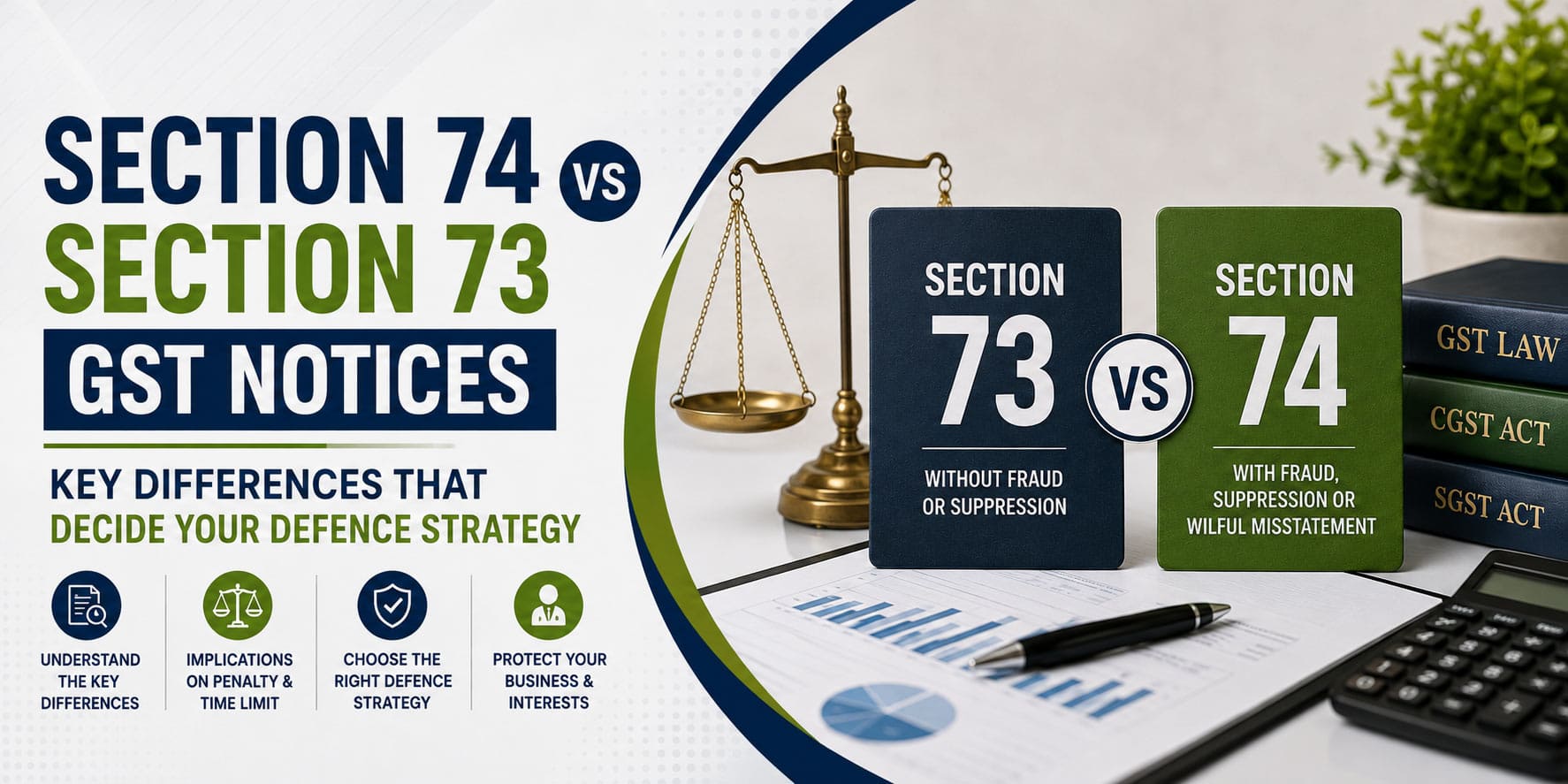
One word — “fraud” — separates a 10% penalty from a 100% one. Here’s how to tell which provision genuinely applies, and why the new Section 74A changes the game from FY 2024-25 onward.
The One Word That Changes Everything
Sections 73 and 74 of the CGST Act sit side by side, cover largely the same category of default — non-payment, short-payment, wrongly availed or utilised ITC, erroneous refund — and yet lead to dramatically different outcomes. The dividing line is a single phrase: whether the short-payment arose “for any reason other than fraud, wilful misstatement, or suppression of facts to evade tax” (Section 73), or because of those things (Section 74).
That single classification decision — made by the officer issuing the notice — determines your time limit, your penalty ceiling, and often the entire tenor of the proceeding. Getting the department to correctly (or honestly) classify a case is frequently the single highest-value argument in a GST defence.
Section 73 vs Section 74 — Full Comparison
| Parameter | Section 73 (Bona Fide) | Section 74 (Fraud/Suppression) |
|---|---|---|
| Trigger | Any reason other than fraud/wilful misstatement/suppression | Fraud, wilful misstatement, or suppression of facts to evade tax |
| Time limit — notice | At least 3 months before the limitation date | At least 6 months before the limitation date |
| Time limit — order | 3 years from the GSTR-9 due date | 5 years from the GSTR-9 due date |
| Penalty — paid before SCN | Nil | 15% of tax |
| Penalty — paid within 30/60 days of SCN | Nil | 25% of tax |
| Penalty — paid after adjudication order | 10% of tax or ₹10,000, whichever is higher | 50%–100% of tax |
The gap is enormous — and often unjustified
In practice, GST notices frequently allege suppression or wilful misstatement without proper reasoning — a GSTR-2A mismatch or an invoice from a since-cancelled supplier GSTIN gets classified as “fraud” without meeting the actual legal threshold for intent. Establishing that the error was a bona fide mistake, not deliberate evasion, is often the entire defence.
Section 74A — The Unified Framework FY 2024-25 ONWARD
Inserted by the Finance (No. 2) Act, 2024 on the recommendation of the 53rd GST Council Meeting, Section 74A consolidates Sections 73 and 74 into a single procedural framework for demands relating to FY 2024-25 and onward. The fraud/no-fraud distinction still determines the penalty severity and outcome — but the time limit is now unified.
Non-Fraud Limb (Sec. 74A)
- Penalty: 10% of tax, or nil if paid before/within the reduced-penalty window
- Single 42-month time limit from the due date of the annual return, regardless of fraud element
- Reduced-penalty payment window: 60 days (increased from 30)
Fraud Limb (Sec. 74A)
- Penalty: significantly higher, up to 100% of tax where fraud is established
- Same 42-month notice window — but the department must present concrete evidence of fraud, not mere assumption
- No tax demand notice may issue at all if the outstanding liability is below ₹1,000
Don’t confuse the applicable year
- FY 2017-18 through FY 2023-24: Sections 73 and 74 continue to apply in full, with their separate 3-year/5-year time limits.
- FY 2024-25 onward: All fresh demand notices must be issued under the unified Section 74A — a legacy Section 73 or Section 74 notice issued for these periods carries a fundamental jurisdictional flaw worth raising immediately.
Which Provision Applies to Which Year
| Financial Year | Applicable Provision | Notice Time Limit |
|---|---|---|
| FY 2017-18 to FY 2023-24 (non-fraud) | Section 73 | 3 years from GSTR-9 due date |
| FY 2017-18 to FY 2023-24 (fraud alleged) | Section 74 | 5 years from GSTR-9 due date |
| FY 2024-25 onward (all cases) | Section 74A | 42 months from GSTR-9 due date / erroneous refund date |
Step one, always: check the financial year the notice relates to before anything else. A Section 73/74 notice issued for FY 2024-25 or later is procedurally defective at the threshold, regardless of the merits of the underlying tax dispute.
The Reclassification Defence
Section 75(2) — the statutory safety net
Where a Section 74 (or the fraud limb of Section 74A) notice is issued, but the adjudicating authority or an appellate forum concludes fraud is not established, the demand must be treated as if it had been raised under Section 73 (or the non-fraud limb) — sharply reducing the penalty exposure.
What courts actually look for
Multiple High Courts have held that mere non-payment or short-payment doesn’t, by itself, establish fraud — a demand order that mechanically confirms tax and penalty without a reasoned finding on intent is vulnerable and has repeatedly been converted from Section 74 to Section 73 on appeal.
How to build this argument in your reply
Directly challenge the fraud characterisation as a preliminary point in your DRC-06 — require the department to identify the specific evidence of intent, not just the underlying discrepancy, and request explicit findings on this point if the matter proceeds to an order.
Common Questions
Can a Section 74 notice be challenged purely on the basis that it should have been Section 73?
Yes — this is one of the most successful and commonly raised defences in GST litigation, particularly where the “fraud” allegation rests on nothing more than a return mismatch or a supplier-side compliance failure with no evidence of the taxpayer’s own intent.
Does Section 74A apply retrospectively to older financial years?
No. Section 74A applies only to demands relating to FY 2024-25 and onward. Sections 73 and 74 remain fully applicable to FY 2017-18 through FY 2023-24.
What is the reduced-penalty window under Section 74A?
60 days from the notice — an increase from the earlier 30-day window under the old Section 74 — during which paying the tax and interest sharply reduces or eliminates the penalty on the fraud limb.
If I pay the tax and interest voluntarily before any notice is issued, do I still face penalty?
Under Section 73, no penalty applies where tax and interest are paid before the SCN is issued. Under the fraud limb, a reduced penalty (rather than nil) typically still applies even for pre-notice payment, given the more serious nature of the allegation.